

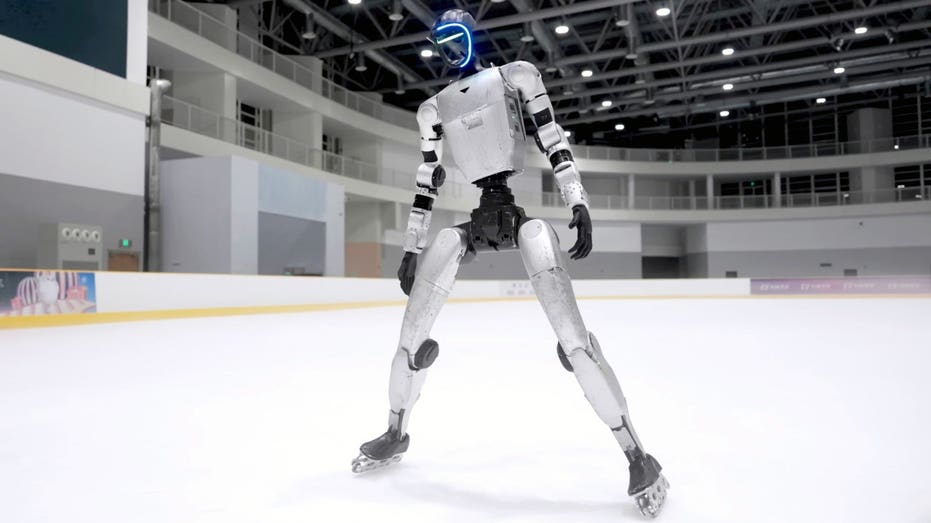
Unitree G1 humanoid robot ice skates and rollerblades
Watch Unitree's G1 humanoid robot glide on rollerblades and ice skates, pulling off spins and flips while staying perfectly balanced in real time.
We've seen robots walk, run, climb stairs and even recently finish a half marathon. What we haven't seen until now is a robot gliding across the ice like an Olympic skater or spinning on one leg on rollerblades without losing balance.
That is exactly what Unitree Robotics just showed with its G1 humanoid robot. In newly released footage, the robot moves on rollerblades and ice skates while keeping its posture steady through coordinated wheel and leg control. It's pretty amazing to watch.
Sign up for my FREE CyberGuy Report
ELON MUSK TEASES A FUTURE RUN BY ROBOTS
When you actually watch the video, a few moments really stand out. It starts with the robot leaning into the motion, almost stepping as it propels itself forward on two wheels, shifting its weight from side to side as if one wheel is leading the next. Its arms move up and down to stay balanced, giving it a rhythm that feels closer to walking than rolling, like it's constantly adjusting in real time.
Then it pulls off a series of spins and an impressive flip, landing clean on two wheels and continuing without missing a beat. No hesitation.
Next, it switches to rollerblades and moves with the same level of control. It glides, does some fancy footwork, changes direction and even lifts one leg while spinning and staying balanced like it's second nature. That alone would be impressive.
But the real wow moment comes at the end. On ice, the robot starts doing smooth twirls, almost like it’s figure skating, while holding its posture without slipping. That’s when you start to see how far these humanoid robots have come.
Most humanoid robots face the same problem. Staying upright while doing anything dynamic pushes the limits of control systems. The G1 changes that equation by blending two approaches. It combines wheeled efficiency with legged adaptability. That means it can roll when speed matters and step when terrain gets tricky.
In the demo, the robot transitions smoothly between these modes. It executes continuous motion instead of stopping to rebalance. You see 360-degree turns, controlled spins and even front flips, all without a visible pause.
That level of fluidity points to improvements in real-time control, balance correction and motion planning. These are areas that have held humanoid robots back for years, until now.
ROBOTS LEARN 1,000 TASKS IN ONE DAY FROM A SINGLE DEMO
The hardware behind the G1 explains why it can pull this off. Unitree designed the system as a full-stack platform for AI training and deployment. That means the robot collects its own data, learns from simulation and applies those lessons in the real world.
The robot comes in two main versions. The Standard model focuses on stationary tasks. The Flagship version adds a wheeled base that can reach about 3.3 feet per second.
Both variations share a humanoid structure with up to 19 degrees of freedom. Each arm has seven degrees of freedom and can handle about 6.6 pounds. A flexible waist allows wide motion ranges, which helps with balance during dynamic movement.
Vision comes from a binocular camera in the head, along with wrist cameras for close-up work. The system can use different grippers, including dexterous hands for more precise tasks.
At the core, the Flagship model runs on an NVIDIA Jetson Orin NX module with up to 100 TOPS of compute. That level of onboard processing supports real-time decision making during complex movement.
Battery life can stretch up to six hours, depending on how hard the robot is working.
For years, robotics has leaned in two directions. Wheeled machines move efficiently but struggle with obstacles. Legged robots handle complex environments but use more energy and move more slowly.
Unitree's approach tries to merge both. By adding wheels to a humanoid frame, the G1 can move quickly across flat surfaces and still adapt when conditions change. That hybrid design also reduces wear on joints and improves energy efficiency over long distances.
It also opens the door to new types of tasks. A robot like this could move through a warehouse, switch to precise manipulation at a workstation and then roll to the next job without slowing down.
Take my quiz: How safe is your online security?
Think your devices and data are truly protected? Take this quick quiz to see where your digital habits stand. From passwords to Wi-Fi settings, you’ll get a personalized breakdown of what you’re doing right and what needs improvement. Take my Quiz here: CyberGuy.com.
NEW MOBILE ROBOT HELPS SENIORS WALK SAFELY AND PREVENT FALLS
The skating is what grabs you first. It is fun to watch and hard to ignore. What stands out after a few seconds is how steady the robot stays the whole time. It keeps moving, keeps adjusting and never looks close to losing control. That is a big change from the stop-and-go motion we are used to seeing. If this keeps improving, and I know it will, you are going to see robots that can move through real environments without slowing down or needing constant input.
So here is the question. If robots can move this fluidly today, how long before they start working alongside you without missing a step and are you OK with that? Let us know by writing to us at CyberGuy.com.
Sign up for my FREE CyberGuy Report
Copyright 2026 CyberGuy.com. All rights reserved.