International News Portal27 November 2026Headlines from established publishers
World
Alexander the Great's long-lost city located after nearly two millennia: 'Absolutely stunning'
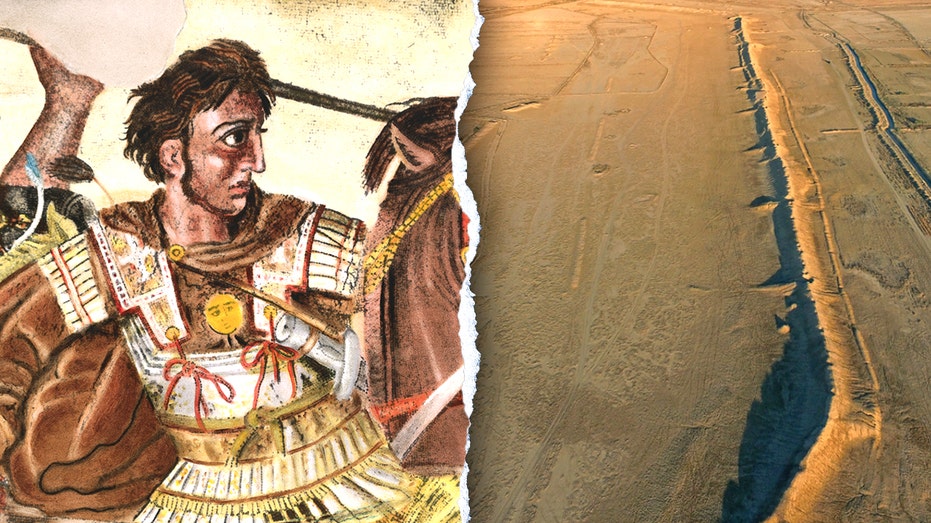
Archaeologists confirmed the location of Alexandria on the Tigris, a lost city founded by Alexander the Great in Iraq that served as a major ancient trade hub.
Archaeologists have confirmed the location of a long-lost city founded by Alexander the Great — a once-thriving trade hub that's been hidden for centuries.
The ancient city, known as Alexandria on the Tigris, is located in southern Iraq, near the Persian Gulf.
It was founded in the fourth century B.C. as a port city linking trade from India to Mesopotamia and the Mediterranean world. It fell into obscurity after the third century A.D., when the path of the Tigris shifted.
Over the past few years, researchers have mapped the city's fortification walls, street grids and city blocks, thanks to drone imagery and high-resolution geophysical scans.
Archaeologists have worked at the site since the 2010s, a time when ISIS exerted control over Iraq — but it wasn't until now that the full scale of the lost metropolis was revealed.
The University of Konstanz in Germany, in a Jan. 28 press release, said excavators were "only allowed to conduct surface surveys under the close supervision of either soldiers or police officers."
Researchers identified temple complexes, workshops with kilns and furnaces and the remains of the city's harbor and canal system.
The city had been "repeatedly flooded," but it was miraculously well-preserved, said Stefan R. Hauser, an archaeology professor at the University of Konstanz.
Hauser told Fox News Digital that, like its more famous counterpart in Egypt, Alexandria on the Tigris was founded at a crossroads between river and sea.
"The size of the city blocks is extraordinary," he said. "It surpasses even those of the major capitals of the time, like Seleucia on the Tigris or Alexandria on the Nile."
Hauser added, "The quality of the geophysical evidence is absolutely stunning… The preservation of buildings is surprisingly good, and we started identifying the walls immediately beneath the surface, which also accounts for the good results in geophysical exploration."
Hauser said the research began in 2016 under British archaeologists Jane Moon, Robert Killick and Stuart Campbell, whom he credited with launching the project.
Excavating the site was a challenge, he said, as summer temperatures rise above 120 degrees Fahrenheit. In addition, the general area suffers from air pollution.
The team of researchers plans to investigate the city's quarter and its workshops and kilns in the future, pending funding.
Hauser stressed that the site could shed new light on the Parthian Empire, which controlled the city centuries after Alexander's conquest. He described the empire as one of antiquity's most understudied powers.
"There is not a single useful summary [of] its history, structure and culture," said Hauser.
The site is "particularly well suited for this kind of research, because there has been no later building activity since antiquity," he added.
"We have the nearly unique chance to reconstruct an entire city plan [through] geophysical research, and currently hope to complete geophysics this year."
We use cookies to run this site and, with your consent, to measure
traffic and improve our content. Necessary cookies are always on. You
can accept all cookies or choose which ones to allow.
Privacy policy.