


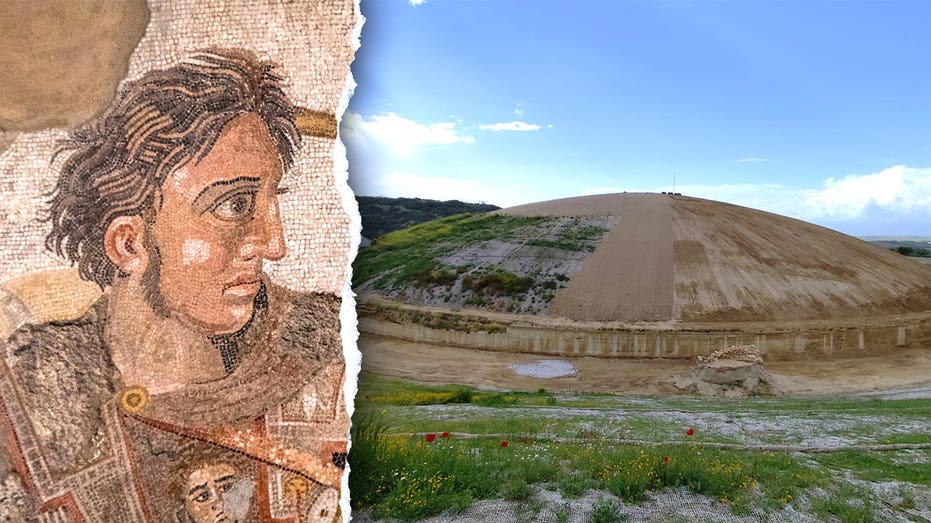
Colossal tomb tied to Alexander the Great revealed by officials: 'Unique and magnificent'
The interior of a massive ancient tomb in Amphipolis has been unveiled by Greek officials. It's a site possibly linked to Alexander the Great and Macedonian elite figures.
Greek officials have unveiled the interior of a massive ancient tomb possibly linked to Alexander the Great as archaeologists continue excavation and restoration work.
Greece's Ministry of Culture announced the news in a statement on May 11.
The excavation centers around the Kasta Tomb in Amphipolis, the ruins of an ancient Macedonian city in northern Greece, about 60 miles northeast of Thessaloniki.
ALEXANDER THE GREAT'S LONG-LOST CITY LOCATED AFTER NEARLY TWO MILLENNIA: ‘ABSOLUTELY STUNNING’
Greek officials said restoration work at the Kasta Tomb in Amphipolis has uncovered the site's full enclosure for the first time, revealing the massive scale of the ancient Macedonian monument.
The enclosure, built in the fourth century B.C., measures roughly 1,630 feet in circumference. It surrounds a burial mound spanning more than 20 acres, as Cover Media reported.
Pictures released by the ministry show marble-lined passageways, elaborate architecture and fine sculptural details that suggest the structure was built for a member of the Macedonian elite.
Officials removed older metal supports to make the monument's interior fully visible, and future plans include installing the tomb's monumental double-leaf Macedonian marble door and restoring parts of the sphinx sculptures that once guarded the entrance.
TREASURES IN ITALY, INCLUDING 2,300-YEAR-OLD TOMB, UNEARTHED DURING SEWER INSTALLATION
"The Kasta Tomb is a unique and magnificent Macedonian monument, which, through the completion of the work of restoring its geometry, but also revealing the entire enclosure, now clearly highlights its historical importance and its value," Lina Mendoni, Greek minister of culture, said in a translated statement.
REAL LIFE EXCALIBUR? MAN ON A HIKE UNCOVERS GOLD SWORD RELIC HIDDEN UNDER TREE
Amphipolis is "associated with major figures of the Kingdom of Macedon, such as the three generals of Alexander the Great, Nearchus, Hephaestion and Laomedon, who resided in the city," according to the Ministry of Culture's website.
"After Alexander's death, the city’s garrison remained loyal to his mother Olympias and only agreed to surrender the city to Cassander, one of Alexander’s successors, on her orders," the website notes.
"Cassander imprisoned Alexander’s wife Roxana and his son Alexander IV in Amphipolis and ordered their murder."
CLICK HERE FOR MORE LIFESTYLE STORIES
Alexander the Great, who lived from 356 B.C. to 323 B.C., is known for establishing the vast Macedonian Empire across parts of Europe, Asia and Africa as a young man.
He defeated the Persian Empire — then the dominant superpower of the ancient world — before dying at age 32 under mysterious circumstances, despite never losing a battle.
TEST YOURSELF WITH OUR LATEST LIFESTYLE QUIZ
Researchers believed Kasta Tomb was "built for someone very close to Alexander the Great," such as his mother, one of his wives or one of his friends, National Geographic reported in 2014.
The latest excavation isn't the only recent archaeological project tied to the legendary Macedonian ruler.
CLICK HERE TO SIGN UP FOR OUR LIFESTYLE NEWSLETTER
Earlier in 2026, Fox News Digital spoke with an archaeologist who helped locate a long-lost city founded by Alexander the Great after centuries of obscurity.
The city, called Alexandria on the Tigris, is located near the Persian Gulf in southern Iraq. It was founded in the fourth century B.C.