



I grew my salary to $180K a year while paying down $40K in credit card debt. I've gone from ashamed to empowered.
A 38-year-old who makes $180,000 a year living in California and Nova Scotia shares her salary journey, and how she paid off her credit card debt.
Courtesy of Lindsey S; BI
Lindsay Stockall is a 38-year-old who splits her time between Newport Beach, California and Halifax, Nova Scotia. Business Insider has verified her income and employment history with documentation. The following as-told-to essay has been edited for length and clarity.
I started from a one-bedroom apartment with an IKEA desk in the corner of my bedroom — no investors, no partners, and no golden spoon.
Today, I'm the founder and CEO of Stockall & Company, a seven-figure performance marketing agency that crossed $1,000,000 in revenue in 2025 and has managed over $1,000,000 in total client ad spend since launching in 2021.
Becoming a founder wasn't my original career plan. When I was 16, I wanted to be a backup dancer for Janet Jackson. Then I got a degree in public relations and planned to work my way up in property management marketing. Before I founded my own agency, I'd been a salaried marketing director.
For a long time, I didn't talk about money because in my 20s, I got into $40,000 of consumer debt accumulated during my university days from trying to keep up with the Joneses — not a smart thing for a 20-something to do. My career was advancing, and I was good at my work, but I wasn't being strategic about my own financial position and plan. That gap cost me years.
Now I talk about it openly — especially with younger women. I love empowering younger generations on how important it is not to live outside your means. You can literally change your life in 10 years in your 20s by being smart with your finances.
Since 2020, I paid off $40,000 in debt, replaced my salary, and built a seven-figure business in five years — not because I had a windfall or a perfect plan, but because I stopped treating my financial situation as something to hide and started treating it as a problem to solve.
Here's my salary journey from my first role through to today.
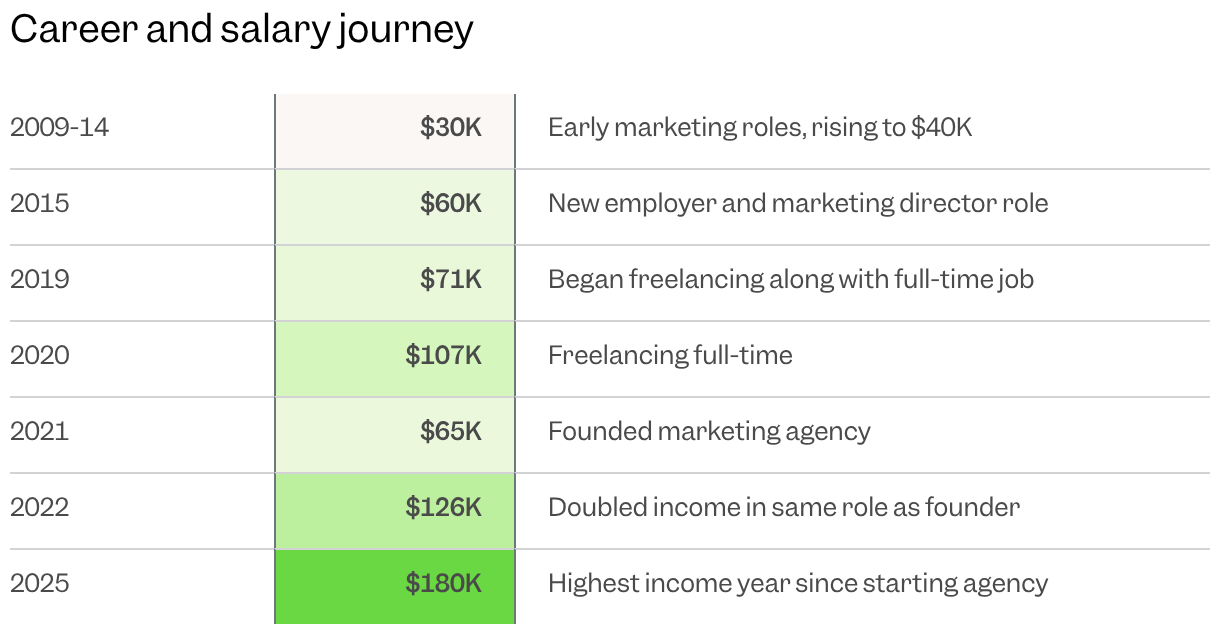
Early marketing roles, $30,000 to $40,000
When I was 22, I started my career in fashion retail in Halifax, Nova Scotia. My first role was working as a buyer and marketing coordinator at a boutique carrying high-end designer collections, and I made about $30,000 a year.
It was commission-based and competitive, and the income ceiling was low — but I was living at home with my parents, so I was able to get by. I attended international market shows, managed inventory, and ran all marketing across digital and print.
I then moved into a brand promotion manager role at a Canadian department store, where I made about $35,000 a year. In March 2014, I moved to a commercial real estate firm as a marketing director, where I was paid a $40,000 salary. That year, while still employed full-time, I launched a small fashion e-commerce business. This gave me some side income; that year, my gross business income was $22,786 and I netted about $5,600.
It was my first entrepreneurial move: building something from nothing, managing inventory, running digital marketing, learning what it takes to drive online sales without a team or a safety net. I ran it alongside my day jobs for nearly four years.
That instinct — to build something on the side before the safety net disappears — turned out to define my entire career.
Marketing director, $60,000
In 2015, after a recruiter contacted me, I joined a beauty company in Dartmouth, Nova Scotia, as director of marketing, overseeing five brands. I hadn't planned to leave my previous position, but I spoke to a few mentors who said I'd be crazy not to take the opportunity.
"Salary Journeys" is Business Insider's first-person series following real people and their real paychecks — how they built their income, what it means for their lives, and what they learned along the way. If you're willing to share how your salary has changed over time, please fill out this Google Form.
I stayed for six years. Working alongside a major beauty brand as a supplier, I managed multi-brand annual marketing plans, paid search and social, influencer campaigns, e-commerce, press, and a 325-person annual company retreat.
My salary had started at $45,000 when I was hired in 2015. I was promoted in 2018 to $60,000 a year, with the potential for an annual bonus, and I thought I'd made it. I'd doubled the salary I'd started my career at. My only major expenses at the time were rent and a car payment.
But I was also carrying roughly $40,000 in personal debt from the spending I'd done in my 20s. Back then, I was going out to dinners and parties, popping out on my lunch hour for a $5 to $7 daily Starbucks drink, going to bars with my friends, and shopping — I needed a new outfit for every occasion.
My credit score had stayed pretty good because I never missed a payment, but I'd never been able to get traction paying the debt down, and I'd been conditioned to feel ashamed about it.
I engaged a financial advisor introduced to me by my uncle and began using a personal budgeting app. The advisor and I met quarterly, had some uncomfortable conversations about the debt, and created a realistic plan. I set up a recurring payment to send $210 each month toward debt repayment.
Once I started budgeting, I completely turned around my spending habits. Those habits have carried forward with me today — if I can't pay for it in cash, I don't buy it.
Added freelancing side gigs, $71,134 net income combined with full-time salary
In 2019, I started taking on freelance clients on the side, primarily paid media strategy and Facebook advertising.
I started freelancing after listening to a Gary Vee podcast where he said if you're in debt, you can make one of two choices: reduce your expenses or make more money. I couldn't live on less — I knew I needed to make more money.
I didn't want to work in a restaurant or retail after working Monday to Friday, 9 to 5, so I decided to freelance instead.
I couldn't live on less — I knew I needed to make more money.
I got my first client by applying to a job posting on Instagram for a remote social media manager. Then I applied for a marketing communications role for a solopreneur, who became my second client. I got another one through word of mouth, and it snowballed from there.
That added meaningful income on top of my salary and gave me the first real line of sight to eliminating my debt. My net income that year reached $71,000.
Started freelancing full-time, $106,661
Then COVID hit. My position was eliminated. The freelance work I'd been building became my only income overnight.
A lot of people sat on their hands and enjoyed a "vacation," and I was like, no, I'm going to jump into freelancing. I was also teaching Pilates three times a week. So that's when it really took off, and I hit six figures for the first time.
My net income in 2020 was $106,000 — higher than any year I'd spent in a salaried role. Within that period, I paid off my $40,000 in debt entirely.
Founder of marketing agency, $180,000
The company that laid me off brought me back briefly in 2020, but then I was laid off for a second time during the shutdowns, and I knew it was now or never for me to go all in on myself. That's when I officially launched Stockall & Co. in May 2021.
What gave me the confidence to do it was speaking to other entrepreneurs and listening to their stories. I knew that if they had confidence in me, I could see it in myself.
I've gone from being a solopreneur to now having a team of 12 specialists across North America. We use AI to enhance our processes, not to replace human brains — to increase productivity so we can focus on what we're good at.
The first year was a reinvestment year: building systems, onboarding clients, establishing positioning. My net income was around $65,000, as I put capital back into the business and cut corners to do so.
I didn't have a roommate or a boyfriend — I didn't have anyone helping me pay the bills. My car was paid off at that point, so rent was my major expense. I also bought a laptop that year. I stopped shopping for clothes, and I wasn't going on trips or out to dinner because I was working a lot. I put my head down, built the business, and lived a very modest lifestyle.
From 2022 to 2025 the agency scaled consistently, mostly through word of mouth and referrals. An article was published about me in a local publication in Halifax, and that helped build brand awareness. I also posted on social media that I was accepting new clients.
During those four years, I had personal income between $103,000 and $180,000 annually, while agency revenue grew to seven figures.
I feel empowered about my salary journey and current compensation level
Once I got out of debt, it was like a weight had been lifted off my chest. I felt empowered and confident, and wanted to share feeling with others. I also started seeing a change physically as well, as I invested more in my health and wellness, ate better, went to the gym, and practiced more self-care.
My ideal salary number would be $250,000, which isn't far off.
Financial literacy shouldn't be a privilege or secret — it should be a conversation. My current compensation reflects the value I deliver and the risk I took to build this. Leaving a position where I was getting a consistent paycheck was an absolute risk — leaning into something where clients can cancel, and there's a level of inconsistency and many unknowns.
My ultimate goal from here is to keep building the agency with integrity. I do want to scale, but never to the point where it compromises quality or integrity. We're just going to continue to hone our craft and be the best in our fields when it comes to creative and ads. My ideal salary number would be $250,000, which isn't far off.
If you're interested in sharing your salary journey, please fill out this Google Form.
Read the original article on Business Insider