


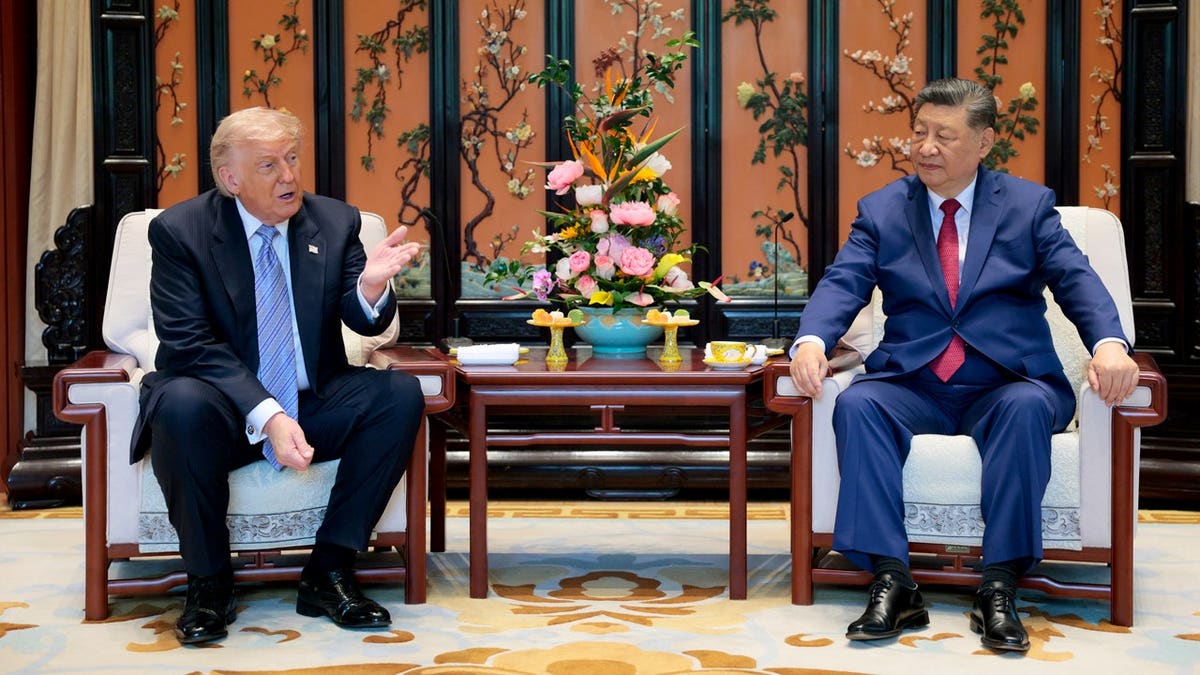
LIZ PEEK: President Trump’s China trip sent an important message liberal media missed
Critics call Trump's Beijing trip a failure, but his surprise inclusion of American CEOs sent a powerful message about U.S. economic dominance to Xi.
President Trump’s critics proclaim the recent trip to Beijing a failure. The New York Times, for instance, says the president "left China without any breakthroughs", meanwhile mocking Trump for calling President Xi "a friend."
The narrative is that the summit failed to meet expectations. Given the stock market’s plunge the day after the visit concluded, that assessment seems reasonable. Fortune wrote that the trade deals did not live up to investors’ hopes; probably more important was that there was no movement towards opening the Strait of Hormuz.
But consider the message Trump delivered to President Xi and to the people of China. Though it fell short of Trump shocking Xi by announcing he had just bombed Syria over a piece of "delicious chocolate cake" in 2017, surprising his hosts by including a veritable galaxy of America’s business stars in the summit sent an equally strong message.
BROADCAST BIAS: NETWORKS SPIN TRUMP’S XI MEETING AS WEAKNESS DESPITE STRATEGIC GAIN
Trump’s extraordinary entourage of CEOs running globally dominant companies reminded the world:
1. The U.S. is winning in AI;
2. The U.S. is winning in energy;
3. The U.S. economy is second to none.
The Chinese like rigid schedules and scripts; they do not like surprises. That Trump included the thirty or so American CEOs in the meeting with Xi threw the Chinese off guard and the program off schedule. That was the point.
Trump told Fox host Sean Hannity, "It was a long meeting…It started off interestingly because they are very organized people." Trump explained, "I suggested that before we start the meeting, I would like to introduce them to you. And they were surprised because it wasn’t, you know, it wasn’t scheduled. And they looked around and they said ‘Er...’".
Trump elaborated: "The Chinese leadership, because it was President Xi and many other leaders... they got used to the fact that we were a little off-schedule here and we’re talking about a subject that wasn’t even thought about."
Just like that, Trump took control of the summit on Xi’s turf. The Chinese dignitaries may have adjusted to it, but you can bet they didn‘t like it. So, when CNN claims that Xi "set the tone" of the summit, they are wrong.
It is true that Xi tried to dominate the meeting from the start by threatening that any change in the U.S. posture towards Taiwan could have grave consequences. Media outlets breathlessly reported this stern warning. Did they or did Xi really think the U.S. was eager to tackle another thorny geopolitical conflict? Xi was playing to his home audience, talking tough about Taiwan’s independence to counter Trump’s bold assault on China’s diminished axis of allies.
After all, China has been losing the geopolitical battle as well as the battle for tech supremacy. President Trump has neutralized Venezuela, China’s most important ally in the Americas, and is well on the way to rescuing Cuba from its 67 years of Beijing-assisted Communist misery.
Meanwhile, the U.S. has not only pummeled Iran militarily but is also currently cutting off its oil exports. China relies on those shipments, especially since it can no longer count on Venezuela to help supply the 70%+ of the oil it imports. And let’s not ignore Russia, which is struggling to keep up its 5-year-long war with neighbor Ukraine that "experts" thought would be over in months. The Economist reports that "the tide of war is beginning to change" and that "Ukraine has begun to claw back territory." If Russia strongman Vladimir Putin is losing, ally Xi is losing, too.
But President Trump’s visit mainly showcased what the U.S. has that China does not have: dominance in the industries that matter today. That supremacy is key to U.S. growth and power.
China has failed to achieve the stated goals of past five-year plans, which have repeatedly called to increase consumer spending, lessen the country’s dependence on exports and cut back on debt-fueled infrastructure spending. None of those objectives has been met.
GORDON CHANG: CHINA'S RISING MARKETS MASK A FRAGILE ECONOMY, SOCIAL DISCONTENT
The latest plan, the 15th, called for greater self-reliance as it pushes tech advancements, while at the same time seeking increased foreign investment to help achieve that self-reliance. As the world, led by Trump, has begun to push back against China’s theft of intellectual property, below-cost exports and other misdeeds, help from abroad will be harder to come by. The U.S. is hamstringing their AI advancement, for example, by limiting their access to top-level chips. Europe is pushing back on EV imports from China.
China’s economy has slowed thanks to tepid consumer demand, a property crisis now in its fifth year and a declining population. CNN reports: "For the first time in three decades, investment in housing, manufacturing and infrastructure – major drivers of the country’s economic growth – reported a decline last year." In March the government set its lowest economic growth target since it began issuing such projections in the 1990s, announcing it would aim for 4.5-5%. That follows three consecutive years in which authorities targeted growth of "around 5%."
CLICK HERE FOR MORE FOX NEWS OPINION
Some of these problems stem from the autocratic and erratic rule of President Xi, who took responsibility for management of the economy several years ago and has failed to deliver. It’s worth noting that Xi could not have assembled a phalanx of prominent business leaders to rival Trump’s partly because he has locked up or "disappeared" thousands of C-suite occupants. As The Economist wrote last year, the "sinister disappearance of China’s bosses" has deepened "the country’s corporate gloom."
For the past two decades, the liberal press has consistently overestimated China’s potential, ignoring the limitations of top-down centralized economic management. Many predicted that China would become the world’s number one economy by now; it hasn’t happened. The U.S., driven by creative freedom, universal opportunity and a system that rewards success, has outgrown and out-innovated every country on earth.
President Trump’s Beijing trip reinforced that truth. It is a message the liberal media may have missed. My guess: the Chinese people read it right.