


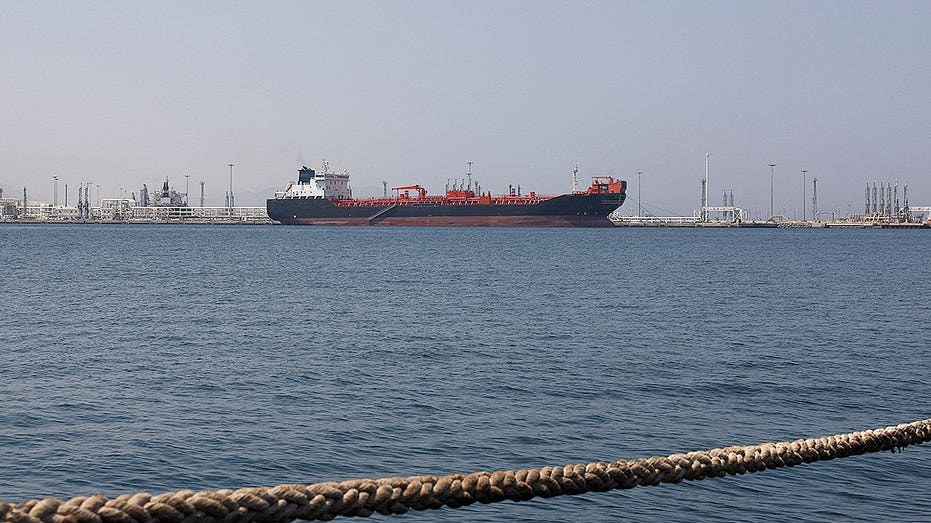
Mass tanker blackout rattles Gulf ahead of 1.35M-barrel oil transfer amid US-Iran talks: firm
Maritime tracking signals collapse near the UAE's Fujairah oil hub hours before President Trump announced progress on a bilateral peace deal with Iran, according to an AI maritime firm.
Maritime tracking transmissions collapsed near the UAE’s main oil hub, rattling Persian Gulf shipping hours before President Donald Trump announced progress was made on a bilateral peace deal with Iran, according to an AI maritime firm.
Maritime intelligence firm Windward AI first detected the blackout in Automatic Identification System (AIS) transmissions near Fujairah, suggesting heightened electronic warfare, jamming, deliberate AIS shutdowns and intense cyber interference near the key UAE oil port.
"Fujairah goes dark: AIS transmissions collapse after Iran’s PGSA announcement," Windward warned in a post shared on X.
"Vessels are still in the area. They are loading less, and a meaningful number have gone dark," the firm said.
As Trump announced that an Iran deal was "largely negotiated" and would see a reopening of the Strait of Hormuz, Fujairah went on to move 1.35 million barrels of crude Sunday aboard a single tanker bound for South Korea.
"Today, May 24, the port moved 1.35 million barrels, a single VLCC, destined for South Korea," Windward said before reporting a tense, ongoing "ceasefire posture" and blockade footprint quickly being set into place.
"One cargo doesn't mark a return to baseline, but it's the first signal of flow resuming out of Fujairah since the announcement," Windward said.
Ahead of the barrel transfer, Trump had stated that Washington and Tehran had "largely finalized" a memorandum of understanding for a peace agreement. He posted an AI-generated image depicting exploding IRGC fast boats in the strait.
TRUMP SAYS IRAN DEAL ‘LARGELY NEGOTIATED’ AS 84-DAY WAR NEARS POSSIBLE END
Iran responded directly by continuing to declare the strategic maritime chokepoint stays under Tehran’s absolute control.
"We reaffirm that the Strait of Hormuz will remain under full Iranian administration and sovereignty, even in the event of reaching any future agreement," Iran’s official military spokesperson, Ibrahim Al-Fiqar, said in a statement shared on X.
"The Islamic Republic emphasizes that the authorities to determine transit routes, timing, and issuance of maritime licenses are an absolute sovereign right exclusively in the hands of Tehran."
The tanker blackout, crude transfer activity and movement toward a U.S.-Iran deal accelerated following the launch of Iran’s Persian Gulf Strait Authority on May 20.
Overseen by the Islamic Revolutionary Guard Corps (IRGC) Navy, the PGSA functions as a sovereign regulator by requiring ships to submit vessel, cargo, insurance and crew details — along with mandatory payments — for "safe passage" through the strait.
Regional analysts told Fox News Digital that, ahead of deal progression, Iran’s territorial claims had even been stretching beyond its own waters into areas tied to Oman and the UAE.
US EYES IRAN FAST BOATS WITH ‘KILL’ TACTICS TESTED IN VENEZUELA DRUG-BOAT STRIKES
Alex Vatanka, director of the Iran Program at the Middle East Institute, told Fox News Digital that enforcement "relies on the IRGC Navy’s asymmetric playbook."
"This includes fast boats, drones, radar tracking, coastal missiles and selective intimidation rather than constant physical interdiction," Vatanka said.
"Tehran wants Gulf states and major importers to gradually accept Iranian oversight of Hormuz as a new geopolitical reality," he added.
While nuclear issues are dominating the current negotiations amid reports of a 60-day ceasefire, the PGSA has quickly emerged as an economic leverage tool threatening global oil and shipping markets.
"Now Hormuz is Iran’s main non-nuclear leverage tool," Vatanka said as the PGSA he claimed gives Tehran a "mechanism to pressure rivals, favor allies and normalize IRGC oversight of one of the world’s most critical energy routes."
According to Vatanka, the system was functioning as a wartime extortion mechanism.
"Ships submit cargo and crew data for approval, while reports point to quiet ‘facilitation payments,’ preferential treatment for friendly states and uncertainty for everyone else," Vatanka warned.
"Iran keeps the penalties deliberately vague. Noncompliant ships risk delays, harassment, drone surveillance, IRGC interception or denial of safe passage — enough pressure to encourage compliance without outright closing the strait."