


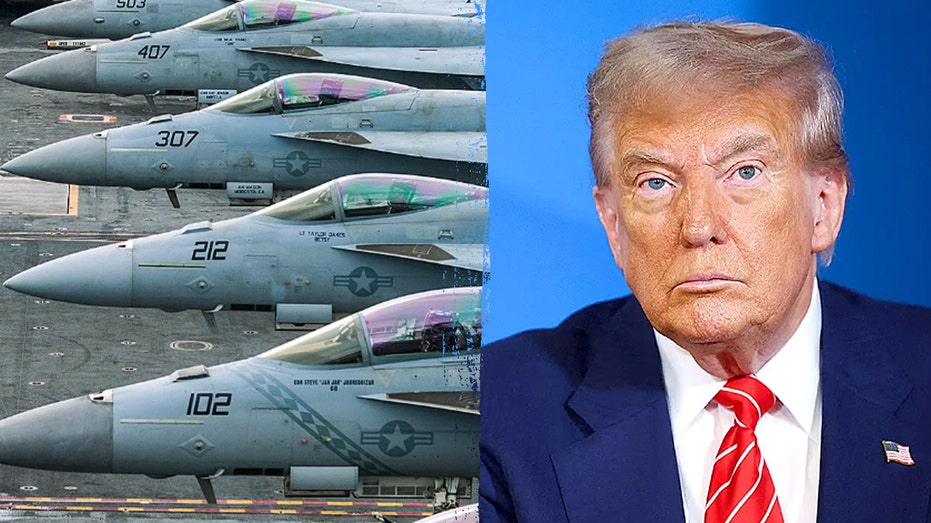
Pentagon slashes NATO combat commitments as Trump pushes Europe to defend itself
The Pentagon informed allies it plans to reduce U.S. military contributions to NATO by one-third to one-half amid a push for European burden-sharing.
The Pentagon recently informed European allies it plans to reduce some U.S. military capabilities available to NATO during a crisis as part of a broader push to shift more of the alliance’s conventional defense burden onto Europe.
The Trump administration plans to reduce certain available capabilities by roughly one-third to one half, officials confirmed to Fox News Digital, including strategic bomber planes, fighter jets and some naval assets.
Pentagon official Alexander Velez-Green informed officials of the coming changes at the NATO Defense Policy Directors’ meeting in Brussels Friday, according to two officials familiar with the matter.
The Pentagon declined to confirm details about the changes, but chief spokesman Sean Parnell acknowledged the shift in a statement to Fox News Digital, framing it as part of a broader effort to pressure allies to assume greater responsibility for Europe’s defense.
PENTAGON OFFICIAL FLAGS RETURN OF 'COLD WAR MENTALITY,' AS TRUMP ADMIN RESHAPES NATO ALLIANCE
"The Department of War announced changes to U.S. contributions to the NATO Force Model at the Defense Policy Directors’ meeting in Brussels," he said. "These changes represent an opportunity for allies to demonstrate that they have heard President Trump’s call for them to step up and take primary responsibility for Europe’s conventional defense."
"Spending more on defense is one thing — and our allies must do so as quickly as possible, consistent with their Hague Summit pledge. It is vitally important, however, for our NATO allies to focus increased defense spending on the combat-credible capabilities most required for Europe’s defense. The Department of War’s announcement offers allies an opportunity to do exactly that."
The move comes ahead of the NATO leaders’ summit in Ankara, Turkey, in July, where President Donald Trump is expected to intensify pressure on allies to shoulder more of Europe’s defense burden while Washington shifts military focus toward the Indo-Pacific.
RUBIO ARRIVES IN BRUSSELS FOR NATO TALKS AMID UNEASE OVER TRUMP’S AGENDA
While European officials largely have avoided publicly criticizing the changes, several have expressed concern to Fox News Digital about the pace and clarity of the administration’s evolving Europe posture plans. NATO Secretary General Mark Rutte sought to reassure allies in recent days, saying any adjustments would occur "over time, in a structured way" and insisting "the U.S. will stay involved in Europe."
NATO foreign ministers meeting in Helsingborg, Sweden, also grappled with uncertainty surrounding recent U.S. troop announcements in Europe.
Swedish Foreign Minister Maria Malmer Stenergard described the situation as "confusing indeed," while Secretary of State Marco Rubio said "it is well understood in the alliance that the United States troop presence in Europe is going to be adjusted."
Regional officials told Fox News Digital they are still seeking clarity on whether future U.S. troop movements in Poland would expand the current American footprint, replace paused rotations, or involve repositioning forces from elsewhere in Europe.
PENTAGON CUTS BRIGADE COMBAT TEAMS IN EUROPE AS TRUMP PRESSURES NATO ON SPENDING
Defense officials increasingly describe the broader shift as part of a post-Ukraine-war restructuring of NATO focused on territorial defense, rapid mobilization and greater European burden-sharing, while the U.S. redirects more military resources toward Asia.
The U.S. currently maintains its largest European troop presence in Germany, where roughly 36,000 American troops are stationed, along with approximately 12,000 troops in Italy, 10,000 in the United Kingdom and an estimated 10,000 in Poland.
The Pentagon in 2025 withdrew an armored brigade combat team from Romania following a temporary deployment tied to Russia’s invasion of Ukraine, part of a broader effort to rebalance the U.S. military footprint in Europe.
More recently, the Trump administration announced plans to withdraw roughly 5,000 U.S. troops from Germany throughout the next year as part of its ongoing Europe posture review, raising new questions among allies about the future scale of the American military presence on the continent.