


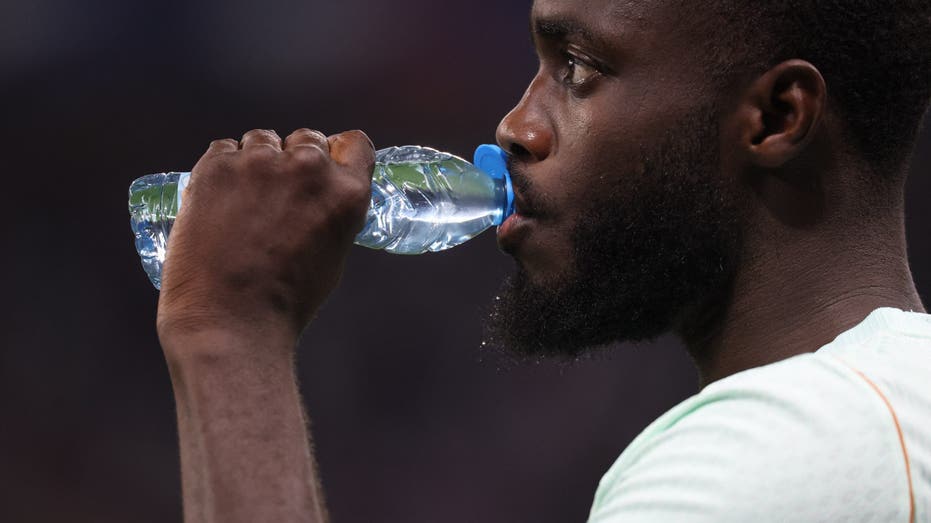
FIFA implements mandatory water breaks in each half for first time at 2026 World Cup
The 2026 FIFA World Cup introduces mandatory three-minute hydration breaks in every match, sparking debate among coaches and fans about game rhythm.
The 2026 FIFA World Cup will introduce one of the most noticeable in-game rule changes in modern tournament history: Mandatory hydration breaks in every match.
For the first time, players will be required to pause twice per game, once in each half, for a three-minute water break, regardless of weather conditions or stadium location across the United States, Mexico and Canada.
Under the new format, referees will stop play at roughly the 22-minute mark of each half. Players will remain on the pitch, where they can hydrate while coaches are able to talk strategy with their team, essentially making this a timeout like us Americans are used to in our major sports. There aren’t team-issued timeouts like in the NFL, NBA, and NHL by the way. Just a quick reminder for you Americans that only get excited about soccer when the World Cup rolls around, like myself.
WATCH THE WORLD CUP FINAL ON FOX ONE
An important note is that the stoppage time will be added back at the end of each half, ensuring the total playing time remains unchanged. FIFA has framed the change as part of its broader emphasis on player welfare, particularly given the expectation of high temperatures in several host cities during the summer tournament.
I just hope European fans take much-needed water breaks in the stands too. A group of English soccer fans posted a video talking about how hot it was for the England vs. New Zealand friendly at Raymond James Stadium in Tampa, Florida, home of the Buccaneers. It’s quite funny.
As for the response to FIFA’s decision, it has certainly sparked debate among fans and analysts, not only because of its impact on match rhythm, but also because it effectively standardizes interruptions that previously occurred only under extreme conditions.
Critics like U.S. men’s national team coach Mauricio Pochettino claimed the breaks "cut the rhythm of the game," which has long been defined by continuous, uninterrupted halves. While Belgium coach Rudi Garcia was more positive, saying the breaks are useful because they allow coaches to "discuss strategy mid-game."
FOX ONE’S NEW WORLD CUP VIEWING EXPERIENCE
This decision is why FOX Sports soccer analyst Alexi Lalas made the joke, "At the end of the first quarter it’s Mexico-1 South Africa-0." Soccer now feels a lot more like quarters due to the water breaks, again which Americans are used to in our major professional sports.
You might be thinking, "Wait a minute. I specifically remember water breaks in the 2014 World Cup hosted by Brazil." You’d be right, but the rules in 2026 are much different.
WORLD CUP PLAYERS WHO COVER THEIR MOUTHS DURING CONFRONTATIONS COULD GET RED CARDS
During the 2014 World Cup in Brazil, FIFA implemented "cooling breaks" for the first time in tournament history. Those stoppages were not mandatory, though, like they are in every match in 2026. They were instead triggered by extreme heat conditions, typically when the Wet Bulb Globe Temperature (WBGT) exceeded safety thresholds. In those cases, breaks occurred around the 30th and 75th minutes and were primarily focused on player safety in the intense humidity and heat.
The key difference in 2026 is consistency. Rather than being an occasional response to weather conditions, water breaks will now be built into every match as a permanent structural feature. FIFA officials argue this removes ambiguity for referees and ensures equal conditions across all matches, while also addressing modern concerns about player workload and heat stress.
Though FIFA does not explicitly say "this is an advertising break" in the laws of the game change, it’s fair to assume this is a way to generate more advertising dollars. It’s extremely valuable advertising real estate for broadcasting partners, similar to the Super Bowl. As you watch games, you’ll see split-screen advertising during these hydration breaks.
It’s safe to say FIFA wouldn’t agree with Coach Boone from Remember the Titans when he said, "Water is for cowards. Water makes you weak."
The United States kicks off its first World Cup match on Friday night against Paraguay at 9 p.m. ET.