

NBA's claim of 'most-watched conference finals in 24 years' is misleading because of broadcast changes
The NBA claims its 2026 conference finals are the most-watched in 24 years, but broadcast TV advantages and Nielsen changes add crucial context.
The NBA is still misleading the public with deceptive press releases touting its 2026 playoff viewership.
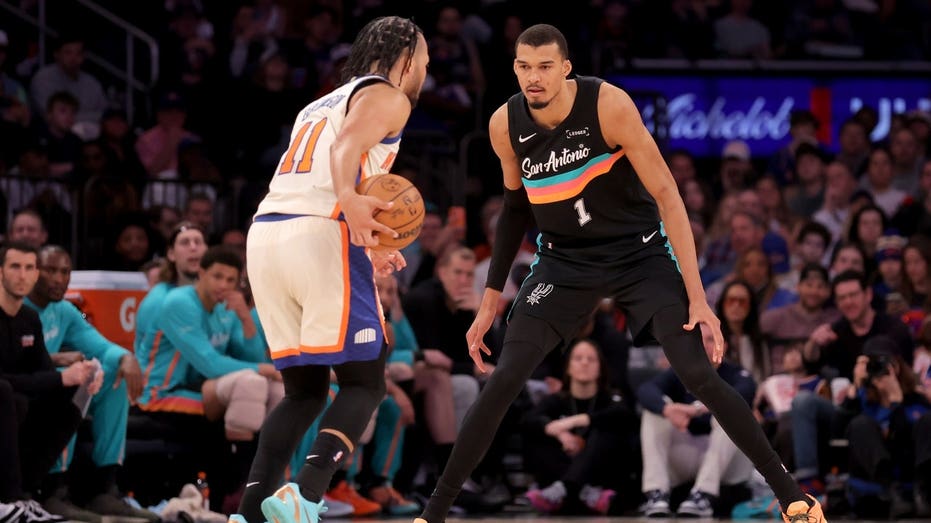
This week, the league claimed the Spurs-Thunder series was the "most-watched conference finals in 24 years," averaging 10.8 million viewers per game across NBC and Peacock.
Twenty-four years, huh?
For context, the last time the NBA aired conference finals games on NBC was in 2002 — exactly 24 years ago.
Since then, conference finals broadcasts have aired primarily on cable, either ESPN or TNT. Just how significant the advantage of broadcast television is over cable became clear during this year's conference finals.
Neither the Spurs nor the Thunder has traditionally drawn particularly well on a national level because of their market sizes. Yet the Western Conference Finals averaged roughly three million more viewers per game than the Eastern Conference Finals, despite the New York Knicks reaching the NBA Finals for the first time since 1999.
Granted, the Western Conference Finals went seven games, while the Knicks swept Cleveland, which certainly affected the overall averages. Still, the fact that teams from Oklahoma City and San Antonio outdrew a New York team making a historic Finals run is telling.
In addition to returning to NBC this season, the NBA has also benefited from changes to Nielsen's measurement system. Since Nielsen introduced its Big Data + Panel methodology, live sports viewership has increased by roughly 10%.
Notice that the fanboys mindlessly regurgitating the NBA's press release never mention those details. Nor do they question one particularly curious aspect of the league's reporting: Peacock.
NBC says Game 7 of Spurs-Thunder averaged 3.23 million viewers on Peacock, a streaming audience "tracked by Adobe Analytics."
What exactly does that mean?
According to industry insiders, those figures are self-reported by NBC. No one is suggesting the network is fabricating numbers. However, Adobe Analytics measures audiences differently from Nielsen. Combining Adobe data with Nielsen data and then comparing the results to historical figures renders any meaningful historical context moot.
STEPHEN A SMITH IS UPSET OVER AN OUTKICK ARTICLE ABOUT 'FIRST TAKE'S' RATINGS
For background, the NBA ratings conversation hasn't been honest for much of the past decade.
Around 2017, ESPN commentators began promoting the idea that the NBA was on the verge of surpassing the NFL, a league that was facing declining favorability as players such as Colin Kaepernick knelt during the national anthem.
Instead, the opposite happened. The NFL went on to set viewership records while NBA ratings steadily declined.
Even so, many sports media personalities rushed to defend their favorite league. Media personalities such as Bill Simmons, Ryen Russillo and Dan Le Batard routinely framed criticism of the league's ratings as politically motivated.
Here's what Barstool's Ryen Russillo said last summer about the NBA's sluggish viewership:
"A lot of the ratings decline stuff is driven by people's political beliefs. If you're really right-wing, you love the idea of the NBA being a dying product because it's probably the most progressive of the leagues."
Around the same time, Russillo and Simmons publicly urged OutKick to cover the NBA's strong first-round ratings.
"Yeah, Clay Travis, how about tweeting about the ratings?" Russillo asked.
"Get Bobby Burack on that one," Simmons replied.
So we did.
We also covered last year's NBA Finals, which drew one of the smallest audiences in league history. Simmons and Russillo had no comment at the time. We reached out.
EMBRACE OF WEMBY AS FACE OF THE NBA PROVES RESISTANCE TOWARD JOKIC WAS ALWAYS RACIAL | BOBBY BURACK
It's not hard to understand why so much of the sports media favors the NBA over other leagues. The NBA is the country's most progressive sports league. Its owners are referred to as "governors." The league has normalized anti-White bigotry both on the court and in the media. Its players are also far more accessible to media personalities, whether through podcasts, television appearances or courtside relationships.
But therein lies the disconnect. While the NBA has done its best to appeal to the media and celebrities, it has sacrificed its relationship with average sports fans.
Fox Sports host Colin Cowherd discussed this phenomenon last year.
"The NBA ratings are down 48% in the last 12 years and they have fallen off a cliff this year," Cowherd said. "It is a really bad look for a family of four to go to a game and the stars don't play.
"Go ask the Democrats. Be warned, once you detach from regular people in America, you will pay a price."
The league has paid a price for it.
Taking emotion out of the discussion, the NBA ratings story is not particularly complicated.
The NBA is nowhere close to the NFL in terms of mass popularity in the United States. It is also well behind college football.
The league is not as popular as it was a decade ago, whether because of the rise of three-point shooting, political activism, load management, injuries to star players, a lack of transcendent American stars or some combination of those factors.
At the same time, the NBA remains a valuable television property. It competes with Major League Baseball for the title of America's third-most-popular sports brand while also providing networks with premium programming during the slower months of the television calendar. Moreover, the Knicks' resurgence and Victor Wembanyama's emergence have injected much-needed energy into the product.
Multiple statements are true at once.
What's also true is that the ratings figures the NBA and NBC are promoting are highly misleading. And it's a damning indictment of the sports media industry that OutKick and Fox News are the only outlets willing to provide readers with the context necessary to understand them.