


Young Americans break sharply from older Americans on China threat, new poll finds
A Reagan Institute survey reveals young Americans are far less likely than older generations to view China as a major threat to the United States.
FIRST ON FOX: Young Americans are far less likely than older generations to see China as a major threat to the United States, according to a new poll, revealing one of the sharpest generational divides in U.S. foreign policy.
Some 93% of Americans age 65 and older said they are concerned about China's ability to spy on the United States, compared with just 62% of those ages 18 to 29, according to the Ronald Reagan Institute Summer Survey.
Younger Americans also were consistently less likely than seniors to express concern about China's potential use of force against Taiwan (56% versus 86%), technology theft (61% versus 91%), purchases of U.S. land (68% versus 93%) and China's role in the flow of fentanyl into the United States (68% versus 92%).
Despite the generational divide, concern about China remained high nationally. More than 80% of Americans said they were concerned about China's role in the flow of fentanyl into the United States, its ability to spy on Americans and its purchases of U.S. land. Sixty-six percent also said Taiwan's security matters to the United States.
FOX NEWS POLL: VOTERS DOUBT NEW AGREEMENT WILL STOP IRAN FROM DEVELOPING NUKES
The findings come as Washington and Beijing are trying to stabilize one of the world's most consequential relationships after years of escalating economic and military tensions.
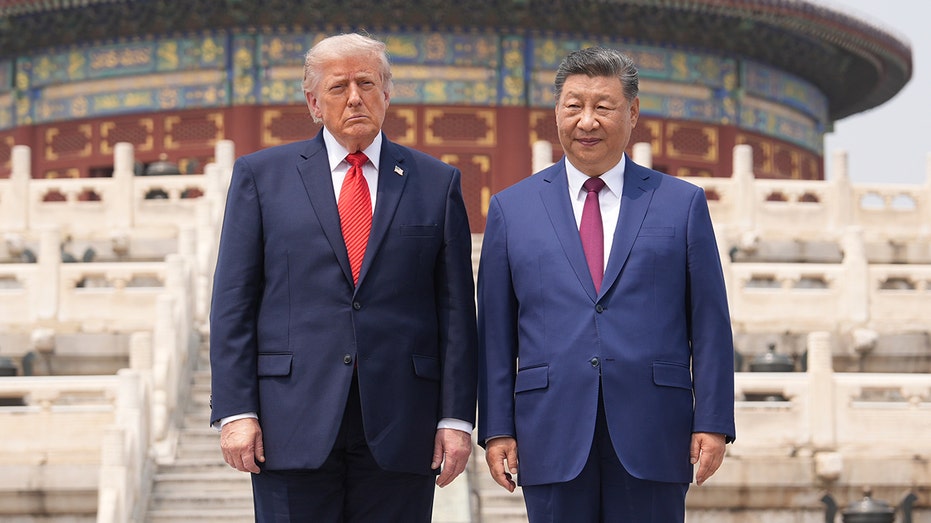
After imposing triple-digit tariffs on China at the start of his administration, President Donald Trump met with Chinese President Xi Jinping in China in May and announced a series of trade and investment agreements and pledged to continue dialogue.
While concern about China remains widespread across the country, the survey suggests younger Americans view the U.S.'s chief geopolitical rival through a markedly different lens than older generations, raising questions about how public attitudes could evolve as younger voters make up a larger share of the electorate.
The findings stand out because they diverge from the prevailing view among many national security experts, who continue to characterize China as America's principal long-term neer-pear competitor and adversary, even as Washington and Beijing seek to stabilize their relationship through diplomacy.
"There is rightful alarm regarding China's historic military buildup and the expansion of its military activities in the region and beyond," War Secretary Pete Hegseth at the Shangri-La Dialogue in Singapore in May.
But, he added, U.S.–China relations are "better than they've been in many years."
After the May summit between Trump and Xi, the U.S. president told reporters: "We settled a lot of different problems that other people wouldn't have been able to solve."
He called Xi a "great leader" and China a "great country."
Other recent research points to broader differences in how Gen Z views U.S. foreign policy.
A 2025 Carnegie Endowment survey found younger Americans were less likely than older generations to prioritize maintaining U.S. technological dominance over China and generally favored a less expansive American leadership role abroad.
The Reagan Institute Summer Survey is the organization's annual public opinion poll on foreign policy and national security, designed to gauge Americans' views on issues ranging from global engagement and military strength to China, NATO, the Middle East and democratic values.
The poll also found broad shifts by party on what America’s role in the world should look like: Republicans were more likely than Democrats to say the United States should be more engaged and take the lead in world affairs.
Seventy-one percent of Republicans said the U.S. should take a leading role internationally, compared with 55% of Democrats. Overall, 61% of Americans said the U.S. should be more engaged in global affairs, while 27% preferred a less engaged approach.
MOST TRUMP SUPPORTERS STILL BACK NATO DESPITE YEARS OF TRUMP'S CRITICISM, NEW POLL FINDS
The findings represent a notable shift from recent years.
Democratic support for greater U.S. engagement fell from 65% to 55% over the past year, while Republican support increased from 69% to 71%, widening the partisan gap from four percentage points to 16. The survey also found 43% of Democrats now say U.S. involvement in the world is harmful, up from 22% a year ago.
The survey was conducted May 26 through June 3 among 1,555 U.S. adults and carries a margin of error of plus or minus 2.5 percentage points. Researchers used a mixed-mode methodology that included live telephone interviews, an online panel and text-to-web responses.
To better reflect the U.S. population, the results were weighted using demographic benchmarks from the U.S. Census Bureau's 2023 American Community Survey, including age, gender, race, region and education. The survey also included an oversample of 338 self-identified MAGA Republicans under age 30, which carries a margin of error of plus or minus 5 percentage points.
The findings also come after a year in which the Trump administration has taken a more assertive posture overseas than some expected.
In addition to ordering strikes on Iran, the administration has expanded military operations against cartel-linked targets in the Western Hemisphere and intervened to capture former President Nicolas Maduro Venezuela, moves that have put questions of American power and global leadership back at the center of public debate.