Doctors took a look at man's painful shoulder—they found the joint was missing
The term "Milwaukee Should Syndrome" was coined in 1981, based on cases in four women.
A 45-year-old construction worker went to the emergency department for his right shoulder, which was extremely swollen and becoming progressively more painful. Doctors took an X-ray to try to see what was causing the problem. But when the images came through, it was what they didn't see that explained the situation: His entire shoulder joint was gone, seemingly blasted apart into small, lingering pieces.
The shoulder joint is a ball-and-socket joint, with the sphere-like head of the upper arm bone (humerus) sitting in the socket of the shoulder blade. According to a case report in the New England Journal of Medicine, the man's X-ray showed that he no longer had a ball at all or an intact socket. His upper arm bone was detached from the joint, and the sphere-like top of his upper arm bone (humeral head) was completely gone. The broken, headless humerus was instead left to float freely in the man's arm, unattached to his upper body.
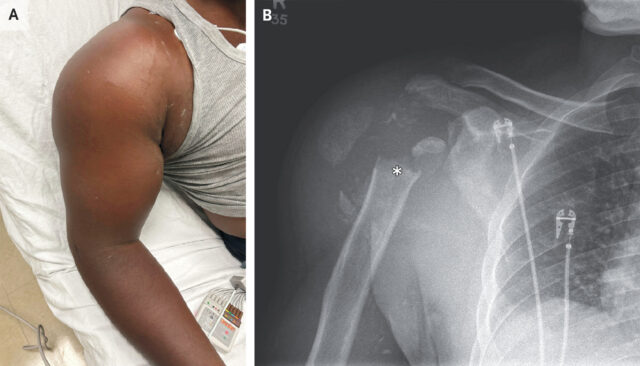 The man's shoulder, visibly swollen, and his X-ray showing destruction of the humeral head with a free-floating upper arm bone.
Credit:
New England Journal of Medicine, 2026
Magnetic resonance imaging, meanwhile, found that the man's rotator cuff—the group of muscles and tendons that holds the upper arm firmly in the socket—was also destroyed. Three of the four main tendons (supraspinatus, infraspinatus, and subscapularis tendons) had full-thickness tears.
This story was first published by Ars Technica. Read the original report
We use cookies to run this site and, with your consent, to measure traffic and improve our content. Necessary cookies are always on. You can accept all cookies or choose which ones to allow. Privacy policy.