


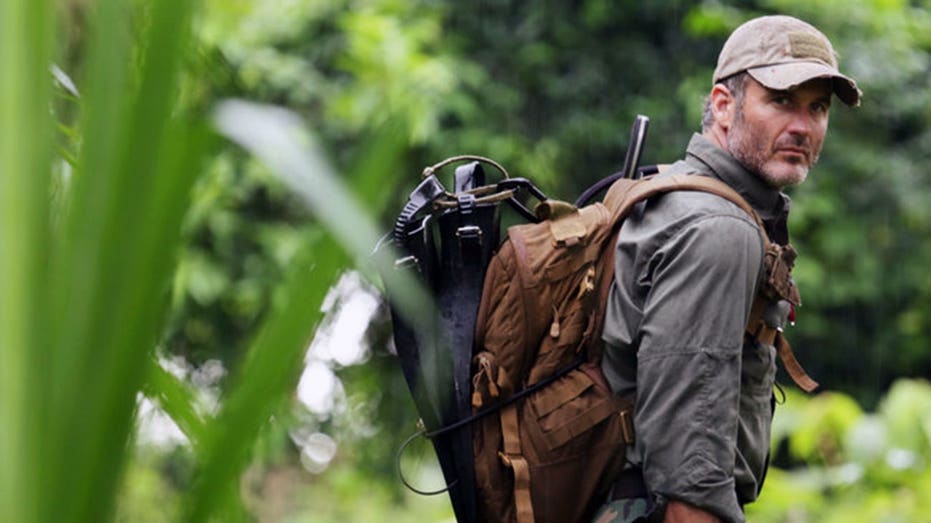
Navy SEAL and survival show host Joel Lambert warns Americans to prepare for weeks without supplies
Navy SEAL and survival show host Joel Lambert warns Americans to stockpile food, medications and water for a six-to-eight-week emergency scenario.
Former Navy SEAL and Discovery Channel host Joel Lambert says Americans preparing for an emergency should forget the Hollywood fantasy of grabbing a backpack and disappearing into the wilderness.
Instead, they should start by making sure they can survive inside their own homes.
Lambert, author of "A Navy SEAL’s Bug-In Guide: How to Turn Your House into the Safest Place on Earth," joined OutKick’s "Tomi Lahren is Fearless" this week to discuss emergency preparedness, wilderness survival and what television survival shows get right — and wrong.
CLICK HERE FOR MORE COVERAGE FROM OUTKICK
While Lambert said he is optimistic about humanity’s future, he also warned that getting there could involve serious uncertainty.
"I think we’re heading toward a brave new world in a good way," Lambert said. "I think we’re in the fourth turning, and we’re moving into a golden age in the world and humanity. However, that’s going to be a bumpy ride."
That makes self-sufficiency especially important, he said, whether the disruption comes from war, political instability, a natural disaster or a widespread power outage.
Lambert’s advice is not built around one miracle tool or expensive piece of tactical gear. He said families should instead prepare for a scenario in which ordinary services and supplies are unavailable for an extended period.
"I think you need to be prepared for a, say, six-to-eight-week scenario where you’re not able to get prescriptions," Lambert said. "You’re not able to get medications. You’re not able to get grocery store runs, or they might be limited, or water issues or power issues."
That means having enough essentials to get every member of the household through several weeks without relying on a last-minute grocery run.
And sure, six to eight weeks of emergency supplies might sound a little alarmist — maybe borderline doomsday prep-y. But you don’t have to be staring down Armageddon or nuclear annihilation for those supplies to come in handy.
A hurricane, major snowstorm, flood or city-wide power outage can disrupt access to food, clean water, medication, electricity or cell service. These things happen all the time.
Lambert grouped human needs into five basic categories: shelter, water, food, communication and navigation.
"Shelter, water, food, which are the most important in that order, and then communications and navigation," he said.
Communication could include anything that allows a person to receive or transmit information, from a cell phone to a signal fire. Navigation means having the ability to travel safely and know where you are even when modern technology or infrastructure is unavailable.
The key, Lambert said, is to prepare before an emergency arrives.
"Get your house in order," he said. "Make sure that you have some food to get yourself through, you know, several weeks of uncertainty."
Lambert also offered a reality check for viewers who think watching survival television has prepared them for the real thing.
He described CBS’ "Survivor" as more of an elimination competition than a true survival program and acknowledged that even legitimate outdoor shows must make concessions for television production.
Lambert hosted Discovery’s "Lone Target," also released internationally as "Manhunt," which followed him as he attempted to evade military and law-enforcement tracking units in remote environments.
"When I started doing survival shows on Discovery Channel, I did not want to be a fake survival show," Lambert said. "I’m like, I just got out of the SEAL team. So I’m like, ‘if I’m going to do this, I’m gonna do it real.’"
Some high-risk portions, such as parachute jumps, were filmed separately so an injury would not derail an entire production. Lambert said the actual pursuits, however, were genuine.
"Everything that happened from the time I inserted ‘til the time I got extracted was real," he said.
He recalled an episode filmed in Africa in which he continued moving through an area where lions were hunting, despite the crew attempting to stop him.
Lambert said he encountered lions that had recently made a kill and realized he "could really literally die in the African bush doing the show."
Still, he continued.
"It’s better to finish and die than quit and live," Lambert said.
Spoken like a true Navy SEAL.
Fortunately, the average person is far more likely to face a power outage, storm or water disruption than a team of trackers and hungry lions.
For ordinary wilderness situations, Lambert recommended remembering the "rule of threes." A person can generally survive approximately three hours without shelter in harsh conditions, three days without water and three weeks without food.
That order matters.
"Everyone always tends to go to food immediately, just because that’s what we all think of, but you can go a long time without food," Lambert said.
Asked whether someone should drink directly from a creek or another natural water source, Lambert said the circumstances will always dictate the decision. But whenever possible, the water should be purified.
"In the wild, you always need to purify your water just ’cause you just don’t know," he said. "You can find the most beautiful mountain stream that’s just clear and perfect, and you don’t know a mile up there’s a dead buck or something laying in the middle of the stream."
WOULD THIS SURVIVAL POD MAKE YOU FEEL SAFER?
Lambert recommended carrying a portable filtration straw or hand pump, along with iodine or chlorine tablets. Those inexpensive tools can dramatically reduce the risk of becoming sick from contaminated water.
Fire is another versatile survival tool. Given a choice between hunting equipment, a tarp or a ferro rod in a tropical jungle, Lambert said he would likely choose the ability to make fire.
"Fire is shelter," he said. "It protects your corporeal body from the elements. You can purify water, you can cook food, you can signal with fire, you keep warm."
The lesson running through Lambert’s advice is that survival is rarely about possessing one flashy item or a singular strategy. The environment, weather and immediate threat should determine the next move.
But for most Americans, Lambert explained, the first move is much simpler. Build a reserve of food, clean water, necessary medication and basic emergency equipment before you need them.
Because when the alarms are already blaring, it may be too late to start getting the house in order.