


One map shows the highest-paying job in every state outside doctors and nurses
Many medical professionals get paid well on average. Business Insider looked at what other jobs pay a lot among those with at least 1,000 employees.
adamkaz/Getty Images
- Business Insider looked at pay for different jobs in every state beyond medical professionals.
- We looked at jobs outside physicians and nurses with at least 1,000 employees.
- Based on that, chief executives and managers made up a lot of the best-paying jobs in the US.
Who is earning a lot of money in your state?
Turns out, it tends to be doctors and other medical professionals. We decided to take a look at what high-paying roles there are that don't require years of medical school or similar training.
Business Insider previously looked at the best-paying job in every state, based on the available wage and employment estimates from the Bureau of Labor Statistics. We looked at the average annual wages of occupations with at least 1,000 employees in May 2025, excluding catchall categories.
That map showed the top-paying gig in 20 states was a type of doctor, such as cardiologists in Texas and radiologists in Pennsylvania, and the top-paying was nurse anesthetists in Alabama and Missouri.
Even at the national level, the nine top-paying jobs on average were medical professionals.
So we decided to see what the map would look like if we filtered out doctors and nurse anesthetists to get a sense of what else pays well. We kept postsecondary health specialties teachers in Mississippi and Arkansas, as well as medical and health services managers in Hawaii.
You can hover over the map to see the top-paying job in each state and Washington, DC, based on the criteria.
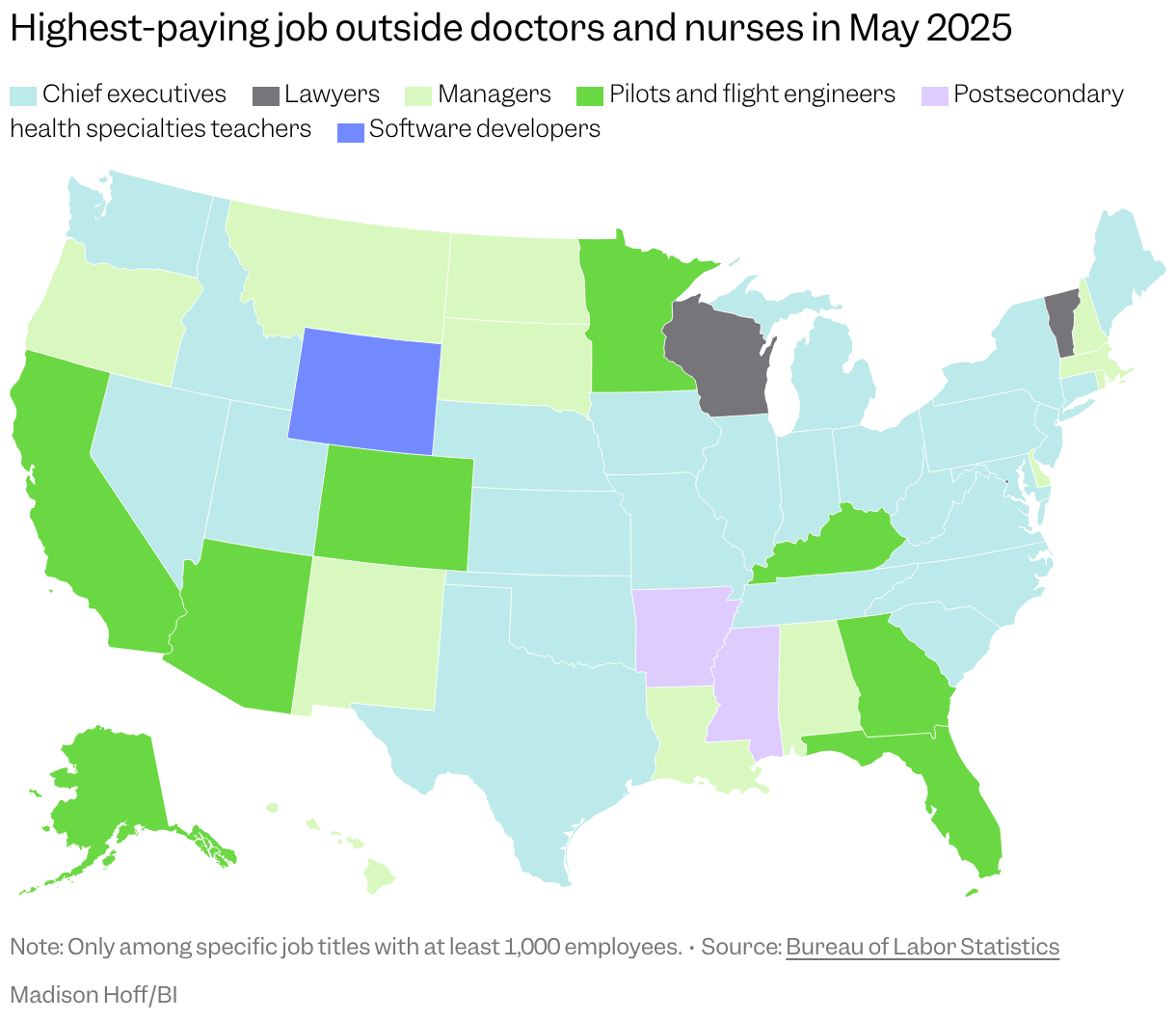
Chief executives were the top role in half the states, such as Texas and Pennsylvania, based on the criteria for this analysis. About a dozen states already had chief executives as their top role before excluding physicians and nurses.
Various kinds of managers were the top-paying in a dozen states in the above map, while pilots and flight engineers accounted for eight states.
Those looking to join the ranks of executives or pivot to a new leadership role will need to consider how to ace job interviews.
Matthew Siegel, a principal in Korn Ferry's executive search practice, walked Business Insider's Sarah E. Needleman through common mistakes executive job seekers should avoid. For instance, they should explain what drove their career moves rather than simply listing switches from their résumé. They should also avoid basic explanations, such as wanting more responsibility. Instead, job seekers could talk about wanting to work on a skill, try a different industry, or whatever motivated the change.
"There's a difference between giving examples and telling a story," Siegel said. "A story has an emotional component."
Job seekers shouldn't ignore crucial gaps between the job requirements and their work experience or skills. Instead, prospective employees should be prepared to explain it or raise it themselves.
"Acknowledging and moving on from it demonstrates maturity," Siegel said. "You don't have to dwell on it."
Read the original article on Business Insider