


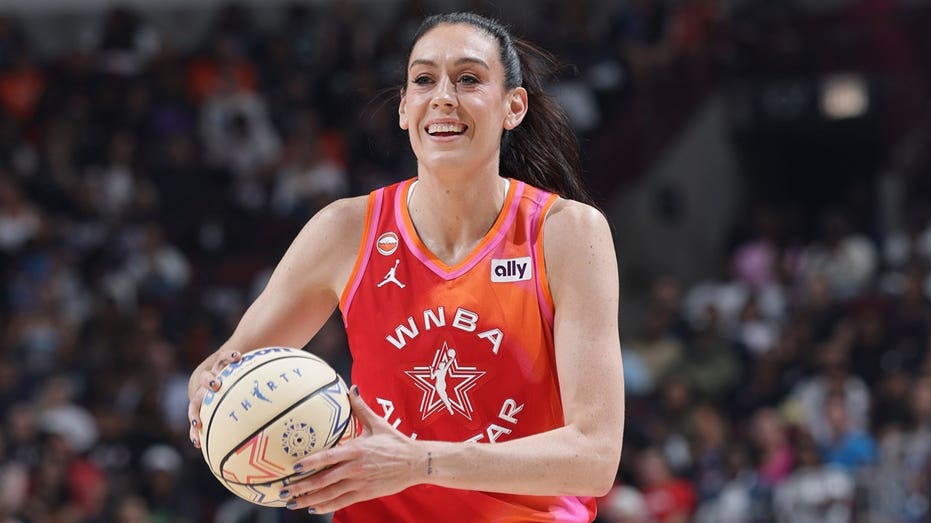
WNBPA says it did not ask WNBA to drop USA 250 All-Star patch after union officer publicly objected
The WNBPA says it never formally asked the WNBA to remove America 250 patches from All-Star uniforms, but the league still hasn't explained its decision.
The WNBA Players Association says it did not ask the league to abandon a reported plan to place USA 250 patches on its All-Star uniforms, despite public criticism of the idea from one of the union’s elected officers.
In a statement to OutKick and Fox News Digital, the WNBPA said members of player leadership contacted the league after Sportico reported that the patches would appear on the uniforms during Saturday’s All-Star Game in Chicago.
According to the union, the WNBA said at the time that no final decision had been made. The league later informed player leaders that it would instead commemorate the country’s 250th anniversary through "America 250" signage in and around the arena and by honoring veterans during the game.
"The league did not seek union input nor was the matter put before player leadership for action," the WNBPA told OutKick/Fox News Digital.
The statement undercuts the claim that the union formally demanded that the patches be removed, or held a vote opposing them. It doesn’t explain why the WNBA decided against putting the patch on the uniforms after Sportico reported that the league planned to do so, or whether the public objection from WNBPA treasurer Brianna Turner influenced that decision.
The WNBA did not respond to questions from OutKick and Fox News Digital about the union’s statement, who made the final decision or why the league chose not to use the patch.
The patches are part of a national initiative that has included the NFL, NBA, NHL, MLB, MLS, NASCAR, UFC and WWE. Every player wore one during the Super Bowl, while NBA players wore them throughout the Finals.
The WNBA was not listed in the initial Fanatics and America250 announcement, but Sportico later reported that the league planned to use the patches during All-Star Weekend.
Then the proposal reached the WNBA.
Las Vegas Aces forward Brianna Turner, who serves as treasurer of the WNBA Players Association and sits on its executive committee, publicly criticized the reported plan.
"Whoever called for the WNBA all-star uniforms to have the USA 250 patch should have thought that through considering no WNBA players would have been free 250 years ago," Turner wrote on social media.
She added that the league’s players are among the world’s most elite female athletes, but that 250 years ago they would have been "breeders or in the fields working all day."
"Be so serious rn," Turner concluded.
WNBA PLAYER SAYS THE LEAGUE SHOULDN'T WEAR USA 250 PATCHES FOR THE ALL-STAR GAME BECAUSE OF SLAVERY
Turner’s comments came before members of player leadership contacted the league about the Sportico report. The WNBPA now says those conversations were limited to seeking information and that the union neither provided input nor considered formal action on the patch.
WNBPA president Nneka Ogwumike later confirmed that the Sportico report prompted players to raise the matter directly with league leadership.
"As players, we did ask about it," Ogwumike told reporters Friday, one day before the All-Star Game. "I think being in a league where you’re able to have that type of conversation with your leadership is important."
Breanna Stewart, another member of the WNBPA executive committee, was asked Friday whether the patches would appear on the All-Star uniforms.
"No, they’re not on the jerseys," Stewart responded.
At the time, neither Ogwumike nor Stewart explained whether players had objected to the patches during their conversations with the league. The WNBPA’s subsequent statement says the matter was never presented to player leadership for action.
What remains unclear is what happened inside the WNBA after player leaders asked about the report. The union says it offered no input and was never asked to take action, but the league has not explained why it ultimately chose arena signage and a veterans tribute rather than the uniform patch.
OutKick and Fox News Digital asked the WNBA whether it initially planned or agreed to use the patches, whether the WNBPA or individual players asked that they be removed, whether any All-Star said she would refuse to wear a uniform featuring one. We also asked who made the final decision and whether the league plans to recognize America’s 250th anniversary in another way.
The league didn’t respond by publication.
Several reports and social media posts described WNBA players as "refusing" to wear the patches, but the WNBPA statement cuts against that framing. The union says player leaders neither offered input nor took formal action on the issue, and there remains no public evidence that any All-Star threatened to reject a jersey featuring the patch.
The WNBA’s only public statement came shortly after the Sportico report and Turner’s criticism.
"Like other major sports leagues, we are exploring how best to commemorate the country’s 250th anniversary," the league told USA Today. "Nothing has been finalized at this time."
That statement gave the WNBA plenty of room to retreat without taking responsibility for the final decision. It also avoided the obvious problem with Turner’s argument: America’s founding ideals were not the cause of the injustices she cited. They provided the moral and legal foundation Americans later used to defeat them.
Turner later softened her initial comments, telling USA Today that she was thankful for what the country had provided her but believed America had not yet achieved "true equality for everybody."
See, here's the problem with all the people who say things like "not everyone is equal in America." Faced with the obvious counterargument, "Please name one law in the United States that proves all citizens are not equal under the law," they never have an answer. Turner didn’t provide any examples of Americans not having "true equality."
If she means that every American does not have the same income, experiences or outcomes, she is correct. No society in human history has produced that form of equality, and holding a country up against a hypothetical utopia is a ridiculous standard that no society could ever reach.
If she means Americans are not equal under the law, however, she is simply wrong.
The Constitution guarantees equal protection of the laws, while federal civil rights statutes prohibit discrimination based on race and sex in employment, education and other major areas of public life. That doesn't mean discrimination never occurs, prejudice has vanished or every person is treated fairly in every interaction. Laws are broken every day, and injustice will always exist as long as human beings exist.
But Turner’s claim treats the continued existence of unfairness as proof that legal equality does not exist. Those aren't the same thing.
There are countries in the world today where women face genuine, government-enforced inequality. Under Taliban rule in Afghanistan, women and girls have been banned from participating in sports and pushed out of education, employment and public life. United Nations experts have said no other country imposes a comparable nationwide prohibition on women participating in sports.
That is legal inequality, and it exists in the world in 2026.
But Turner lives in a country where women can become professional athletes, labor leaders, executives, judges, elected officials and business owners. She earns a living playing basketball in the most prominent women’s professional league in the world. She is free to criticize her employer, the government and the country without facing government punishment.
Her public objection was defended by the president of her union. Whether Turner’s criticism influenced the league’s decision remains unanswered, and the WNBPA says player leadership didn't formally participate in that decision.
That's not evidence that America has failed to make progress. It's evidence of exactly the opposite. It shows just how much progress the country has made.
Turner’s argument freezes America in 1776 and ignores the 250 years that followed. The founding principles she treats as irrelevant became the framework Americans used to expand citizenship, voting rights and equal protection under the law. The WNBA itself, and Turner’s ability to earn a living as a professional athlete while publicly criticizing the country, are products of that progress.
Essentially, the existence of the WNBA is the perfect argument for American greatness. Yet, it's sad to see how many players and coaches in the league seem unwilling to acknowledge that.
Minnesota Lynx coach Cheryl Reeve offered a more measured explanation Friday, describing the patch question as a "difficult balancing act." She said the league represents people with different political views and should be capable of recognizing the country’s anniversary while continuing to address social issues.
Fine, but wearing a small patch acknowledging America’s 250th birthday doesn't actually require "balance."
The patch didn't endorse a political candidate or claim that the United States had never done anything wrong. It didn't ask WNBA players to abandon their beliefs or stop advocating for their preferred causes.
It was a bare-minimum acknowledgment of the founding of the country in which the league operates and the freedoms that allow its players to speak as loudly as they do and the one that allows them to earn a living playing basketball.
That freedom is not universal: World Bank Group data says women are legally barred from certain jobs and industries in 77 economies.
Professional sports remain one of the few areas of American life where people with dramatically different political views regularly gather around a shared team, city or country. Patriotic moments in sports work because they don’t need to be complicated. Athletes representing the United States hear the national anthem and understand that they are competing for something larger than themselves. Fans see the flag and take pride in the country those athletes represent.
The WNBA often seems determined to turn even the simplest patriotic gesture into an unnecessary ideological debate.
Players have the right to do that. Turner is free to believe America’s founding is not worthy of celebration because the country failed to live up to its stated ideals in 1776. Ogwumike and the WNBPA are free to amplify that argument and question the league’s decisions.
The public is equally free to find the position ridiculous and hypocritical, and choose to support other leagues that better represent their feelings.
The WNBPA has now provided its account of the jersey patch controversy. It says player leaders sought information, offered no input and were never asked to take action on the patch.
That leaves the WNBA with several unanswered questions. Why did the league move away from the uniform patch? Did Turner’s public criticism factor into the decision? Did any individual player express opposition? And why did the league choose less visible arena signage rather than join other major sports organizations in putting the commemoration on its uniforms?
The union has answered for itself. The league has not.
The WNBA is one of the clearest examples of the progress Turner claims has not produced "true equality." Women earn a living as professional athletes, exercise influence through a powerful labor union and publicly criticize their employer and country without government retaliation.
Yet when the league reportedly considered putting a small symbol of America’s 250th anniversary on its All-Star uniforms, the patch never appeared.
The WNBA still has not explained why.