Dogs can tell if you're scared or sad
fMRI scans show happiness, fear, anger, and sadness have distinct brain activity patterns in doggy brains.
fMRI scans show happiness, fear, anger, and sadness have distinct brain activity patterns in doggy brains.
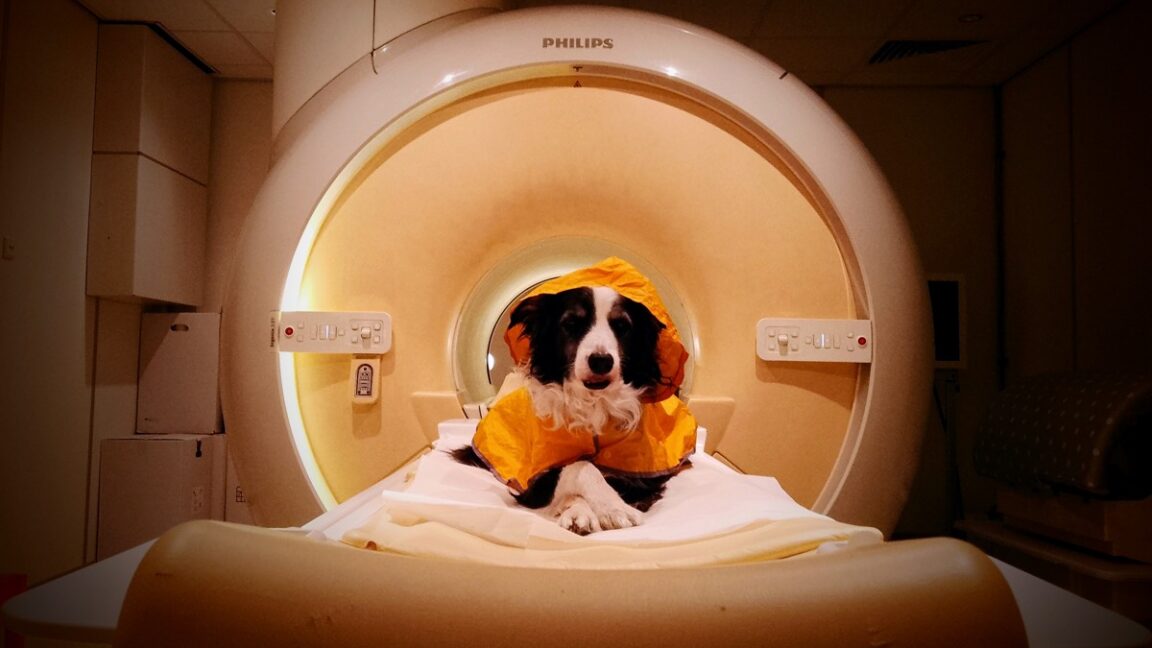
Any dog owner would tell you that their canine companions are attuned to their humans' emotional state and respond accordingly. Scientists have performed fMRI scans on dogs and identified a specific brain region that processes happy human facial expresses, like a smile, according to a new paper published in the journal iScience. They also found that dogs can tell the difference between negative facial expressions, specifically anger, sadness, and fear.
“Humans are really good at picking up small details on the face, and so are dogs,” said co-author Raúl Hernández-Pérez of the University of Vienna. “This makes dogs very interesting. By studying their brains, we can understand what adaptations have developed to support their remarkable social and emotional understanding of humans.”
Prior behavioral studies have shown that dogs are sensitive to emotion in human faces. Dogs will, for example, choose a box their human has identified with a happy expression over one the human treats with fear or disgust. Past fMRI studies found that an area in the canine left temporal cortex showed a stronger response to human faces compared to dog faces, as well as a greater response in the caudate, hippocampus, and amygdala to human faces showing emotion versus neutral faces.
This story was first published by Ars Technica. Read the original report
We use cookies to run this site and, with your consent, to measure traffic and improve our content. Necessary cookies are always on. You can accept all cookies or choose which ones to allow. Privacy policy.