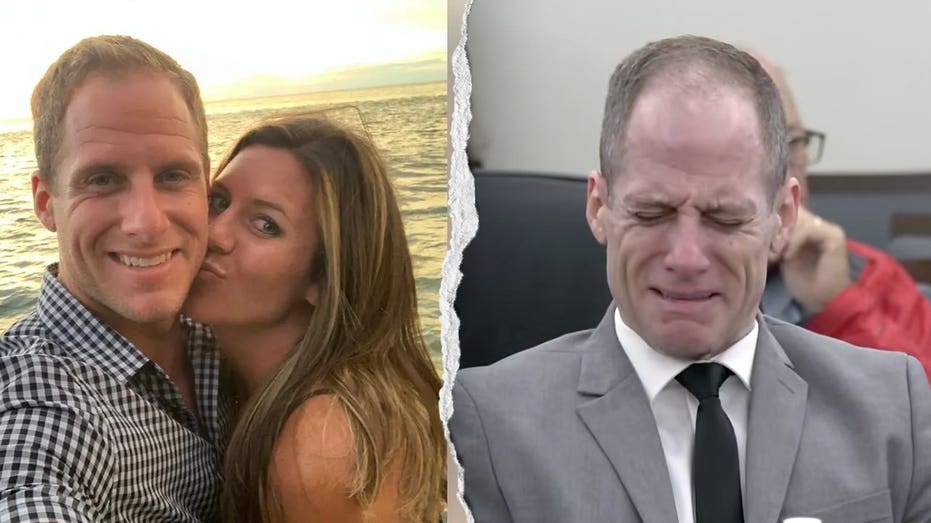
Former "American Idol" contestant Caleb Flynn's missing handgun sent investigators into storm drains with a high-powered magnet, underneath vehicles and through attic insulation as they searched for the weapon prosecutors allege he used to kill his wife.
Despite the extensive search, investigators never found the gun, a Tipp City detective testified Monday during Flynn's murder trial in Ohio.
Flynn is accused of fatally shooting his wife, Ashley Flynn, inside the couple's home on Feb. 16 before staging the scene to look like an intruder had broken in. He has pleaded not guilty to aggravated murder and other charges.
Detective Adam Bernard walked jurors through the lengths investigators went to as they searched for the missing firearm in the days after Ashley's death.
Police searched the backyard and nearby wooded areas before turning their attention underground, where investigators used a high-powered magnet to search storm drains along several streets.
Bernard testified that investigators removed the drain covers, lowered the magnet inside and swept connecting pipes before he physically climbed into accessible culverts with a flashlight to search areas the magnet may have missed.
Investigators later had both vehicles from the Flynn home placed on lifts so they could search underneath them and other areas where something could have been hidden, Bernard testified. That search also came up empty.
Police even rented equipment to remove insulation from the attic as they continued looking for the gun.
Bernard testified that investigators also tried to trace Flynn's firearm purchase history after Flynn previously said he bought a gun in South Carolina, where he obtained his concealed-carry permit.
The detective said he called nearly two dozen gun stores in the state looking for records that could identify the make, model and serial number of a firearm purchased by Flynn.
Dr. Bryan Casto testified that the entrance wounds overlapped and the bullets traveled through Ashley's head on nearly parallel paths. One of the bullets exited her head before reentering her left arm near the elbow, where it was recovered during the autopsy.
Casto said the wounds and the paths of the bullets suggested Ashley was shot at close range, but he could not say exactly how far away the gun was when it was fired.
The pathologist determined Ashley died from multiple gunshot wounds to the head.
Earlier Monday, Ohio Bureau of Criminal Investigation crime scene investigators walked jurors through evidence collected throughout the Flynn home as prosecutors sought to show the alleged break-in had been staged.
A BCI crime scene technician who had examined between 20 and 30 forced-entry doors testified that the damage to a side garage door did not look like the forced entries she had previously investigated.
She said the damage was on the inside of the door rather than areas she would typically expect to be damaged if someone had kicked or pried their way inside.
Flynn's defense challenged the state's conclusions on cross-examination, pointing out that investigators could not determine when some of the door damage occurred and that no blood-spatter analysis was performed because conditions at the scene were not suitable for one.
David Hammond, a senior special agent with BCI, also testified that he was not aware of evidence showing blood spatter from Ashley's shooting on Flynn's clothing.
Bernard testified that he printed tips received by Tipp City police and passed them to the FBI for follow-up. He said he did not know whether the FBI investigated that particular tip.
We use cookies to run this site and, with your consent, to measure
traffic and improve our content. Necessary cookies are always on. You
can accept all cookies or choose which ones to allow.
Privacy policy.