


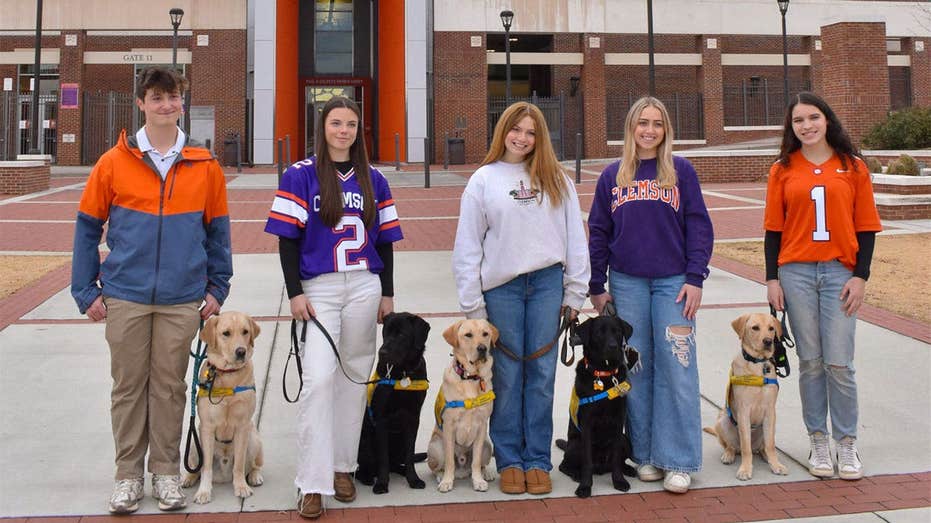
Even on opening weekend, football players at Clemson, LSU might be upstaged on campus by these furry friends
LSU and Clemson students raise Canine Companions puppies on campus, training them to become service dogs for people with physical disabilities.
At colleges like LSU and Clemson, football is king. And, especially this time of year, the BMOCs (Big Men On Campus) are usually the football players.
As the Tigers from both LSU and Clemson get set to tangle in Baton Rouge on Saturday to open the 2026 college football season, no one’s more popular on their respective campuses than those BMOCs.
Except...
STAY "FEARLESS" ON THE GO! TAKE TOMI LAHREN WITH YOU. DOWNLOAD THE TLIF PODCAST NOW!
What if some APOCs stroll across the Quad? (APOC: that’s short for Adorable Puppies On Campus.)
LSU and Clemson have their fair share of APOCs, too.
While both schools may be well known for football, they’re also known for having an affinity for very special (and adorable) dogs. Both LSU and Clemson have clubs on campus that assist a national non-profit organization named Canine Companions with raising and training little puppies into full-fledged service dogs that are assigned to people in need.
Students on campus who are in the club volunteer to raise specially bred Labrador Retriever puppies for more than a year, teaching the sweet and adorable creatures commands, cues and social behavior.
So…a BMOC versus an APOC spotted in the wild on campus? Well, it might not be all that close as to which one will draw the most attention.
"When people see our dogs on campus, they always stop and say hi and ask to pet them and they’ll want to know about our club," Clemson senior Brooke Knight, president of the Canine Companions club on campus said. "They’ll want to take pictures. It’s just super cool to see people wanting to interact with us and the dogs."
The Clemson club has raised 15 dogs on campus since 2021. At LSU, the four-year-old club typically raises five dogs a year. Raisers are given approval to take their puppies to class, across campus, into every building and to events. The puppies at Clemson and LSU become part of the campus family, and, even though they are canines, they are essentially considered honorary "Tigers."
"It definitely makes you popular to walk around with a dog," said LSU sophomore and club president-elect Finley O’Con, who will be getting her first puppy to raise in about two months. "You'll talk to 15 people just walking through the quad because they want to know: ‘Why do you have a dog? What's the dog's name? Tell me about this club. Tell me about Canine Companions.’ And it's definitely really good advertisement to have a dog. "
"Raisers" undergo a comprehensive vetting process. They are typically assigned a puppy by Canine Companions around the 8-week mark of the puppy’s life, and they’ll raise the puppy for the next 14 to 16 months.
College students, typically with no other dependents, are perfect to provide the puppies with a laser focus. They also happen to be in a great environment to expose the puppies to one of the biggest parts of this stage of their learning: socialization.
From quiet libraries, in which the raisers teach their puppies to settle under a table, to bustling quads, in which the raisers teach their puppies not to chase every person or squirrel, to a gathering or loud sporting event, in which the raisers teach their puppies how to be calm amidst the chaos, college campuses challenge the puppies with every possible stimuli and circumstance.
"Through Canine Companions, it is required that (raisers) attend at least two puppy classes a month. And obviously, there are plenty of chances for the raiser to go home, teach the dog basic commands and then again, at our club meetings we like to show off their talents, and it gets the dog really excited to learn more stuff," said LSU senior Kelsey Johnson, the club’s current president. "They have a lot of different opportunities to be able to be trained. "
After about 18 months of being a raiser on campus, Clemson junior Allie McCafferty, her club’s vice president, recently returned her puppy Vinny to Canine Companions so that he could start professional training. It’s a six- to nine-month process that is the last step before a puppy can become a full-fledged service dog or facility dog.
CLICK HERE FOR MORE SPORTS COVERAGE ON FOXNEWS.COM
"He is the absolute best," McCafferty said of Vinny. "He is so incredibly calm. Nothing affects him ever. He’s so cuddly, which is my favorite. He’s incredibly attentive. Any time I look down at him, he’s just staring up at me waiting for me to tell him what to do next.
"The balance of time with classes and trying to focus on him can be a challenge. But if we are busy studying or we can’t take our dogs to a lab or something like that, we do have a lot of (dog) sitters in the club who can help us. Having the support here of the club, to watch our dogs when we need it, to have other dogs to play with, has been really great."
Of course, raisers don’t need to be college students. Raisers live all over the country, are all ages and can have all kinds of different life circumstances, from young working singles, to retired couples to busy families with multiple young kids.
Loving dogs, and wanting to help people in need, are two of the biggest criteria for raisers to become a perfect match with Canine Companions.
Canine Companions was founded in 1975 in Santa Rosa, Calif., and in 1976 the first service dog, Abdul, was placed by the organization. More than 8,500 dogs have been placed since.
Last year, the organization celebrated 50 years of service, and as of January, Canine Companions is working with more than 2,800 actively placed service dogs while guiding more than 1,100 raisers of puppies, like those at LSU and Clemson, that hope to one day be service dogs.
Over five decades, Canine Companions, at no cost to its clients, has assisted people with physical disabilities or challenges, cognitive issues and post-traumatic stress disorder. Professionals who need the assistance of the dogs as part of their work in health care, criminal justice or education also have long-standing relationships with Canine Companions.
It is this noble cause that fuels the selflessness of raisers. It can be a bittersweet job as they put so much into a beloved creature that they will ultimately have to let go.
Raisers not only devote an incredible amount of their own time and resources for more than a year while they raise the puppies into dogs that are primed for professional training, they also agree to weather the difficult emotions and tears of saying goodbye when it’s time for their puppies to move on to that next stage.
After her puppy spent nearly a year and a half with her on LSU’s campus, senior Ella Menard dropped off Loyal to professional training in May. She misses him every day.
"So Loyal's now in his second semester (at professional training), which is crazy because it feels like I just dropped him off," said Menard, the former president of the LSU club and now its current vice president. "He's moving along. He is starting to learn some ambulatory skills , like basic foundational skills for a manual wheelchair. It's exciting, He's doing fairly well.
"He's still kind of figuring out how to walk politely on a leash, which is no surprise. I fully expected that. In some outings, he's kind of, you know, getting distracted, wanting to go see everybody. He's just a very friendly dog, but he needs to focus, and I think he's getting there. He actually just got a new trainer, so we'll see how that works out. "
Interestingly, if any puppy doesn’t make it through professional training for whatever reason, raisers will be asked if they would like their puppy back, free of charge, to love again as just a pet.
Of course, all raisers hope for success, which is the bittersweet part. Success for the puppies and for the organization and for the people in need who ultimately get the dogs, means some heartache for them.
"Turning in Loyal was probably one of the hardest days of my whole life, but it taught me that I can have an attachment to something, that I can love this dog, but know that he's meant for more," Menard said. "He's going to make somebody's life a lot better. I think that's my main takeaway from the club is that you can do hard things.
"The heartbreak was hard, but the joy (Loyal) brought me was worth all the tears. "
To learn more about Canine Companions, or to donate, visit: canine.org. You may also follow Canine Companions on Instagram, Facebook and Twitter.
Would you consider being a raiser for Canine Companions, or have you been involved with the organization already? Let me know: [email protected].