International News Portal14 November 2026Headlines from established publishers
World
Strange rock catches scientist's eye during creek search, leading to rare discovery
An Ice Age Pacific mastodon molar in immaculate condition was found in a San Mateo County creek, and scientists say the rest of the skeleton may still be buried there.
A scientist surveying a California creek recently stumbled across something unexpected: a tooth from the mouth of an Ice Age giant.
The discovery of the tooth, which belonged to an ancient Pacific mastodon, was announced by the Midpeninsula Regional Open Space District (Midpen) in San Mateo County, California.
Mastodons were massive, elephant-like herbivores that went extinct roughly 11,700 years ago, near the end of the last Ice Age.
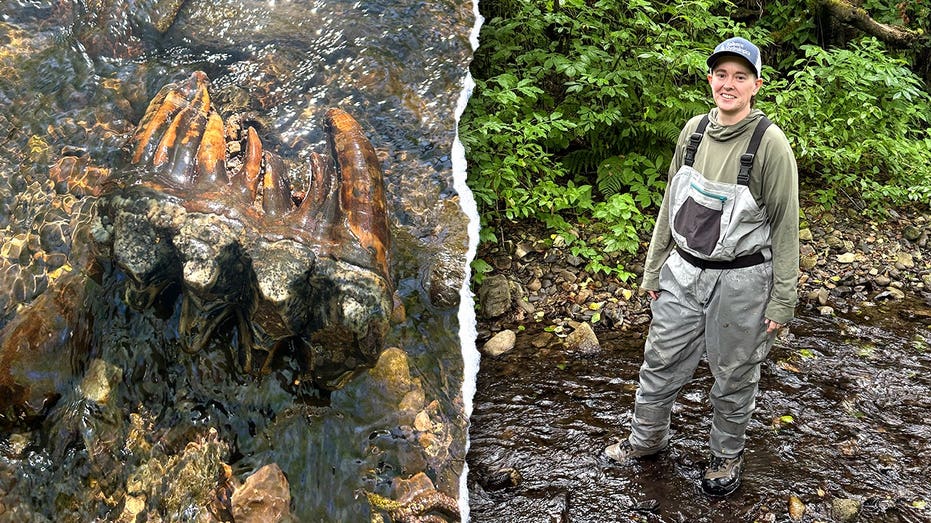
The tooth was found in a Midpen preserve creek by Brigid Lynch, a Balance Hydrologics geomorphologist who was surveying the area as part of an effort to improve the habitat of the threatened California red-legged frog.
"As a geologist, I've gone out and seen stuff in the field, but definitely nothing as exciting as this," Lynch said in a release.
Pictures of the molar show its strange shape, which Lynch initially thought was an oddly shaped rock.
The tooth is in "immaculate condition," Wayne Thompson, CEO of Pacific Paleontology, told Fox News Digital in an interview.
Thompson, whose job it was to examine the fossil and assess the site where it was discovered, said the tooth likely dates back between 50,000 and 100,000 years, based on where it was found.
"There is a lot of misinformation going around about the age of the tooth," he said. "Most of the reports out [there] are saying it's 10,000 years old, but it's not 10,000 years.
"From the location where the specimen was found, we can pretty confidently say that it’s much, much older than 11,700 years — probably on the order between 50 and 100,000 years," he added.
Thompson said the condition of the tooth also offers clues about what happened to it after the mastodon died, noting that it "hadn't moved very much in the stream where the creature died."
"Mastodon teeth are — the roots are extremely fragile — and this one had the majority of the roots of the molar still preserved with it intact, and so, it wasn't tumbled around in the stream," he said.
The paleontologist believes the rest of the animal may still be at the site.
Thompson said mastodons favored creek and river valleys, browsing on leaves rather than grazing on grasses as mammoths did.
Alder trees, he said, were among their preferred food sources — and they still line the creek where the tooth was found.
"Even today, when we went out to the site to inspect where the biological monitor was surveying, there were still hundreds of alders along the stream," Thompson said.
We use cookies to run this site and, with your consent, to measure
traffic and improve our content. Necessary cookies are always on. You
can accept all cookies or choose which ones to allow.
Privacy policy.