


France is devouring itself as school riots reveal a crisis far bigger than broken classrooms
France student protests over crumbling schools expose deep tensions as Jean-Luc Mélenchon's La France Insoumise allegedly exploits the growing unrest.
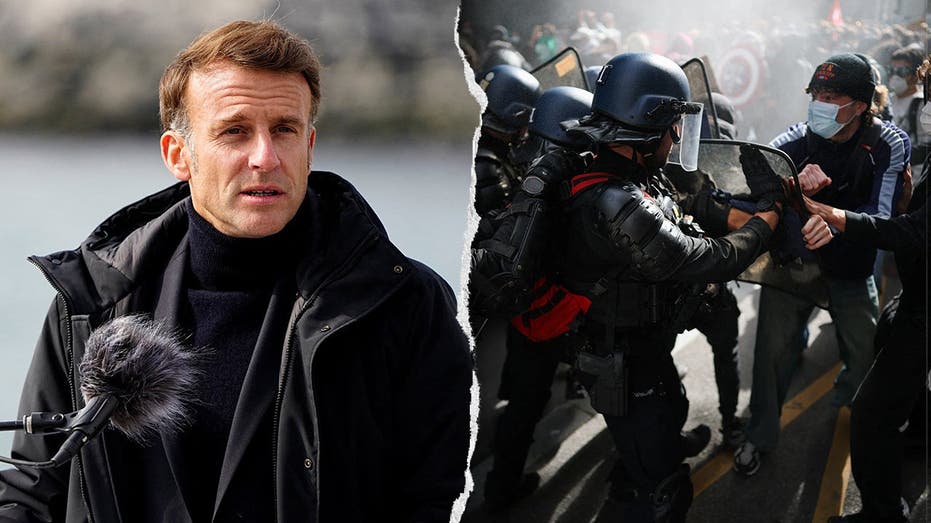
Student protests over crumbling schools despite billions in public spending are fueling a broader crisis in France, as experts warn that the country's mounting financial troubles, President Emmanuel Macron's weakened political center and radical movements are pushing the unrest far beyond its original educational grievances.
Simone Rodan-Benzaquen, the Foundation for Defense of Democracies' senior envoy for Europe, told Fox News Digital in an interview from Paris that what began in September with legitimate complaints about school conditions has increasingly been exploited by political forces seeking confrontation with the state.
"Overall I'd say the anger is real but the violence I would say is organized," she said, adding that destroying schools would do nothing to improve the education system.
FRANCE EXPLODES AGAIN AS STUDENTS RIOT OVER EDUCATION
Seventy-two percent of education expenditure went toward salaries, social contributions and pensions for teaching and non-teaching personnel, while just 8.5% went toward investment, including infrastructure and equipment. The figures cover the entire education system, not just high schools, according to France's Education Ministry's 2026 statistical overview.
Harvey Feigenbaum, a professor of political science and international affairs at George Washington University and an expert on French politics, told Fox News Digital that France's underlying problem is a government caught between expensive social commitments, sluggish economic growth and mounting pressure to cut spending.
"France is in deep debt. It wants to cut its expenses," Feigenbaum said, explaining that years of financial pressure and neglected school facilities have fueled frustration among students.
The scale of the financial predicament is striking. According to Eurostat, French public debt stood at 117.6% of GDP in the first quarter of 2026, the third-highest ratio in the European Union, behind Greece and Italy.
Reuters reported October 8 that rising borrowing costs and investor concerns have severely limited the government's ability to resolve unrest through additional spending, a strategy employed during previous waves of French protests.
The financial squeeze has collided with an increasingly fragmented political system, creating opportunities for parties at both ends of the political spectrum to capitalize on public dissatisfaction.
FRENCH SCHOOL RIOTS DEEPEN AS EXPERTS POINT TO FAR-LEFT ALLIANCE FUELING ‘BROADER CONFRONTATION’
For Feigenbaum, the long-term roots of the crisis lie in Macron's political legacy.
When Macron won the presidency in 2017, he promised to move beyond France's traditional left-right divide, combining policies from both sides into a new centrist political movement.
But Feigenbaum argues that the strategy produced an unintended consequence: weakening France's established moderate parties without creating a durable governing coalition to replace them.
"What he ended up doing was attracting the moderate voters from the parties of the moderate left and the parties from the moderate right, and essentially destroyed those parties," Feigenbaum said.
He argued that the collapse of the traditional political center helped create space for more ideologically polarized movements. "Macron is a smart man, but he's a terrible politician," the professor added.
Macron's controversial pension reforms illustrate the difficulty of persuading French voters to accept reductions in longstanding public benefits, Feigenbaum argued. Those efforts triggered widespread protests, while implementation of the 2023 retirement changes has since been suspended until 2028.
The situation became especially difficult after Macron called snap parliamentary elections in 2024, producing a deeply divided National Assembly without a governing majority.
"Even if the government wanted to do something coherent, they simply don't have the votes to do it," Feigenbaum said.
That paralysis has left Prime Minister Sébastien Lecornu handling the immediate unrest while Macron faces questions about the stability of the political system he helped reshape.
The protests began in the Paris suburbs in September amid complaints about overcrowded classrooms, inadequate heating and cooling, aging buildings and teachers who were not replaced when absent.
Rodan-Benzaquen said the anger reflected years of educational instability, frequent ministerial changes and reforms that have failed to resolve persistent school problems.
She also pointed to a broader sense of anxiety among young people about their economic future, artificial intelligence, climate change and international conflicts.
According to the OECD's September 2026 Education at a Glance report, France spent $16,674 in funding per student in general upper-secondary education in 2023, compared with an OECD average of $12,421, adjusted for purchasing power.
Yet teachers and students continue to complain about basic shortages.
Responsibility for public high school buildings and equipment falls to regional authorities, while the national government oversees much of the education system, including teacher staffing.
Feigenbaum said France's centralized education structure makes national leaders the focus of public anger when schools fail to deliver.
The pressure has already forced a concession.
Reuters reported Friday that Education Minister Édouard Geffray announced an emergency plan to deploy 3,000 qualified educators to particularly affected schools, costing several dozen million euros.
Student unions welcomed the measure as an initial victory but pledged to continue demonstrating.
The spending figures raise broader questions about whether France's financial and political priorities have left sufficient resources for maintaining school infrastructure and meeting students' needs. They do not, however, establish that teachers' unions or other organized constituencies have improperly diverted funding.
TEEN'S HAND BLOWN OFF BY POLICE GRENADE DURING FRENCH STUDENT PROTESTS: REPORT
As the demonstrations expanded, the involvement of France's hard-left La France Insoumise party, known as LFI, led by Jean-Luc Mélenchon, became an increasingly contentious issue.
Reuters reported October 1 that French intelligence agencies had told a government crisis meeting that LFI and affiliated activists played a role in fomenting the unrest. Interior Minister Laurent Nuñez also cited agitators moving between schools to encourage violence.
LFI has denied responsibility and accused authorities of aggravating tensions through their response.
Rodan-Benzaquen said far-left movements were capitalizing on students' frustration.
"There is an obvious instrumentalization, obvious manipulation," she said, arguing that activists were seeking to push some protesters toward violence.
She linked the unrest to what she described as Mélenchon's broader political strategy ahead of France's 2027 presidential election.
"His idea is that on the one hand he will scare voters on the right and on the far right, who will then go to vote for the far-right, and on the other hand he would mobilize his own camp," she said.
Rodan-Benzaquen argued that intensifying political confrontation could help Mélenchon consolidate his support among younger voters and immigrant communities, while portraying the far right as an increasingly serious threat.
She described it as a calculated political strategy rather than a spontaneous response to students' concerns.
The involvement of LFI politicians has been documented by French media, although there is disagreement over whether the party helped initiate the demonstrations or became involved after the protests began.
An October 2 investigation by Le Monde examined a police intelligence assessment describing radical-left activity around schools in Seine-Saint-Denis but questioned whether the evidence established that the movement itself was politically orchestrated.
Feigenbaum offered a more cautious interpretation, describing some of the violent perpetrators as fringe provocateurs who exploit broader demonstrations without necessarily directing them.
"They're not being organized by some, you know, some mastermind at the national level, at least as far as anyone knows," he said.
FRANCE ROCKED BY STUDENT RIOTS AS HUNDREDS ARRESTED, VIOLENCE SPREADS NATIONWIDE
The demonstrations have also raised questions about whether Islamist groups and pro-Palestinian activists are seeking to use the unrest to advance broader ideological causes.
Rodan-Benzaquen argued that Mélenchon's emphasis on Gaza and the Palestinian cause has helped bring together political constituencies that might otherwise have little in common.
"It's sort of the idea of sort of an intersection of different movements where they manage to bring together the different groups, the far left, Islamist movements, pro-Palestinian activists," she said.
She pointed to Palestinian flags appearing during the demonstrations as an indication of how the movement has expanded beyond its original educational demands.
The FDD expert argued that Islamist elements were attempting to capitalize on the turmoil, although she cautioned against reducing the entire crisis to immigration or religion.
"But this goes far beyond the issue of immigration, it goes far beyond the issue of Islamism, it goes far beyond the issue of Islam," she said.
EUROPE’S LEFT COURTS MUSLIM VOTERS AS ANTI-ISRAEL POLITICS RESHAPE CONTINENT
The government's latest concessions have not ended the protests.
According to Reuters on Friday, 141 schools remained closed while students continued demanding broader reforms. Nearly 10% of teaching hours in French public high schools remained unstaffed.
For Rodan-Benzaquen, one of the greatest dangers is that the demonstrations reflect a society increasingly divided into competing political realities.
She described how her 17-year-old son created separate left-wing and right-wing Instagram accounts and encountered radically different portrayals of the same unrest: one emphasizing police violence and the other violence by protesters.
"Now, if you live in two drastically different realities, it is very complicated to come to any form of dialog and end agreement," she said.
Her warning extends beyond France's current protests.
"We are in an extremely polarized environment," Rodan-Benzaquen said, noting that social media can deepen divisions and allow confrontations to escalate rapidly.
Feigenbaum sees an additional structural danger: a government burdened by accumulated financial obligations and deprived of the political consensus needed to reform them.
The result is a country spending heavily to sustain its public institutions while struggling to deliver the services citizens expect — and a political system increasingly consumed by conflict over how to fix them.
What began as a rebellion against broken classrooms has become a test of whether France can reconcile its costly promises with its financial reality before the divisions consuming its schools deepen further.