


Young New Yorkers are facing a tough job market — and a college degree may not make a difference
Unemployment rates in NYC show that young workers with degrees face challenges similar to those of non-degree holders. It may be because of AI.
Spencer Platt/Getty Images
- Unemployment rates for NYC graduates and non-graduates are converging.
- 22- to 27-year-old New Yorkers face similar unemployment rates whether or not they have a degree.
- Fewer Americans see college as vital, partly due to rising costs, per a recent Gallup poll.
It's been a cornerstone of the job market for decades: Higher education is the surest path to steady employment. But in the Big Apple, there are signs that may no longer be the case.
The unemployment gap between young New Yorkers with college degrees and their peers without degrees has dramatically narrowed; for a few months this year, the latter actually had slightly lower unemployment than the former — a potential sign that entry-level white-collar roles are succumbing to AI creep.
Business Insider analyzed the 12-month moving average of the unemployment rate for 22- to 27-year-olds with and without college degrees in the NYC metro area, using data from the Current Population Survey, accessed via IPUMS.
In June, the unemployment rates for both young New Yorkers without a degree and those with a bachelor's degree or higher were at the same level of 7.7%. By September, non-degree candidates had returned to a higher rate of 8.1%, while those with a degree stood at 7.3%.
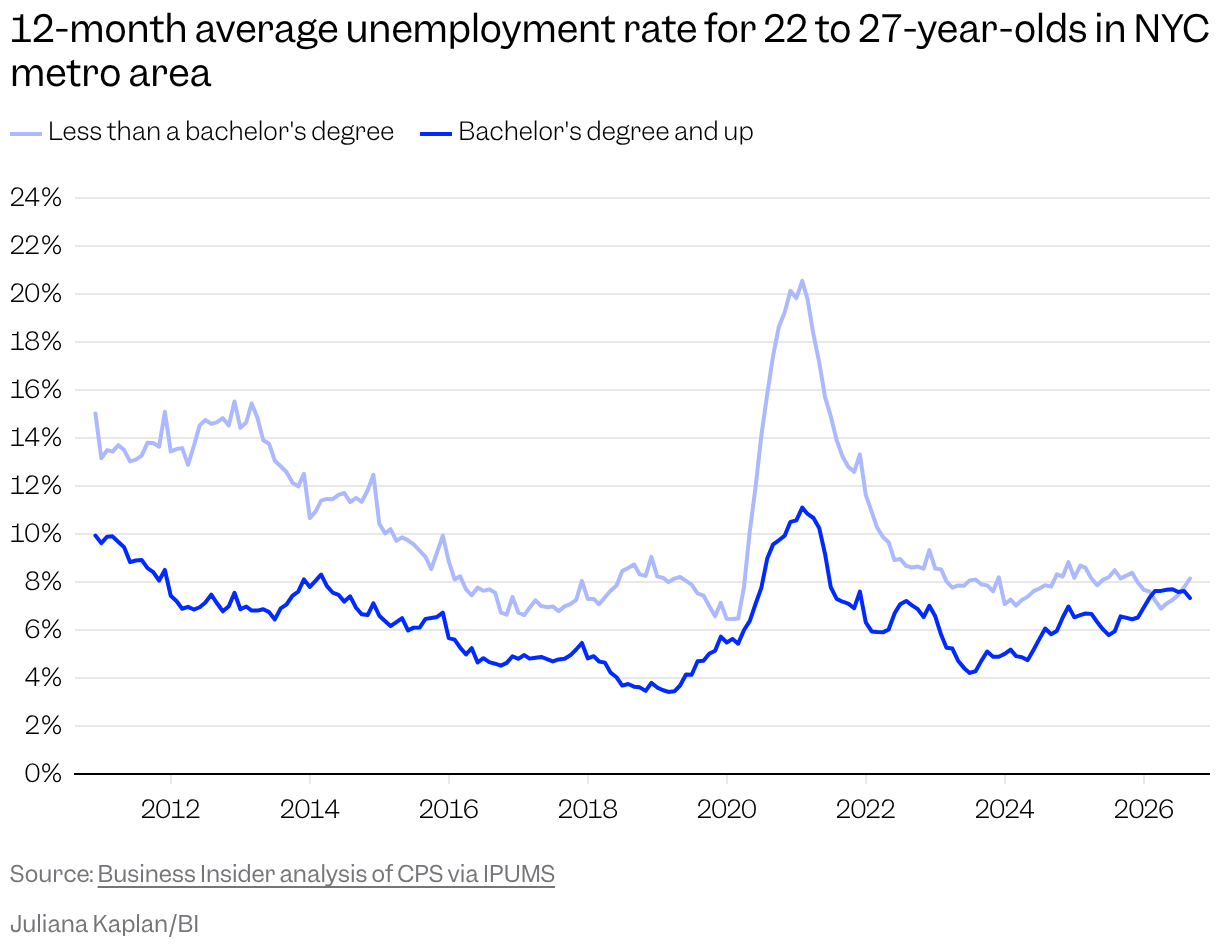
A May report from New York City Comptroller Mark Levine found that this was the "first time on record" young adults with a Bachelor's degree or higher experienced an unemployment rate slightly higher than that of those without a college degree.
This historic swap comes after an increase in the unemployment rate among recent graduates and a decrease in the unemployment rate among same-age adults without a degree, which has "historically been relatively high," according to the report.
The decline in New York's college degree premium comes in a broader low-hire, low-fire economy, where layoffs have remained low, and job openings have been fewer. That's especially true for industries hardest hit by AI, such as tech, where there's been a pullback in entry-level job openings.
"This is because technical skills—many supplanted by AI—have become less imperative, while soft skills and specialized company or industry-specific knowledge have become more so," said the report from the New York City Comptroller. That dynamic impacts young workers — who haven't had a chance to accumulate institutional knowledge — the most. On X, Levine highlighted the changing fortunes of the city's young workers as "one more possible sign that AI is already impacting employment in NYC."
That comes as more Americans question whether higher education is worth it, especially in the age of AI. A record low number of 31% of Americans consider college "very important," according to a Gallup poll released in October. The percentage of those who perceive going to college as "not too important" has increased by about the same level. The decrease was seen across demographic groups, including those who typically placed greater importance on college.
These shifts in perspective could be partially tied to the rising cost of college, according to the Gallup report. But, even if AI is making it harder to find a job, the college wage premium hasn't dissipated — it might just take younger workers longer to land those salaries.
Are you a young worker newly entering the labor market? Share your experience with a reporter at [email protected] or [email protected]
Read the original article on Business Insider