


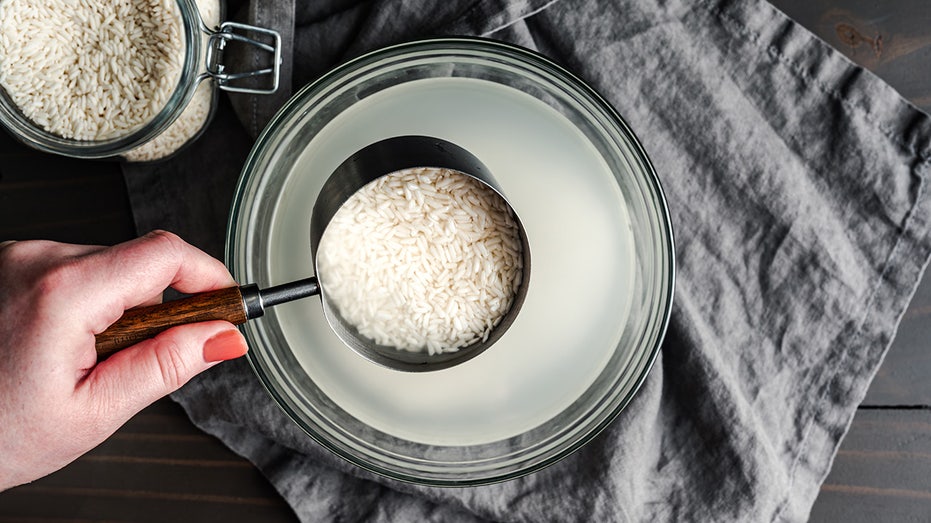
You're probably cooking rice wrong, and chefs reveal the simple mistake to avoid
Chefs reveal why rinsing basmati and jasmine rice before cooking is the key to fluffy, distinct grains that never clump together in the pot.
Rice may be a kitchen staple, but cooking it well at home can be trickier than it seems.
Experts say the trick to tender rice with distinct grains that stay separate instead of clumping together may begin before you even turn on the stove, with a step many home cooks skip.
"I generally rinse before cooking when I want a light, fluffy result," Dennis Littley, a New Jersey-based classically trained chef and founder of Ask Chef Dennis, told Fox News Digital.
FOUR FOODS YOU SHOULD NEVER STORE IN THE FREEZER — AND WHERE TO KEEP THEM INSTEAD
He recommends rinsing long-grain white rice, basmati and jasmine rice until the water goes from very cloudy to mostly clear. It doesn't need to be perfectly transparent, he said.
The rinse removes some of the loose surface starch that can make rice gummy or clumpy, Littley said. Then, drain it well so the water-to-rice ratio is not thrown off.
But chefs also note that not every type of rice should be treated the same.
CELEBRITY CHEF SAYS IF YOU CAN DRIVE TO MCDONALD'S, YOU CAN COOK HEALTHY MEALS AT HOME
"The important thing is to adjust your technique for the type of rice you're using rather than applying one method to every variety," Littley said.
Christine Pittman, the Florida-based founder and CEO of COOKtheStory, TheCookful and COOKforTWO, said she reserves the rinse for short-grain rice and for when she is cooking rice in a pressure cooker.
Littley and Pittman both suggest skipping the rinse for risotto, noting that the starch helps make the dish creamy.
THE BEST CHEESE FOR A BURGER, ACCORDING TO AN EXPERT — AND WHY SOME POPULAR PICKS FALL FLAT
A recent side-by-side test by Food & Wine found that rinsed and soaked basmati and jasmine rice were lighter and fluffier than unwashed rice, which clumped together. The test combined rinsing and soaking, not rinsing alone.
"I especially like soaking basmati rice for about 20 to 30 minutes before cooking," Littley said. "It helps the grains hydrate evenly and can give you longer, more distinct grains with a nice fluffy texture."
There are other ways home cooks can improve their rice, too.
CLICK HERE TO SIGN UP FOR OUR LIFESTYLE NEWSLETTER
Pittman recommends a little less than 2 cups of water for every 1 cup of long-grain white rice but says the amount varies by variety. For Japanese-style short-grain white rice, a rough stovetop starting point is 1 1/4 to 1 1/2 cups of water per cup of rice. Littley likewise advises following the package or recipe directions for the specific rice.
While brown rice can also be rinsed, its bran layer means it needs more water — about 2 cups per 1 cup of rice — and more time to cook.
Briefly toasting rice in a little oil or butter after rinsing and draining, but before adding liquid, can add a nutty flavor and help keep the grains defined, Littley said.
TEST YOURSELF WITH OUR LATEST LIFESTYLE QUIZ
Once the rice and cooking liquid are in the pot and the liquid comes to a boil, lower the heat to a gentle simmer and cover the pot, Littley said, and avoid lifting the lid or stirring while it cooks, Littley said. When the rice is done, take it off the heat and let it rest, covered, for five to 10 minutes before fluffing with a fork. Letting it rest allows moisture to redistribute for a more even texture.
Once the rice and cooking liquid are in the pot and the liquid comes to a boil, lower the heat to a gentle simmer, cover the pot and avoid lifting the lid or stirring while it cooks, Littley said. When the rice is done, take it off the heat and let it rest, covered, for five to 10 minutes before fluffing with a fork. Letting it rest allows moisture to redistribute for a more even texture.
For Pittman, the fluffing step is also crucial to good rice. She recommends fluffing it with a dinner fork, using a "gentle folding motion" to lift the rice from the bottom of the pot rather than stirring it vigorously.
CLICK HERE FOR MORE LIFESTYLE STORIES
"You're really only touching the bottom of the rice with your fork, and the rest of the rice on top is moving sort of like a little avalanche from the pressure of the fork underneath," she said.
If it's undercooked, Pittman said, add a little hot water, cover the pot and return it to low heat.
"Overcooked rice is bad, but my hot take is that undercooked rice is worse," she said.