Astronomers watched a star spiral to its death inside a giant companion
A recent brightening turned out to be from a star orbiting inside another.
A recent brightening turned out to be from a star orbiting inside another.
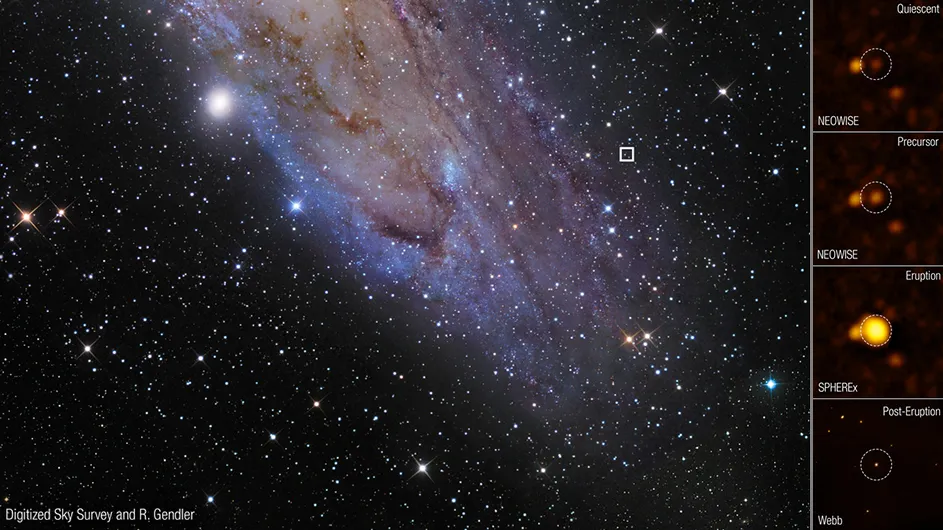
In the Andromeda Galaxy, a giant star about seven times as massive as the Sun spent nearly a decade slowly swallowing its much smaller companion. The process, known as common envelope evolution, was proposed in the 1970s to explain how some of the tightest pairs of stars in the Universe form, but no one had ever caught it in the act.
In a new Nature study, astronomers led by Viraj Karambelkar, an astrophysicist at Columbia University, finally witnessed the entire spectacle from the decades before it began to the eruption that ended it in late 2025. “It lasts for a few years, maybe a few decades,” Karambelkar said. “Stars evolve on time scales of millions of years. So, it's really like a blip on the entire cosmic time scale.”
Some pairs of stars orbit so close to each other that they could not have formed at that distance, so their orbits must have shrunk. Common envelope evolution is the leading explanation for that shrinkage. When one star in a binary grows old, it expands into a giant, and its outer layers can engulf its companion. The two then share a single, loosely bound envelope of gas. As the engulfed star drags through it, it loses orbital energy to friction and spirals inward. Depending on how much of the envelope gets lost, the pair either ends up in a much tighter orbit or merges.
This story was first published by Ars Technica. Read the original report
We use cookies to run this site and, with your consent, to measure traffic and improve our content. Necessary cookies are always on. You can accept all cookies or choose which ones to allow. Privacy policy.