New Orleans cruise ship disaster timeline reveals tanker's troubled past and frantic final minutes
The Atlantic Asphalt tanker lost steering just minutes before slamming into the docked American Heritage cruise ship in New Orleans on Friday.
The Atlantic Asphalt tanker lost steering just minutes before slamming into the docked American Heritage cruise ship in New Orleans on Friday.
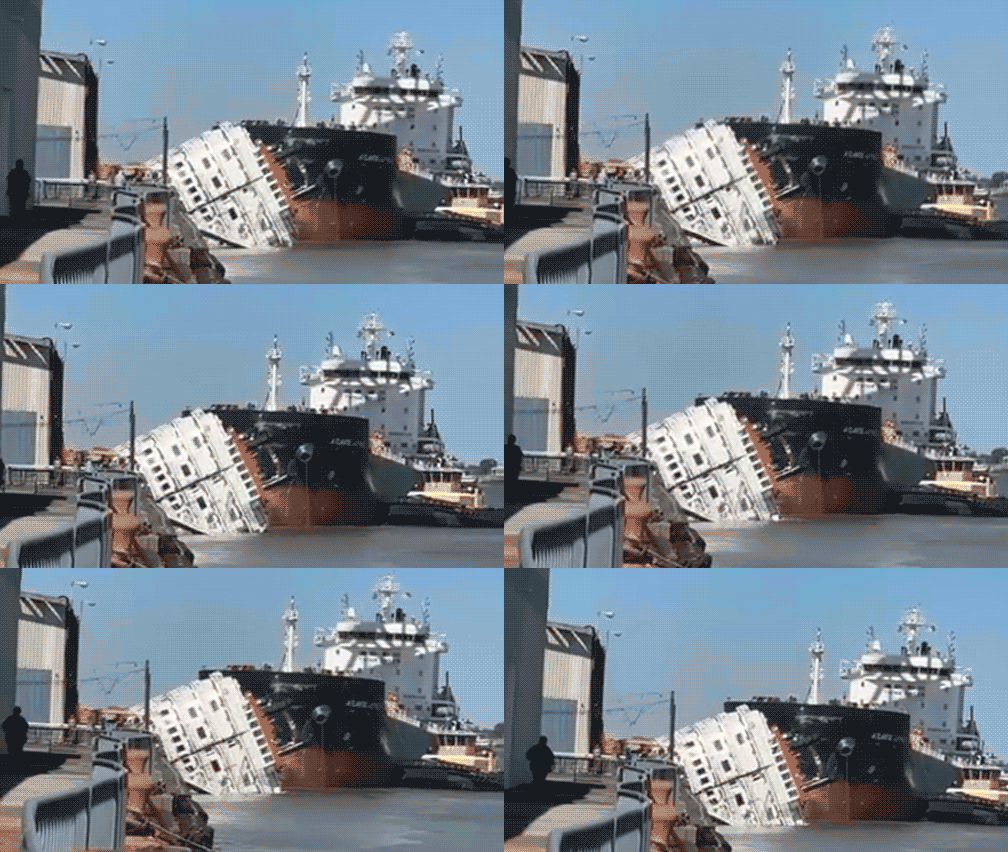
A timeline of Friday's horrific crash between a cruise ship and tanker in New Orleans reveals how the massive vessel lost steering control just minutes before slamming into a docked cruise ship, raising questions about the tanker's troubled safety history.
The collision between a cruise ship and tanker caused the passenger vessel to take on water before capsizing around 22 minutes later, which sent passengers and crew scrambling to get off the ship. While 32 people were hospitalized, no deaths were reported. Federal investigators are working to find out what caused the tanker's steering failure.
Here's a timeline of the New Orleans boat crash on Friday (All in Central Time):
The American Cruise Lines vessel arrived near the Port of New Orleans after completing a Mississippi River cruise that lasted several days. The boat was docked for two hours before the collision and was in the process of beginning to let passengers disembark, according to officials. Around 200 people were on the ship.
The Atlantic Asphalt, which carried 19 crew members and a local river pilot, departed from Lower 9 Mile Anchorage, located near Mississippi River mile marker 83.
Its destination was an oil facility in Reserve, Louisiana.
According to the NTSB, the tanker suffered a steering casualty which left its rudder fixed in the starboard position, causing the vessel to make a turn toward the Mississippi River's east bank.
It's not yet clear what caused the steering malfunction.
According to the NTSB, crew on the tanker issued various emergency commands such as a whistle, requests for assistance, commands to deploy anchors, emergency orders and radio warnings before colliding with the American Heritage.
FOLLOW THE FOX TRUE CRIME TEAM ON X
The Atlantic Asphalt collided with the American Heritage cruise ship near the Port of New Orleans.
Shortly after the tanker crashed into the American Heritage, it began taking on water as passengers and crew tried to evacuate. The ship also began to tilt toward the river's middle course.
TWO DEAD, INCLUDING INFANT, AFTER BOAT CAPSIZES IN NEW YORK HARBOR; 12 RESCUED
A massive rescue operation consisting of Coast Guardsmen, police, firefighters and other first responders also began, with other tugboats and commercial vessels also coming to assist.
CLICK HERE FOR MORE FROM THE FOX TRUE CRIME HUB
The American Heritage cruise ship capsized as it rolled onto its side and became partially submerged. According to the NTSB, the vessel capsized 22 minutes after the tanker first hit it.
All passengers and crew on the cruise were accounted for, with 32 people taken to local hospitals for non-critical injuries.
LISTEN TO THE NEW 'CRIME & JUSTICE WITH DONNA ROTUNNO' PODCAST
Friday's collision wasn't the first time the tanker came under scrutiny for safety issues.
The Atlantic Asphalt tanker was cited in June for faulty electrical wiring in the ship's pump room, according to records obtained by NOLA.com. In 2024, inspectors who boarded the ship found its rescue boats weren't prepared to launch effectively in an emergency.
In 2024, inspectors logged two breakdowns in the ship's navigation systems. In September 2024, the vessel "experienced loss of communication between the bridge and main engine," according to Coast Guard officials in Wilmington, Delaware.
Two months prior to that, the automatic pilot system malfunctioned as it approached Baltimore.
This story was first published by Fox News - Latest. Read the original report
We use cookies to run this site and, with your consent, to measure traffic and improve our content. Necessary cookies are always on. You can accept all cookies or choose which ones to allow. Privacy policy.