The 10 states set to build the least housing in the coming years
US housing permits data from shows Alaska, Connecticut and Illinois lag in building permit issuing, risking higher home prices by 2028.
US housing permits data from shows Alaska, Connecticut and Illinois lag in building permit issuing, risking higher home prices by 2028.
Marli Miller/UCG/Universal Images Group via Getty Images
Some states across America need to pick up the homebuilding pace — or housing prices could catch up to them.
From January to August 2026, the US national average for housing permits — indicating how many housing units are approved to be built — was 2.83 units per 1,000 residents, according to an October research report from the Lied Center for Real Estate at the University of Nevada, Las Vegas.
The report provides insights into what the housing market could look like in 2028 and 2029, as these approved permits come online as available housing units, said Nicholas Irwin, coauthor of the report and research director at the Lied Center for Real Estate. Across the country, some states lag behind the national average, which could drive up housing prices in the near future as housing supply fails to catch up with demand.
"If you don't add supply, and demand keeps growing as more people move in and more households are formed, it just puts upward pressure on prices," Irwin said.
Here are the states that are issuing permits at the lowest rate per 1,000 residents.
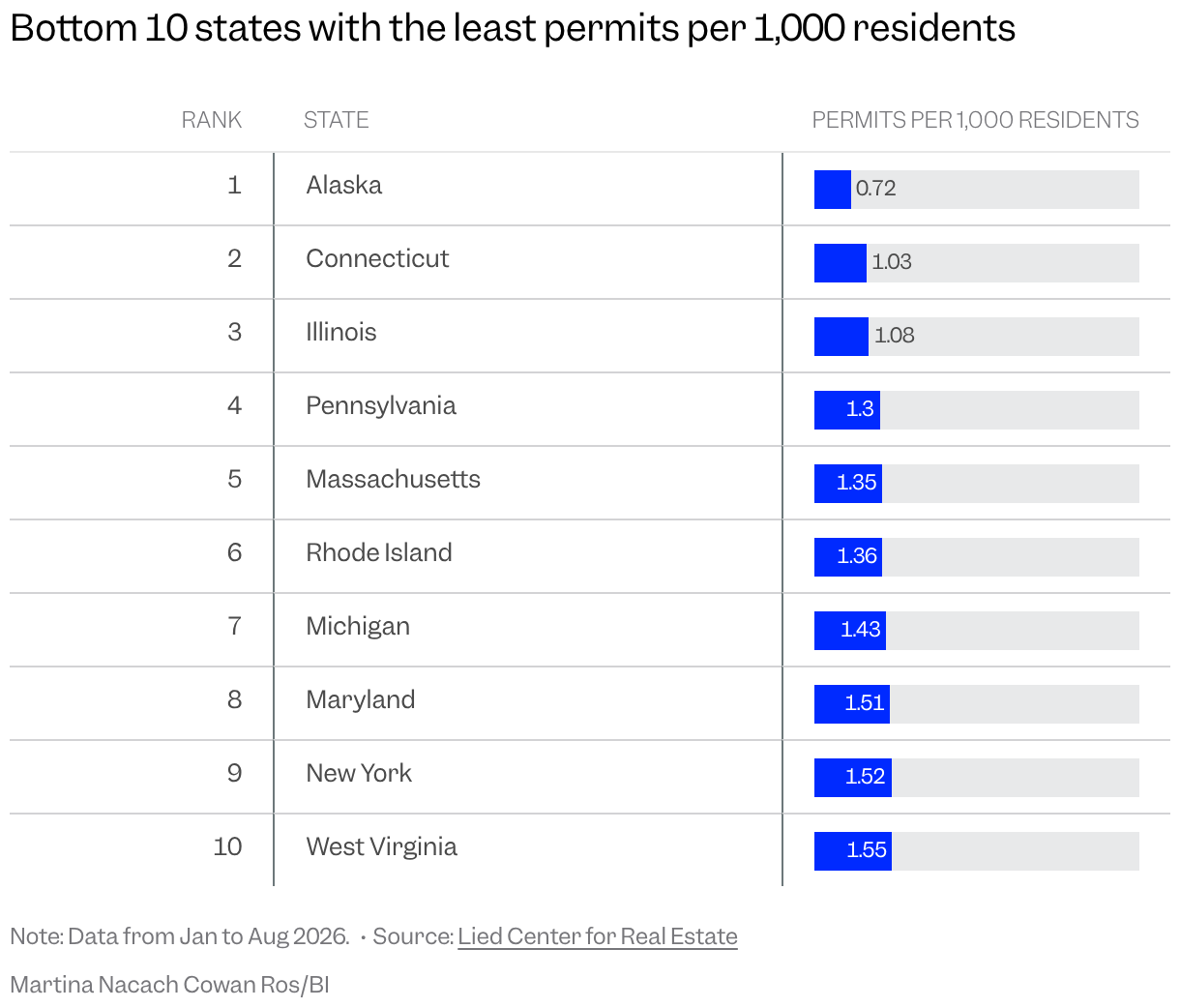
The states lagging in issuing building permits could face growing affordability concerns, especially those falling short of projected household growth, another measure included in the report.
"If we are already at a lag in some of these states — your Nevadas, your Connecticut's, Maryland's — when it comes to building, that's just going to exacerbate currently experienced affordability concerns for each of those states' residents," Irwin said.
Alaska was the state with the lowest ranking, standing at 0.72 permits per 1,000 residents, after only 528 units were approved from January through August 2026, 75% below the national rate, the report said. Its permit acceptances have also declined year-over-year, down 8.3% from the same period in 2025 and 12.3% from 2023.
Connecticut was ranked the second-lowest state in number of permits per resident in the US, as it approved 3,799 permits, 64% below the national rate. This rate is 17.7% less than during January to August of 2025, and 9.3% lower than the same period in 2023. It was the lowest-ranked state in the report's overall housing supply pipeline rankings — performing poorly across four metrics, including the permit rate per 1,000 residents.
Regarding the overall ranking, Irwin said some states are struggling on all fronts.
"Nevada, Alaska, Connecticut, North Dakota, Maryland are all doing really poorly, and they're doing poorly no matter how much we weigh our different four pillars," Irwin said.
West Virginia was ranked the 10th-lowest state in building permits per resident, at 1.55, 45% below the US average. Overall, it ranked 22nd in the report, with mixed performance across metrics.
While its overall number of permits per resident lagged behind other states, its pace of permits relative to household growth was the third-highest in the nation — meaning permitting is outpacing its projected household growth by 5.72. This is because the number of households is projected to shrink in West Virginia, according to the report.
Irwin said there are some states that "no matter how you weigh" them consistently end up at the top or bottom of the rankings.
"No matter how you look at the data, the building permit regime and how housing is being constructed in these areas is falling way behind of what's needed," he said. "Our main thing, if we can give anything, is just build more housing, build all types of housing."
Read the original article on Business InsiderThis story was first published by Business Insider. Read the original report
We use cookies to run this site and, with your consent, to measure traffic and improve our content. Necessary cookies are always on. You can accept all cookies or choose which ones to allow. Privacy policy.