Unemployed Gen Zers don't think they can land a new job. Good news: They're wrong.
Workers used to have a good handle on how quickly they'd be able to find a new job. Now they underestimate themselves.
Workers used to have a good handle on how quickly they'd be able to find a new job. Now they underestimate themselves.
MementoJpeg/Getty Images
If you're out of work and believe the outlook for a new job is too dreary, you're probably being overly pessimistic.
That might sound like something your mother would say, but new data shows that, since the pandemic, newly-unemployed Americans aren't very good at assessing how easily they'll get rehired — especially younger workers.
An analysis from the New York Federal Reserve's Liberty Street Economics blog looks at how workers' expectations of finding a new job stacked up against reality.
Before 2020, Americans were pretty good at predicting their employment prospects; the expected job-finding rate and the actual job-finding rate tracked closely together, according to the authors' analysis of the Current Population Survey and the Survey of Consumer Expectations. It follows newly unemployed workers, who have been jobless and looking for four weeks or fewer, and their actual success at finding a new role.
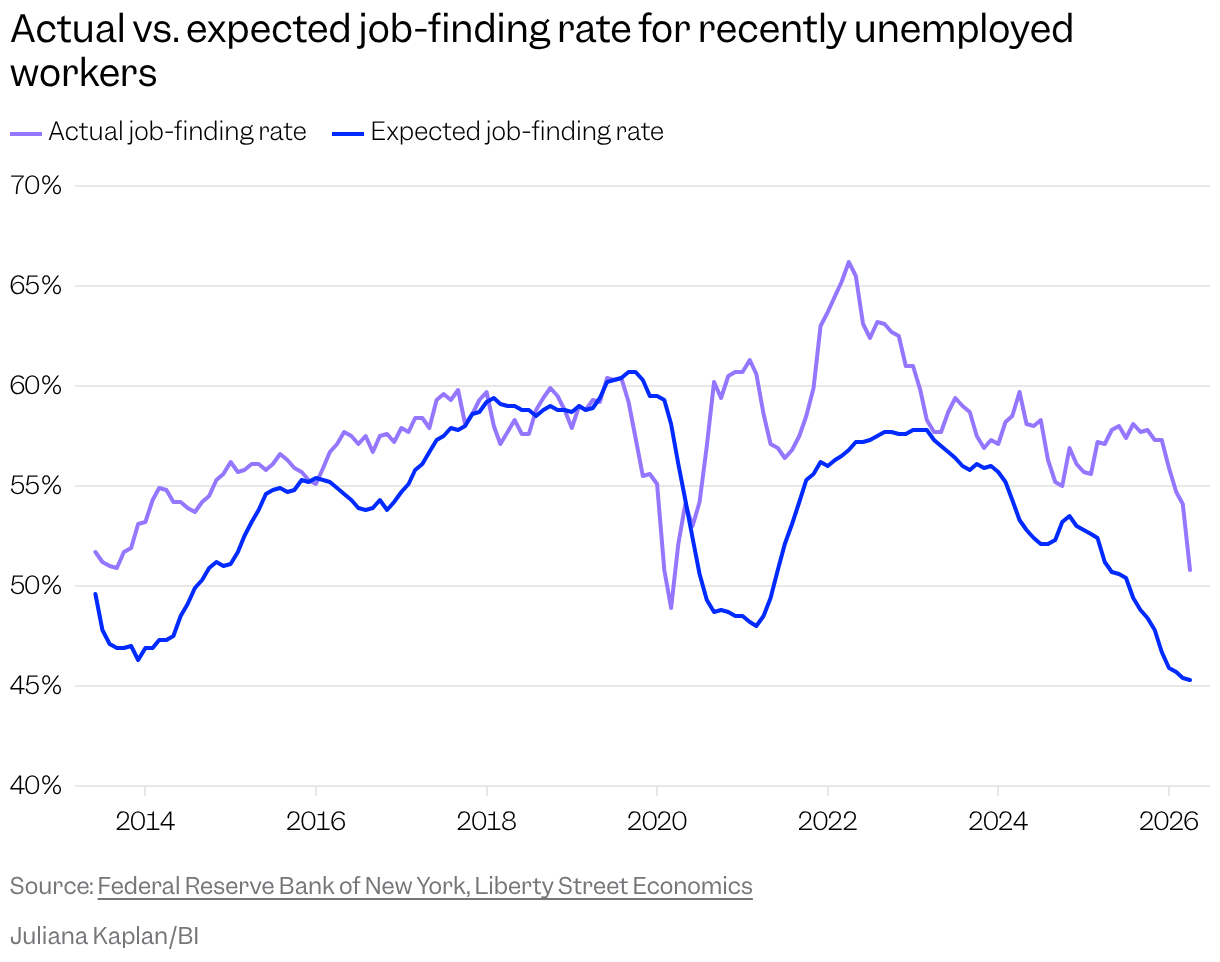
But when the pandemic hit, workers' expectations of how easy it is to find a job diverged from reality, and haven't come back in line. In other words, workers are far too pessimistic about their ability to find a job. That's being driven especially by younger workers under 30.
Before the pandemic, younger workers actually felt overconfident about their ability to find a job, tracking above their actual results.
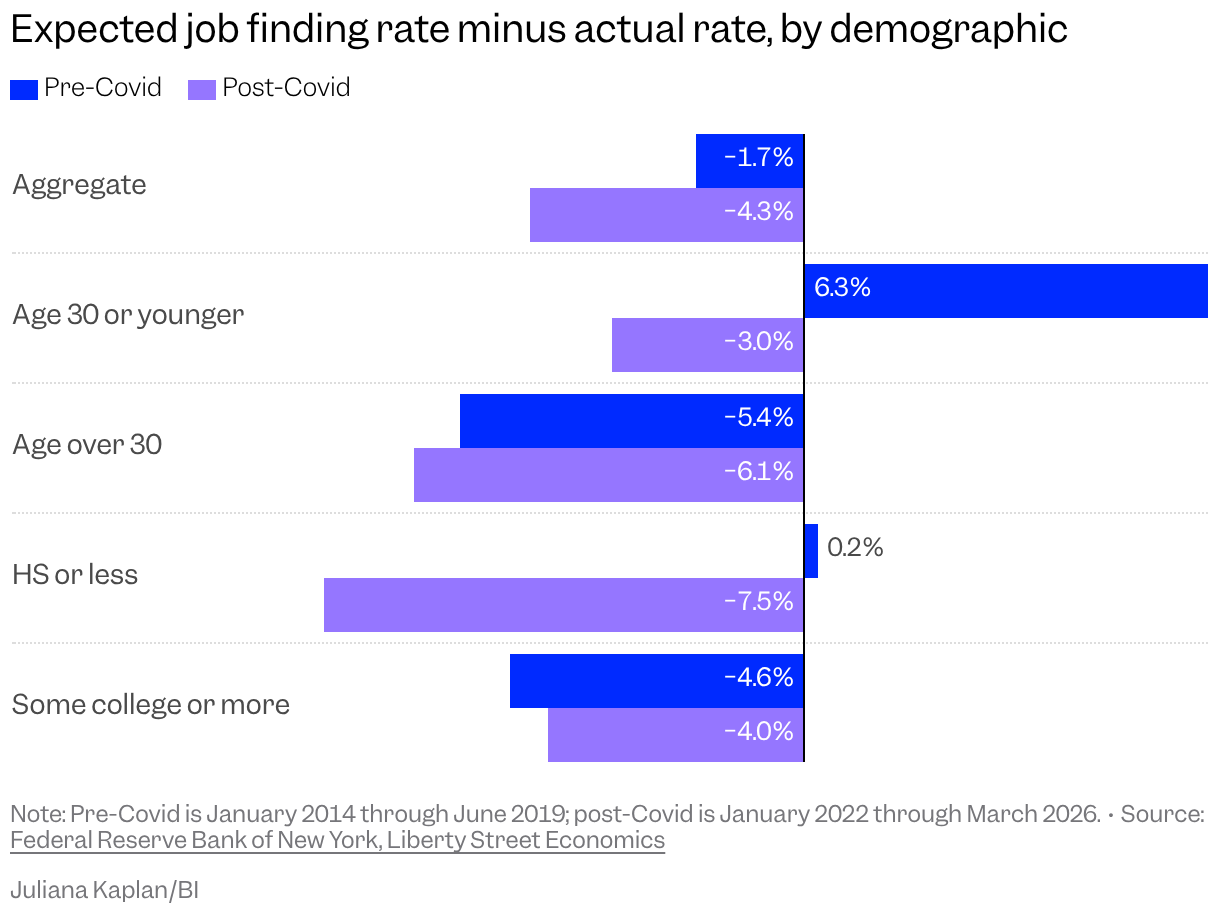
But after the pandemic, that optimism soured drastically. Workers under 30 went from overstating their expected job-finding rates by 6.3 percentage points to understating them by 3 percentage points. That might stem from pandemic-era labor market scars; Gen Z workers were disproportionately laid off in the immediate onset of the pandemic, with 25% of workers ages 16 to 24 in 2020 losing their jobs. Now, when Gen Z loses a job, they're much more likely to think they won't land a new role — even though that's not the reality.
It's not just younger workers feeling unduly shaky about their stability. Tenured workers — who were likely further ahead in their careers than that younger group — are still worried about losing their roles.
The New York Fed analysis finds another mismatch there: Historically, the longer a worker stays in the job, the less likely they are to lose that job. But workers don't feel that way — after two years, the actual job loss rate is half of the perceived job loss rate. In other words, workers are much more likely to keep their jobs after spending time in those roles, but they don't feel that way. That may be yet another layoff scar shaping workers' perceptions of their own standings. It might also be driven by another recession-battered generation.
Millennials were more likely to face layoffs in the comedown from the post-pandemic, zero-interest-rate hiring spree. Those scars might show up now in how likely they think they are to lose their jobs — even if they're likely pretty secure.
Read the original article on Business InsiderThis story was first published by Business Insider. Read the original report
We use cookies to run this site and, with your consent, to measure traffic and improve our content. Necessary cookies are always on. You can accept all cookies or choose which ones to allow. Privacy policy.