


House Democrats vote to continue DHS shutdown despite Iran threat, Noem's ouster
House Democrats largely voted against funding the Department of Homeland Security, despite the heightened threat situation amid the U.S. military operation in Iran.
House Democrats largely voted to allow the Department of Homeland Security (DHS) shutdown to keep going on Thursday, shrugging off Republicans' concerns about the increased domestic terror threat amid the U.S.-Israeli operation in Iran.
It comes hours after President Donald Trump shocked Capitol Hill by ousting DHS Secretary Kristi Noem and appointing Sen. Markwayne Mullin, R-Okla., as his replacement.
But that did not stop the vast majority of Democrats from voting against a bipartisan DHS funding bill aimed at funding the cabinet agency through Sept. 30, the end of the fiscal year.
Nearly identical legislation already passed the House in January, but House GOP leaders wanted to force the vote again in light of heightened national security concerns within the country's borders.
MCCARTHY URGES DEMOCRATS TO ‘DO YOUR JOB’ AS DHS FUNDING STALL HEIGHTENS SECURITY CONCERNS
While largely symbolic, it shows Republicans' pressure strategy is falling on deaf ears as the left continues to protest President Donald Trump's strategy to combat illegal immigration.
The bill was the product of original bipartisan negotiations that followed the longest-ever full government shutdown in U.S. history, which ended in November after 43 days.
It would fully fund all aspects of DHS while also including new guardrails on Immigration and Customs Enforcement (ICE) demanded by Democrats, like a body-worn camera mandate and new required training on public engagement and de-escalation.
But Democrats walked away from the deal en masse amid fallout from Trump's immigration crackdown in Minnesota, which saw two U.S. citizens shot and killed by federal agents during anti-ICE demonstrations there. The operation has since ended.
Democratic leaders are still insisting on withholding their caucus' support, however, until further restrictions are put on ICE and Customs and Border Protection (CBP) agents on the ground in various cities.
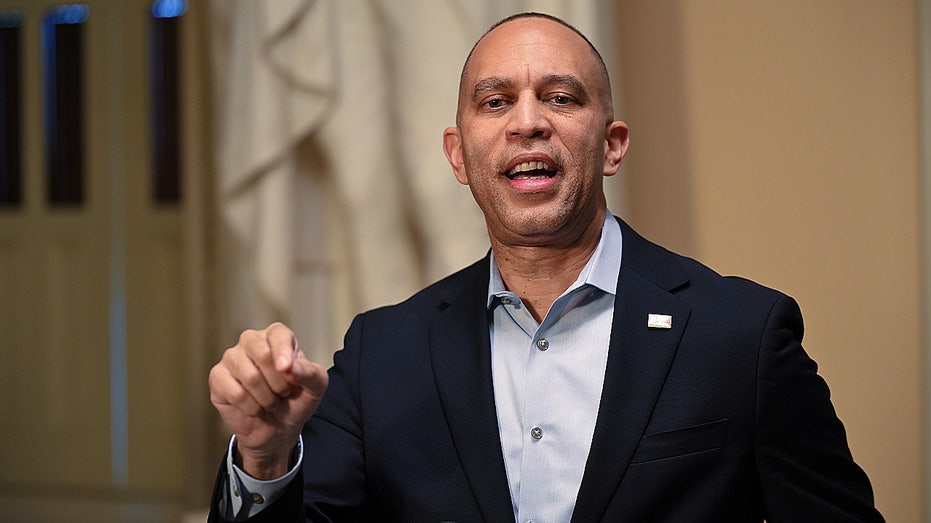
And House Minority Leader Hakeem Jeffries, D-N.Y., signaled to reporters that Noem's ouster was not enough.
"It's not like Kristi Noem was the one who was involved in negotiating anything. She was a corrupt lackey. So we were dealing with the White House before, and we're going to continue to deal with the White House at this point," he said.
Meanwhile, the resulting DHS shutdown has taken on new significance as the U.S. continues its campaign to take out Iran's top leadership and its military sites.
Republican leaders are warning that keeping DHS in a shutdown state is dangerous for national security, given its jurisdiction over agencies that monitor threats from home and abroad.
SWALWELL PRESSED ON DEMOCRATS' RESISTANCE TO FULLY FUNDING DHS AMID IRAN THREAT
"Now is the time to be vigilant at home and to ensure that all of our doors are locked, so to speak," Speaker Mike Johnson, R-La., said during a press conference Wednesday. "And yet, as all this is happening, we have Democrats running around here playing political games in Congress. It's infuriating. They've shut down the very agency that is responsible for securing the homeland."
House Minority Leader Hakeem Jeffries, D-N.Y., called Republicans' argument "insane" when asked by Fox News Digital earlier this week.
"Donald Trump launches an unauthorized war in the Middle East. … He decides that he wants to spend billions of dollars to bomb Iran, rather than spend taxpayer dollars to lower the grocery bills that are crushing the American people, and then wants to use his unauthorized war as an excuse to continue spending taxpayer dollars to brutalize or kill American citizens by continuing to unleash ICE without restriction on the American people?" Jeffries posed. "I think it's ridiculous."
It's the Senate, however, where passing that DHS funding bill is actually key to ending the shutdown. The upper chamber voted again Thursday on the original legislation that passed the House in January, but it failed to reach the 60 votes necessary to overcome a filibuster.