


Palantir executive says AI enabling rapid battlefield planning and high-speed US strike operations
Palantir CTO Shyam Sankar describes AI military tech as an "Iron Man suit" for troops, saying human judgment still drives all battlefield decisions.
AI-powered battlefield technology is enabling the U.S. and its allies to carry out military operations faster and more efficiently than ever before, Palantir CTO Shyam Sankar said Monday, pointing to the Iran conflict as evidence of a seismic shift in modern warfare.
"The planning that happened was done in a fraction of the time it would have taken in prior conflicts of this scale, and we accomplished more than twice as much per day of strikes," Sankar told "America's Newsroom."
"How do you do 2,000 strikes in 48 hours?" he asked. "It’s the sophistication of the technology, combined with service members who are better than we deserve. It has proven the deterrent capability."
Questions about precision have surfaced following reports of a strike that hit an Iranian girls’ school, killing over 100 civilians.
PENTAGON’S AI BATTLE WILL HELP DECIDE WHO CONTROLS OUR MOST POWERFUL MILITARY TECH
The Trump administration has said the strike was carried out by Iranian forces, but a Department of War (DoW) investigation into the incident is ongoing.
When asked about the incident, Sankar largely deferred to the DoW investigation, but noted technology's history of "[reducing] collateral damage."
"We forget that in World War II, only 6% of bombs dropped actually hit their target," he said.
ALL 4 IRAN WAR ASSUMPTIONS DEAD WRONG — TRUMP PROVES EXPERTS GOT FOOLED AGAIN
"There were 50,000 French civilians that were killed in the prep fires for Normandy, so... if I was to speculate… the investigation will show that actually the incorporation of more sophisticated technologies would prevent collateral damage."
AI-enabled systems, Sankar continued, allow military planners to quickly develop and refine operations, increasing both the speed and efficacy of modern combat.
"Instead of [having] a period of execution, instead of maybe one attempt at coming up with a plan, you have 30 attempts because of the leverage that you have from technology to do it, so you have a more refined plan, a more accurate plan, a more lethal plan that accomplishes your operational objectives," he said.
While advanced technology is playing a growing role on the battlefield, Sankar also emphasized that decision-making authority still relies on human judgment, describing the relationship between human and technology as a collaborative partnership rather than a replacement.
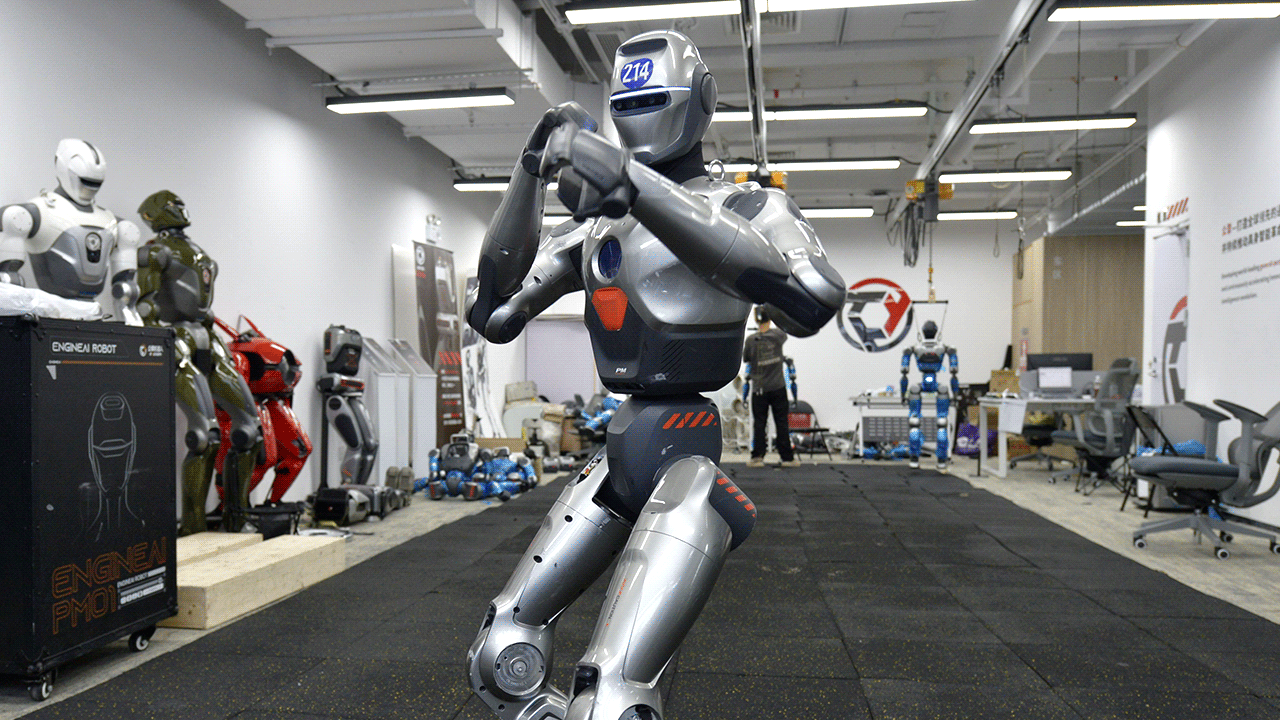
"I think a better way of thinking about it rather than a back and forth is Luke Skywalker and R2-D2. It's a team. You're building a team of human computer symbiosis. It's an Iron Man suit for our uniform service members to get more done," he said.