


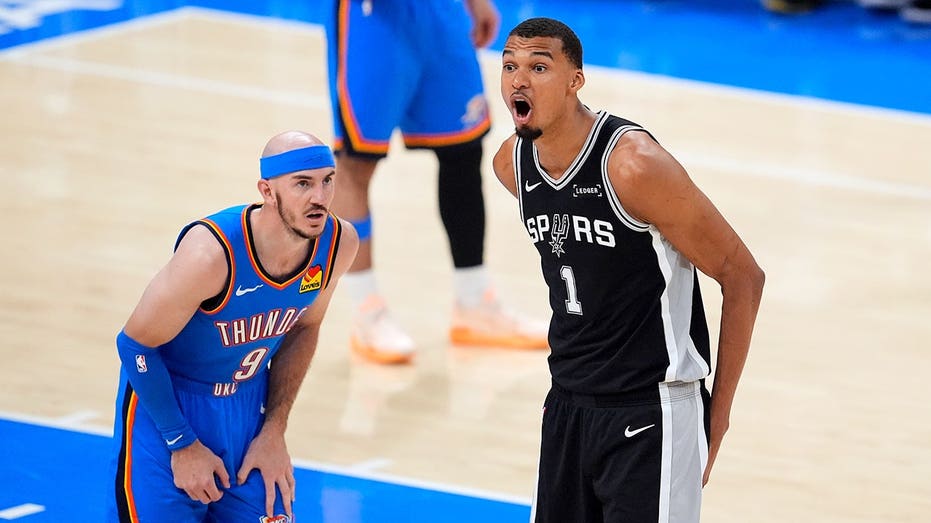
Can Victor Wembanyama be the true face of the NBA as a European? | Bobby Burack
At just 22, Victor Wembanyama led the Spurs to an upset playoff win with a historic performance that positions him as the NBA's next great superstar.
Of the NBA's many struggles in recent years, the lack of a true face-of-the-league player for the next decade ranks near the top.
By every meaningful metric, LeBron James remains the NBA’s most popular (and polarizing) player. The problem is that James turns 42 this year, has not seriously competed for a championship in more than five seasons, and is likely entering the final season of his career. At this stage, he is no longer a top-10 player in the league.
While the NBA has continued to cling to stars from the previous era, other major sports leagues have transitioned seamlessly to a new generation of superstars. The NFL has Patrick Mahomes. MLB has Shohei Ohtani. The WNBA, despite its efforts to bury her, has Caitlin Clark. Even golf has Scottie Scheffler.
READ MORE OF BOBBY BURACK'S COLUMNS HERE
The NBA, meanwhile, has struggled to turn its best current players into true mainstream cultural attractions, whether it be Nikola Jokic, Shai Gilgeous-Alexander, Luka Doncic, Giannis Antetokounmpo or Anthony Edwards.
The league may have finally found its answer.
On Monday night, Victor Wembanyama showcased his audition as the best player in basketball at just 22-years-old. He led the Spurs to an upset Game 1 victory over the defending champion Thunder with a historic 41-point, 24-rebound performance. Defensively, he completely warped the game with his length, timing, and shot-blocking instincts.
At 7-foot-4, Wembanyama is perhaps best described as Wilt Chamberlain meeting Bill Russell, except with a jump shot. He can score in the paint and from 28 feet away.
No, seriously:
It is hardly hyperbolic to say Wembanyama is still an unfinished product with the talent to become one of the more dominant players in basketball history. No player has ever looked like this or played this way, statements previously reserved only for the likes of Shaquille O’Neal and LeBron James.
The question is whether he can eventually reach that same level of stardom as James and Shaq on and off the court.
The challenge is that he is from France. As OutKick recently documented, NBA fans and players alike have been reluctant to embrace European stars. Former players Kendrick Perkins and Gilbert Arenas have openly admitted that American-born athletes are territorial about European players encroaching on their space.
National identity matters especially in the NBA, where superstardom is driven as much by commercials, social media influence and cultural relevance as it is by on-court production.
Sports media reporter Ryan Glasspiegel observed after Game 2 that "Wemby is going to test the two obstacles for NBA superstardom at once: whether America can actually get behind a foreigner and a behemoth."
I think the answer is yes.
For one, Wembanyama is Black.
Jokic and Doncic did not just have to overcome resistance toward European players. They also faced an undeniable racial component in how they were discussed and perceived. That is not conjecture.
SPORTS MEDIA RACE-BAITERS ARE ALREADY TAKING NIKOLA JOKIC CRITICISM TOO FAR
Consider the animosity Caitlin Clark has faced solely because of her skin color. In 2023, Kendrick Perkins attempted to convince ESPN viewers that Jokic was viewed as an MVP candidate only because White players are graded on a curve. ESPN also published a highly misleading article referring to Jokic as the "latest great white hope" after he won his first championship. Opposing players have referred to Doncic on the court as a "b---- ass white boy."
Naturally, the racialization of Jokic and Doncic, and Dirk Nowitzki before them, has influenced how portions of the NBA audience, particularly within the league’s sizable African American fan base, perceive those players.
As a Black player, Wembanyama won't have to deal with the same level of racism from fans, players and analysts as Jokic. Therefore, the conversation surrounding him should be less divisive from the outset.
He also plays a significantly more electrifying brand of basketball than most international stars. Jokic and Doncic rely more on skill, pace and intellect than overwhelming athleticism or raw physical dominance. Wembanyama’s game is visually intoxicating, from his engulfing blocks to offensive moves that pay homage to legends like Kareem Abdul-Jabbar and Hakeem Olajuwon.
Put simply, Wembanyama is built for the SportsCenter Top 10, assuming that still exists.
Further, he appears to have a genuine edge to him on the court. He clearly took it personally having to defend Chet Holmgren and Shai Gilgeous-Alexander on Monday night. He outplayed both of them.
However, he does need to stay out of political crosshairs.
Data points show that the NBA and many of its stars lost popularity in 2020 when the league openly embraced far-left political activism. LeBron James, specifically, has never fully regained the broad public support he enjoyed before trying to become an activist figure.
Earlier this year, Wembanyama spoke out against Immigration and Customs Enforcement (ICE).
"PR has tried, but I’m not going to sit here and give some politically correct [answer]," he told reporters in January. "Every day I wake up and see the news, and I’m horrified. I think it’s crazy that some people might make it seem like or sound like the murder of civilians is acceptable."
Notably, there is no evidence that ICE has "murdered" civilians, which carries a specific legal definition.
For the sake of both the NBA and his own stardom, Wembanyama would be wise to stick to sports and avoid unnecessarily cutting his potential fan base in half.
If he does, he has the potential to become exactly what the NBA has spent years searching for: its next true face of the league.