


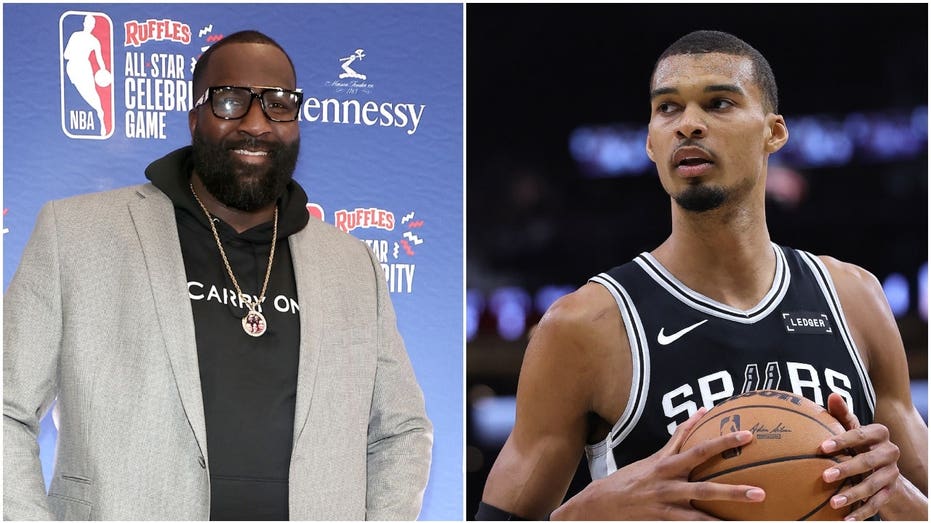
Kendrick Perkins accidentally exposed the NBA's biggest problem during ESPN's 'First Take'
Victor Wembanyama's playoff dominance highlights what ESPN analyst Kendrick Perkins calls the NBA's international takeover and its impact on American fans.
Kendrick Perkins said the quiet part out loud during ESPN's First Take on Wednesday.
The NBA analyst was discussing Victor Wembanyama after the San Antonio Spurs star once again reminded everyone that he is not a normal human being (don't call him an alien unless you want Stan Van Gundy to scold you).
The 2023 No. 1 overall pick scored 27 points, grabbed 17 rebounds and added five assists and three blocks to lead the Spurs to a Game 5 win over the Minnesota Timberwolves, 126-97, on Tuesday night. The victory put San Antonio one win away from a trip to the Western Conference Finals.
Wembanyama is 7-foot-4, handles like a guard, shoots threes, and blocks shots. He already looks like the best two-way player in the league. He's truly unlike anything basketball fans have ever seen, arguably a better Giannis Antetokounmpo than, well, Giannis Antetokounmpo.
That led Perkins, who has had some really terrible opinions in the past, to reach an interesting conclusion.
The NBA belongs to international players.
"I thought American basketball was catching back up," Perkins said. He argued that Antetokounmpo's injury issues and Nikola Jokic's slight decline this season (in Perkins' view) provided an opening for Americans to step back into the spotlight over a pair of foreigners who have dominated the league in recent years.
Then came Wembanyama.
"And then all of a sudden, Wemby comes along in this postseason and last night in particular, and shows us that no, it still belongs to the international players," Perkins said. "The international players have completely taken over our league."
It's not often I find myself agreeing with Perkins, but this is one of those times. However, he didn't go far enough. He accidentally identified one of the NBA’s biggest problems.
Perkins continued by rattling off the recent MVP winners: Shai Gilgeous-Alexander, Nikola Jokic, Joel Embiid, Jokic again, Jokic again, Giannis Antetokounmpo and Giannis Antetokounmpo again. An American-born player hasn't won the league's MVP award since 2018 (James Harden). It's not likely to happen this season, either, with SGA the overwhelming favorite to capture the award for the second consecutive season.
The ESPN analyst then added that Wembanyama is going to be the best player on the floor "on both ends" for the next decade and is likely to add his name to the foreign-born MVP list in the near future.
Again, he’s probably right.
And that’s a problem for the NBA in America.
Not because international players are bad. Quite the opposite. They have brought a ton of skill to the league and the game of basketball in general, including college hoops. That’s great for the NBA globally. But it’s not great for the league domestically (although, foreign money pads the bank account just the same, so the league might not even care).
Americans like rooting for Americans. This is not complicated, even though people in sports media love pretending that it is.
ZERO BS. JUST DAKICH. TAKE THE DON’T @ ME PODCAST ON THE ROAD. DOWNLOAD NOW!
Look at hockey. For decades, hockey struggled to grab the average American sports fan because it never really felt like an American sport. It was dominated by Canadians, Russians, Swedes, Finns and Czechs. Great players. Great sport. But for many casual American fans, it didn’t feel like ours.
Then Team USA beat Canada for Olympic gold, and suddenly the entire conversation changed. Matthew Tkachuk, Jack Hughes, Connor Hellebuyck and the rest of the American stars didn’t just win. They made Americans feel like hockey belonged to them, too.
That matters.
The NHL didn’t fundamentally change overnight. The rules didn’t change. The ice wasn’t any bigger. The puck wasn’t any easier to follow. But once Americans saw American stars beating Canada at its own game, the sport felt different. And TV ratings have shown that the Olympics bump increased American interest in the NHL.
The NBA is dealing with the opposite problem.
For years, the NBA had a very easy domestic marketing formula: sell American greatness.
Magic Johnson. Larry Bird. Michael Jordan. Shaquille O’Neal. Kobe Bryant. LeBron James. Steph Curry. Kevin Durant. Dwyane Wade. Charles Barkley. Allen Iverson.
Yes, the league had international stars mixed in, and some were great players. But the face of the league was almost always American. More specifically, the NBA’s cultural power was built largely through black American superstardom.
That’s why one of the laziest narratives in basketball has always been that the NBA, or NBA media, secretly wants more European stars because some of them are White.
That's patently false and not supported by a shred of evidence.
Do people really think American fans preferred Nikola Jokic because he’s white over LeBron James, Steph Curry, Kobe Bryant, Allen Iverson or Anthony Edwards? Come on. That's easy to disprove because when Jokic's Nuggets won the NBA Finals in 2023, it was one of the lowest-rated series ever (excluding the years affected by COVID). When Curry's Warriors were dominating the league, NBA Finals games were averaging nearly 20 million viewers.
In addition, some of the best international players in the league aren’t white. Wembanyama is black. Giannis is Black. Embiid is black. Shai is black. This isn’t a "white European" takeover. It’s an international takeover.
Second, American fans have always connected more with American stars, regardless of race. Black American NBA stars (really, all elite black athletes) have been among the most famous, popular and marketable athletes in the history of this country. Michael Jordan and Tiger Woods are two of the most recognizable figures in American pop culture.
The issue isn’t race.
The issue is connection.
Wembanyama, Jokic, Luka Doncic and Giannis are incredible athletes.
But they don’t feel like American sports heroes. Because they aren't.
That might make some people uncomfortable. It shouldn’t. It’s just reality.
Sports fandom is tribal. It’s regional. It’s national. It’s emotional. And in the United States, fans still want a reason to feel like the league belongs to them.
Perkins captured that with one phrase: "our league."
He didn’t say "the league." He said "our league."
For many American basketball fans, the NBA increasingly doesn’t feel like "our league" at the very top. It feels like a global league that happens to play most of its games in the United States.
Maybe the NBA is fine with that. Maybe Adam Silver and league executives look at international growth, global merchandise sales and streaming numbers and shrug. Maybe they believe losing a bit of American cultural attachment is worth gaining a larger worldwide footprint.
That’s a business decision.
But don’t act confused when the average American sports fan doesn’t feel the same attachment to a league where the best player conversation is dominated by a Serbian, a Slovenian, a Greek-Nigerian, a Frenchman, a Cameroonian and a Canadian.
As good as they are, they’re not American-born.
And that matters in the United States.
CLICK HERE FOR MORE OUTKICK SPORTS COVERAGE
"There is no hope for us to take over our league," he said. "There is no hope whatsoever, at least for the next 10 years, for us to get our league back."
That’s a wild thing to hear from an ESPN NBA analyst.
It’s also the truth.
Wembanyama isn’t the NBA’s problem. He might be the future of basketball from a gameplay and talent perspective.
But if the future face of the NBA is not an American star, then the league has to accept what comes with that.
Global relevance might go up.
American emotional investment might not.
And for a league built in America, that’s a bigger problem than many are willing to admit.