

TikTok's middle class is gaining power
"Micro" creators on TikTok have seen a dramatic uplift in the fees they charge brands for partnership deals. Bigger creators didn't fare so well.
Ulet Ifansasti/Getty Images
- A version of this post appears in the CMO Insider newsletter.
- You can sign up for Business Insider's weekly marketing newsletter here.
The TikTok middle class is thriving.
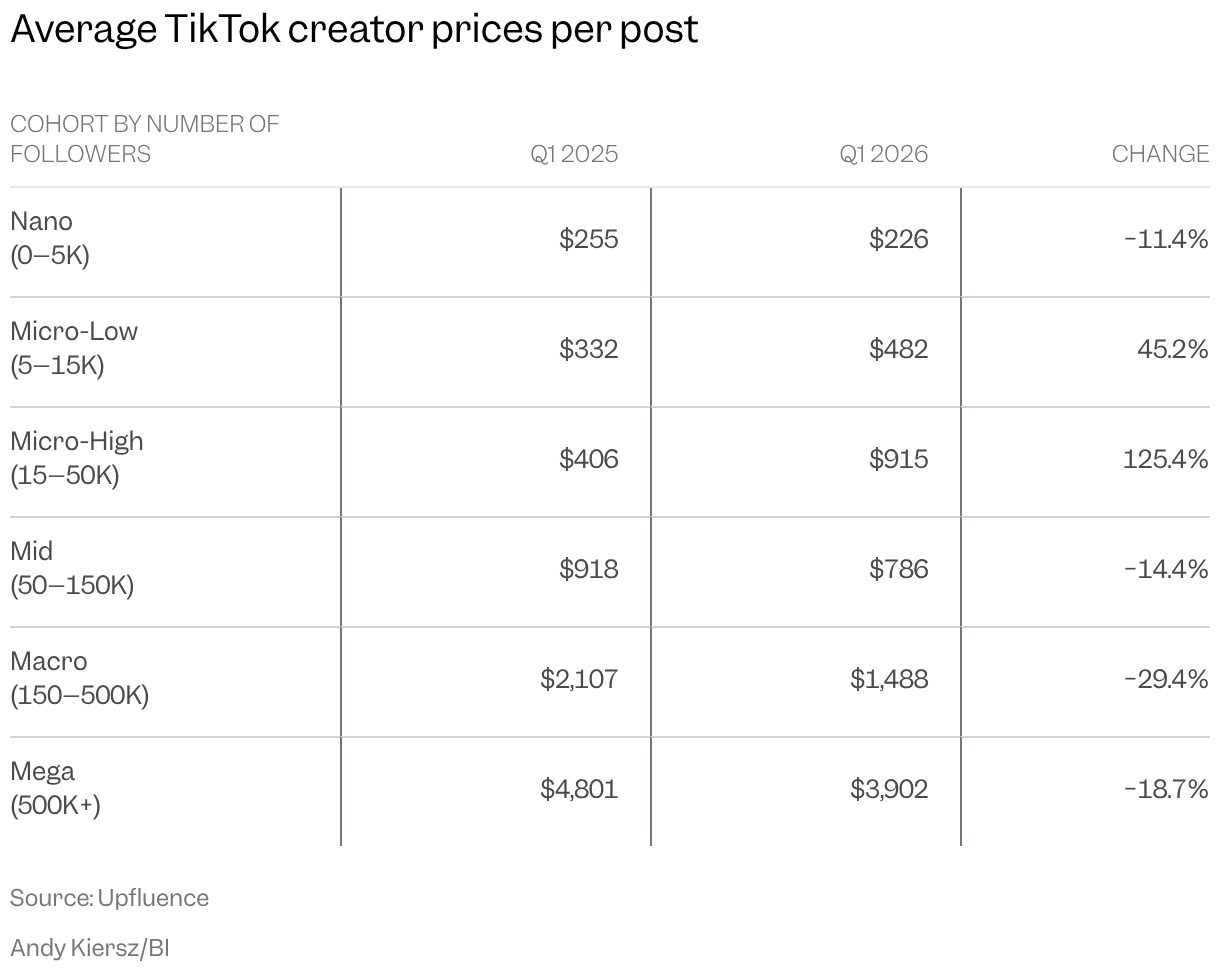
The average rates that TikTok "micro" creators — those with follower counts between 5,000 and 50,000 — charged brands for partnership deals rose dramatically in the first quarter compared with the year-ago period.
That's according to data compiled exclusively for CMO Insider by Upfluence, an influencer and affiliate marketing platform. Upfluence analyzed more than 5,000 TikTok deals across its network.
Creators on the higher end of the "micro" spectrum (15,000 to 50,000) saw their average fees between January and March rise 125% year-on-year.
Bigger creators didn't fare so well.
Over the same period, the average fees for "macro" (150,000 to 500,000 followers) and "mega" (more than 500,000 followers) TikTok creators fell 29% and 18%, respectively.
Five other influencer marketing companies told me they're seeing similar trends among their networks.
Why TikTok microinfluencers are having a moment
What's behind the micro boom?
Upfluence CEO Vivien Garnès said it's likely a sign that marketers are finally wrapping their heads around TikTok's algorithm, which can make even the smallest and newest creators become instant viral sensations.
"TikTok was the shiny new thing," Garnès said. "When you're new to a platform, you tend to put money on the most visible creators — so this creates market dynamics where the macros have all the bargaining power."
Now, more brands are building programs around the long tail of TikTok creators.
Lowe's CMO Jen Wilson told me this week that the brand's creator network, launched last year with MrBeast as the figurehead, now has 27,000 members, predominantly micro influencers with 50,000 followers or fewer.
Lowe's
Then there's the "creator army" that Duolingo CMO Manu Orssaud told me he's building. The learning app is signing up paid ambassadors and encouraging them to make TikTok burner accounts to post fun content on behalf of the Duolingo brand.
The epicenter of this TikTok creator quake, though, might well be traced back to Unilever.
Last year, CEO Fernando Fernández said the CPG giant planned to work with 20 times as many influencers as before. By December of last year, Fernández said Unilever was working with around 300,000 creators around the world. Some industry insiders predicted this move would spark a surge in creator marketing fees as rival brands rushed to expand their own influencer strategies.
Initially, that inflation was mostly concentrated at the macro end of the market. Now, it looks like the little guys are beginning to reap some of the benefits.
Why TikTok is an outlier
That said, Garnès told me that TikTok influencer marketing trends were different from those on rivals like Instagram and YouTube.
TikTok Shop could be one reason, according to Lily Comba, CEO of influencer marketing agency Superbloom. Big-name brands from Ulta Beauty to Ralph Lauren and Samsung have launched storefronts on TikTok Shop in the last year.
"Brands are increasingly prioritizing micro influencers for stronger engagement and conversion," and TikTok shop provides that opportunity, she added.
EMARKETER, a sister company of Business Insider, forecasts that 51% of US social buyers — social media users who have made at least one purchase on a social platform — will shop on TikTok this year, more than Instagram (47.2%) or Pinterest (20%).
Brands are also on the lookout for smaller creators with curated communities, said Asti Wagner, CEO of Invyted, an app that connects brands with influencers. Engagement rates are a bigger indicator that a video might convert than follower counts, she added.
Brand partnership history matters, too, said Jake Kitchiner, cofounder of the YouTube influencer discovery tool ChannelCrawler.
"Once smaller creators have done a few paid deals, they usually become more confident in pricing themselves," Kitchiner said. Over time, it's natural that micro creators increase their rates as they gain more experience and demand, he continued.
The rise of paid 'boosting'
Imogen Coles, Ogilvy's head of influence, said it often makes more sense for brands to use smaller creators because they can create more assets at a lower cost per post.
It's getting harder for branded content to get organic reach, even when a creator has a large following. That's led brands to pay more money to platforms to "boost" creator posts. In a world where brands rely on paid reach, how many followers a creator has matters less.
"We need more assets, because we know paid media is more effective when we use creator assets," Coles said. Micro creators can provide a greater bang for your buck if what you care about is the number and quality of the creative assets.
The catch with using a pool of smaller influencers — over a more targeted set of larger ones — is that they require greater management, she said.
"You've got more influencer contracts, you've got more vetting to do, you've got more content reviews," she said.
Read the original article on Business Insider