


Air Force reveals B-2's hidden ship killer capability as China threat grows
The announcement comes as the Pentagon increasingly focuses on preparing for a potential conflict in the Indo-Pacific, where China's rapidly expanding navy would present one of the U.S. military's biggest challenges.
The Air Force revealed Monday that its flagship B-2 Spirit stealth bomber can now strike enemy warships with the long range anti-ship missile (LRASM), publicly unveiling the capability after a live-fire exercise in the Western Pacific.
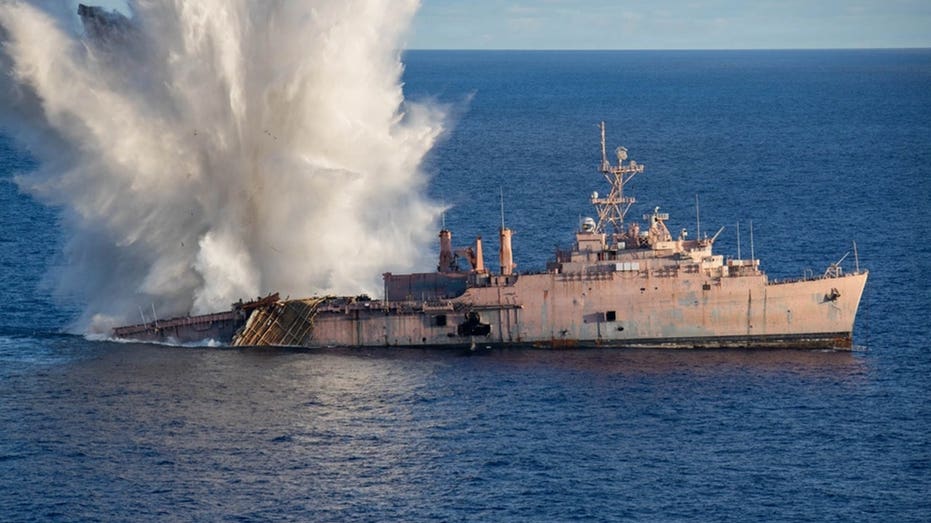
The stealth bomber launched a long-range anti-ship missile during Exercise Valiant Shield 26, a U.S.-led multinational exercise involving American and allied forces across the Western Pacific, in a sinking exercise north of the Mariana Islands.
The announcement comes as the Pentagon increasingly focuses on preparing for a potential conflict in the Indo-Pacific, where China's rapidly expanding navy would present one of the U.S. military's biggest challenges. Publicly demonstrating the B-2's new maritime strike capability also serves as a signal that the stealth bomber could play a key role in holding high-value naval targets at risk.
"The B-2's impressive performance underscores the U.S. military’s commitment to adaptability and flexibility in the face of emerging security challenges," Gen. Kevin B. Schneider, commander of Pacific Air Forces, said in a statement.
TRUMP PLAN FOR FOREIGN SHIPBUILDERS COULD CREATE 540,000 JOBS AND EXPAND US FLEET
"By prioritizing counter-maritime strike operations, we can maintain a decisive edge over adversaries, protect our national interests and ensure the free and open Pacific that underpin our global security."
Pacific Air Forces (PACAF) could not immediately be reached by Fox News Digital for details, but confirmed to The War Zone that the B-2 fired the anti-ship missile at a decommissioned amphibious warfare ship known as the USS Juneau during the exercise.
U.S. and partner-nation forces battered the decommissioned warship, which entered service in 1969, with coordinated air, surface and subsurface strikes June 27 and June 28, sending it to the bottom of the Philippine Sea more than 200 nautical miles off the coast of Guam, according to a Navy release. A Japan Maritime Self-Defense Force submarine delivered the final blow with a torpedo.
TIM SHEEHY EXPOSES A 'SCARY' SHIPBUILDING COLLAPSE THAT LEAVES THE US VULNERABLE TO CHINA
China continues to expand the world's largest navy and fields an array of long-range anti-ship missiles aimed at keeping U.S. forces at bay in the Western Pacific. The People's Liberation Army Navy will grow from more than 370 battle force ships to roughly 435 by 2030, according to Pentagon projections. U.S. Navy currently operates about 291 battle force ships.
But Beijing has yet to field its long-awaited H-20 stealth bomber, leaving the U.S. with an operational capability China has not yet publicly demonstrated: pairing a stealth bomber with a long-range anti-ship cruise missile capable of striking high-value naval targets in heavily defended airspace.
While long range anti-ship missile already is carried by the Air Force's B-1B Lancer and the Navy's F/A-18E/F Super Hornet, integrating the missile onto the B-2 gives the Air Force a stealth platform capable of carrying the weapon.
The B-2 Spirit is the Air Force's only operational stealth bomber, designed to penetrate sophisticated enemy air defenses while carrying both conventional and nuclear weapons. Most recently, B-2s flew from Whiteman Air Force Base in Missouri to strike Iranian nuclear facilities during Operation Midnight Hammer, dropping 30,000-pound GBU-57 Massive Ordnance Penetrator bombs in the weapon's first combat use.
The demonstration could also foreshadow future missions for the B-21 Raider, the Air Force's next-generation stealth bomber, which eventually will replace the B-2. While the Air Force has not disclosed which anti-ship weapons the B-21 will carry, officials say it is being designed to employ a broad mix of stand-off and direct-attack conventional munitions.
EUROPE'S $116B FIGHTER JET 'FAILURE' RAISES FRESH DOUBTS ABOUT ABILITY TO DEFEND ITSELF WITHOUT US
The B-21 is expected to begin entering operational service in 2027.