


African nations on ‘knife’s edge’ as US embassy warns Americans of long-range attacks
With regional tensions mounting, the Horn of Africa risks war between Ethiopia and Eritrea. Following attacks in Addis Ababa, the U.S. embassy warned citizens of long-range threats.
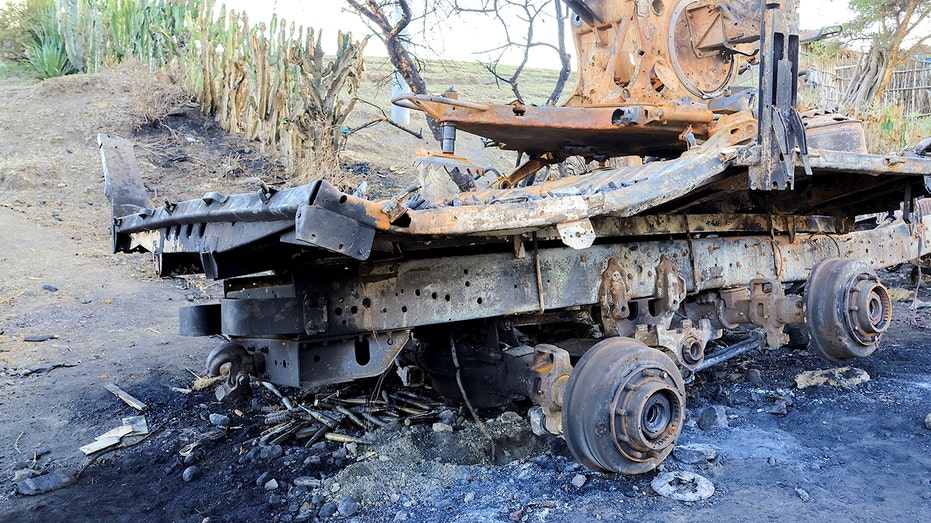
The entire Horn of Africa region is said to be on a knife’s edge. As explosions reportedly claimed to be caused by drones hit Ethiopia's capital city in early October, the U.S. embassy in Addis Ababa warned U.S. citizens of the danger of ‘long-range attacks.'
Analysts say there’s a high probability that Ethiopia and Eritrea are about to erupt in a new war, with worrying regional backing for both sides.
Former CIA analyst and National Security Council Africa director Cameron Hudson says the Trump administration needs to become more involved. He told Fox News Digital, "Regional leaders will say privately that they don’t want a regional war. But with so many armed actors and so much meddling going on in each other’s countries, a regional conflagration becomes increasingly likely. It is this kind of miscalculation that the Trump Administration needs to be working now to guard against."
The U.S. Embassy in Addis Ababa took to its website to caution Americans in Ethiopia that it "is aware of reports of possible long-range attacks directed at Ethiopian military installations on several instances in October of this year. U.S. citizens should accordingly exercise caution and follow the advice of local authorities."
The Embassy also hit out at reported disinformation, "some social media accounts contain false and misleading reports about the security situation in Ethiopia. U.S. citizens are urged to verify information using multiple sources or reliable information."
Indeed, although explosions in and around Addis Ababa, mainly at military installations, can be confirmed as having taken place, it cannot be established that the frightening spectacle of drones crashing into buildings in a major African city which houses the headquarters of the African Union happened.
Requests for comment to the Ethiopian government were not returned.
TRUMP GETS MAJOR WIN AGAINST CHINA IN AFRICAN RARE EARTH MINERALS RACE
Dr. Jalale Getachew Birru, Regional Expert of the U.S.-based Armed Conflict Location and Event Data research group, told Fox News Digital this is potentially a worrying development. "If identified as an aerial or drone attack, they exceed the capabilities of Ethiopia’s domestic insurgent groups, confirming Ethiopia's allegation of foreign state involvement."
The rebel groups opposing Ethiopia’s government have joined together to form the Ethiopian Peoples’ Forces Alliance for Survival. This coalition claimed responsibility for the Addis Ababa attacks, stating they used drones.
Blen Mamo, executive director of the Ethiopian Horn Review thinktank, is also concerned about a new phase of conflict using drones. Mamo told Fox News Digital, "should the Alliance for Survival possess drone capabilities, it could fundamentally alter the dynamics of the conflict, refocusing strategic control on aerial dominance. "
In early October, Ethiopian troops pushed out rebel groups who had occupied the Tigrayan capital, Mekelle. This operation ended a four-year-long ceasefire between Ethiopia and Tigray, the northernmost province of Ethiopia.
Last week, reports claimed Eritrean troops had entered Ethiopia. Although the allegations have not been independently verified, Fox News Digital has seen multiple videos showing what appears to be large convoys of trucks carrying uniformed soldiers passing through the Ethiopian city of Adigrat. Addis Ababa is said to have subsequently launched drone attacks and pushed the Eritreans back over the border.
The latest fighting was sparked principally by Ethiopia’s statements that it wants to get access to Red Sea ports. The country became landlocked when Eritrea became independent in 1993. In a speech as he was sworn in for a new 5-year term Oct. 5, Ethiopian Prime Minister Abiy Ahmed said sea access was "of vital importance to Ethiopia’s civilization."
He added, "Based on the principle of give and take, we will work diligently to ensure that Ethiopia has an outlet to the sea."
US VISA CLASH EXPOSES SUDAN’S FORGOTTEN WAR AS FOREIGN POWERS COMPETE FOR STRATEGIC FOOTHOLD
Possible regional expansion of any conflict also comes from the creation of the Grand Ethiopian Renaissance Dam. Egypt and Sudan are at odds with Addis Ababa, after it built the dam across the Blue Nile , affecting access to water to these countries which are downstream. Egypt this month took up a formal position against Ethiopia, when it created a coalition with Sudan, Eritrea and Somalia.
The State Department has been active diplomatically to try and resolve the situation. A spokesperson told Fox News Digital Undersecretary of State for Political Affairs Allison Hooker met this month with Eritrean Foreign Minister Osman Saleh and spoke with Ethiopian Foreign Minister Gedion Timotheos.
Also, Assistant Secretary for African Affairs Frank Garcia met with Minister Saleh. The spokesperson added, "Both U.S. officials underscored the importance of respecting the sovereignty and territorial integrity for all countries in the Horn of Africa."
Following these discussions, State Department spokesman Thomas "Tommy" Piggott released a statement, saying, "Increasing cross-border tensions between Ethiopia and Eritrea have the potential to affect the entire region. The Horn of Africa cannot sustain another military conflict and humanitarian crisis. A conflict jeopardizes ongoing U.S. collaboration on shared interests with both countries."
Piggott added, "We strongly urge Ethiopia and Eritrea to respect the sovereignty and territorial integrity of their neighbors , exercise maximum restraint and return to dialogue and cooperation as agreed in their 2018 peace framework. Peace through dialogue is the only path toward sustainable security, economic growth, and prosperity."
The Horn Review’s Mamo told Fox News Digital the reality on the ground is "increasingly pointing toward a conflict that may prove impossible to avoid," and warned of Egypt’s motives: "Parallel military and technical cooperation with Asmara (the capital of Eritrea) also adds strategic depth along Ethiopia’s northern frontier, while Egypt’s expanding role in Somalia and Red Sea port initiatives extends its regional influence."
"The situation in Ethiopia and in the region is extremely dynamic," analyst Cameron Hudson told Fox News Digital. Hudson added, "The question remains, given the weakness of the internal (rebel) coalition, will external forces attempt to step in and exert greater leverage against Abiy."
He continued, "We are seeing Eritrea begin to move forces into Ethiopia, while a coalition of regional states including Somalia, Egypt, Sudan and Eritrea have issued a statement that amounts to a veiled threat against Ethiopia and its regional ambitions to establish a Red Sea naval presence and expand a series of hydroelectric dams on the Nile. The entire Horn of Africa region is on a knife’s edge and it is being made only more complicated by Houthi efforts to shut Red Sea shipping and the war in Iran."
"The risk of regional conflict remains high," Hudson said. "Egypt would be happy to see Ethiopia bogged down in internal conflict and unable to pursue its ambitions on the Nile and in the Red Sea. Similarly, Sudan hopes that internal conflict in Ethiopia distracts Addis from its support of the rapid support forces militia in Sudan’s war."
"Local disputes can quickly become regional and international disputes with global consequences very quickly in this corner of the world," Hudson added, "closure of the Bab el Mandab straight, owing to unchecked tensions and violence across the Red Sea, will quickly be felt in the U.S."