


Pizza before tomatoes? Ancient Rome's version of America's favorite food looked nothing like today's
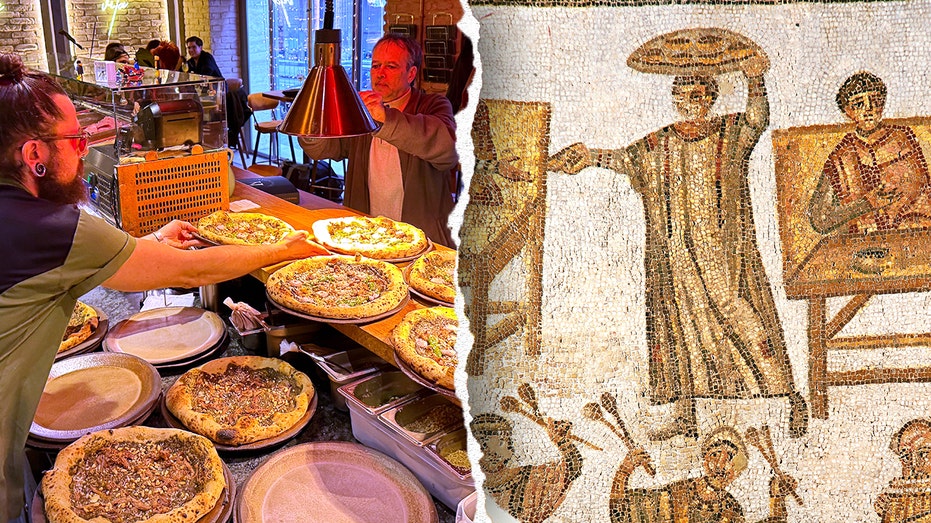
A Budapest pizzeria has created an ancient Rome-inspired pizza with no tomatoes or mozzarella — featuring fermented fish sauce, olive paste and duck leg instead.
A restaurant is selling an ancient Rome-inspired pizza — and it may not taste anything like modern diners expect.
Neverland Pizzeria in Budapest, Hungary, is selling a limited-edition pie featuring ingredients that would have been available in ancient Rome.
That means no tomatoes — a New World crop — and no mozzarella.
ARCHAEOLOGISTS REVEAL NUTRITIOUS FOOD REMAINS DISCOVERED IN ANCIENT VILLA QUARTERS
Instead, the pie features epityrum, an olive paste, and garum, a fermented fish sauce popular in ancient Rome.
Its base is made of ancient grains, including einkorn and spelt, and the dough contains fermented spinach juice to help it rise.
The pie also features confit duck leg, toasted pine nuts and ricotta, plus a grape reduction.
Neverland Pizzeria founder Josep Zara said he was inspired by a fresco unearthed in Pompeii in 2023 that appeared to show a focaccia-like flatbread with spices, pomegranate seeds and dates.
"We sat down to imagine what we might be able to make using these ingredients, and without using things like tomatoes and mozzarella," Zara told The Associated Press.
"We had to exclude all ingredients that originated from America."
ARCHAEOLOGISTS UNEARTH ANCIENT BREAD THAT SURVIVED UNDERGROUND FOR 5,000 YEARS
Head chef Gergely Bárdossy said the limited ingredient list forced the team to rely heavily on experimentation.
"The fact that there wasn't infrastructure like a water system at the time of the Romans made things difficult for us, since more than 80% of pizza dough is water," Bárdossy told the AP.
"We had to come up with something that would have worked before running water."
To modern diners, the dish resembles a small flatbread made of wheat, honey and olive oil, said Lisa Roberts, a New York-based culinary archaeologist who specializes in the Mediterranean.
TEST YOURSELF WITH OUR LATEST LIFESTYLE QUIZ
"The garnishes might include a cheese pesto, made with olive oil and herbs, and locally grown fruits, including pomegranate seeds, dates, pears and plums," she told Fox News Digital.
"If I saw this pizza today in New York or L.A., for example, I would think it was a modern chef's new take on pizza — like a breakfast or brunch pizza."
Romans were known for their love of garum "on everything," Roberts said, and she compared the fermented condiment to fish sauce or miso.
"Ancient writers prized it both as an ingredient and as medicine," she said.
CLICK HERE TO SIGN UP FOR OUR LIFESTYLE NEWSLETTER
"In Italy and Spain, modern versions are made with anchovies. For Americans, Thai fish sauce would be the closest in flavor profile but less salty."
If the salty-savory-sweet combination sounds unfamiliar, Roberts noted it already has its place in American food culture.
She cited prosciutto-wrapped melon, pineapple on pizza and maple-glazed bacon as popular examples.
"I make a salad dressing with miso, honey, olive oil and lemon, and it's delicious drizzled over vanilla ice cream," she said.
CLICK HERE FOR MORE LIFESTYLE STORIES
The dish is best seen as a "distant ancestor" of pizza, which was created over a millennium later, Roberts said.
"This dish belongs to a tradition called xenia, in which food images were offered as hospitality gifts in the ancient world," she said.
"In Virgil's Aeneid, Aeneas and his companions use flat wheat cakes as edible 'tables,' placing fruit and other foods on top of them. After finishing the meal, they eat the bread itself, showing that bread could serve both as a plate and part of the meal."
As for the pizza's popularity, Bárdossy said that it appeals to a "narrow niche" of people.
"Most people want more conventional pizza, so it's not for everyday eating," he told the AP.
"It's something special."
The Associated Press contributed reporting.