


Hundreds of Russian Shaheds are descending on Ukraine in the daytime, signaling a new kind of warfare
Typical nighttime drone waves are giving way to massive attacks that last days, with the most recent bombardment involving over 1,500 drones.
Pierre Crom/Getty Images
- Instead of attacking with Shaheds at night, Russia is now trying dayslong strike campaigns.
- This week, Ukraine said it was attacked with over 1,500 drones and 50 missiles for two straight days.
- Two analysts studying Shahed warfare said it's an early sign of a new tactic aimed at wearing Ukraine down.
For Ukrainian cities, the last two days have been a near-constant barrage of drones and missile strikes, culminating in Russia's largest and most unrelenting long-range attack in the war so far.
It's another major episode in a new style of Russian drone warfare emerging in the last few months.
Where the Kremlin previously relied on attacking Ukraine with delta-wing Shaheds at night — when they're harder to spot — it's starting to deploy them in extended windows that last long into the day, forcing Ukrainians to shelter for hours or take their chances to go about their lives.
Ukrainian President Volodymyr Zelenskyy said his country came under siege from 1,567 drones and 56 missiles from Wednesday to Thursday, describing the assault as "massive and virtually continuous."
Genya SAVILOV / AFP via Getty Images
This week's bombardment was a "prime example" of the trend, said Igor Anokhin, a Ukrainian senior analyst who sifts through data on Russia's Shahed strikes for the Washington-based think tank Institute for Science and International Security.
The latest salvo marks the fifth time that the Kremlin has used sustained strike periods this year, he told Business Insider.
"I wouldn't call this a fully established pattern yet, but it is clearly becoming a new operational model," Anokhin said.
The first of these prolonged attacks was in late March, when Russia launched nearly 1,000 drones into Ukraine over 24 hours, Anokhin added. Another notable example occurred in mid-April, when continuous drone and missile attacks lasted for 32 hours.
That's against a daily average of 143 to 219 drones this year, depending on the month, according to Anokhin's analyses of Ukrainian and open-source data.
Russia often also targets Ukraine's electrical grid, forcing millions to go through the winter without heat in a campaign aimed at reducing the population's will to resist.
Why daytime strikes?
Enduring an extended onslaught is exhausting, as Business Insider's Jake Epstein and Rob Leslie found during the recent attack. They took cover for hours in a Kyiv bomb shelter, waiting sleeplessly through the night as explosions rattled the city.
Shahed attacks are so frequent that they've already become an accepted part of life for Ukrainian civilians. Anokhin said that's the point.
"The main goal is psychological pressure and economic terror," he said. "Keeping Ukrainian cities on high alert for many hours, disrupting civilian life, and targeting energy and critical infrastructure."
The heightened pressure also puts Ukraine's multi-layered air defense network to the test. To counter aerial attacks, Ukrainian forces deploy a mix of mobile machine-gun crews, interceptor drones, electronic warfare, and high-end defensive missiles.
Nina Liashonok/Ukrinform/NurPhoto via Getty Images
The sheer volume of threats from Russia strains that system. For example, it runs the risk of forcing Ukraine to fire more rare, expensive interceptors to destroy a cheap drone, making room for ballistic missiles to find their mark.
Russia employed that tactic this week: After hours of drone attacks, missiles began pounding Kyiv on Wednesday evening.
Zelenskyy said air defenses destroyed at least 93% of Russia's drones during the attack, but that only 73% of Russia's missiles were downed. As of Thursday evening, 24 people were confirmed dead, and another 48 were injured, he added.
Each Shahed costs less than $50,000 to produce and carries up to 110 pounds of explosive that strikes with a shrapnel-laden blast powerful enough to cripple buildings and kill civilians.
Danylo Dubchak/Frontliner/Getty Images
Federico Borsari, a researcher at the Center for European Policy Analysis who focuses on drone warfare, told Business Insider that the daytime attacks can also serve a secondary purpose.
Many of Russia's decoy drones are equipped with electro-optical sensors, which can scout the battlefield while soaking up Ukrainian air defense munitions, he said.
"The main targets are typically mobile fire groups, ground-based air defense launchers, and other high-value military targets," Borsari added.
In other words, the daytime drone waves can pinpoint high-value targets for follow-on attack.
Anokhin's analysis found that in April, 66% of Russia's launched one-way drones were Shaheds, while the rest were decoys or other types of strike drones.
The production problem
Russia has attacked in longer windows before, but not at this scale. Both Borsari and Anokhin said a key change is Russia's growing ability to deploy more drones faster.
"It would be ideal to destroy production in Alabuga," said Anokhin.
The Yelabuga Special Economic Zone, also known as Alabuga, in Russia's Tatarstan region, is home to the Kremlin's main factory for Shaheds, which has come under intense global scrutiny as a vital component of the Russian war effort.
Russia is working quickly to ramp up production there, even as Ukraine sends its own long-range drones to attack the factory.
On May 9, Radio Free Europe reported that satellite images showed new facilities and hangars at the site, expanding the campus by 340 hectares while more construction was starting on another 450 hectares.
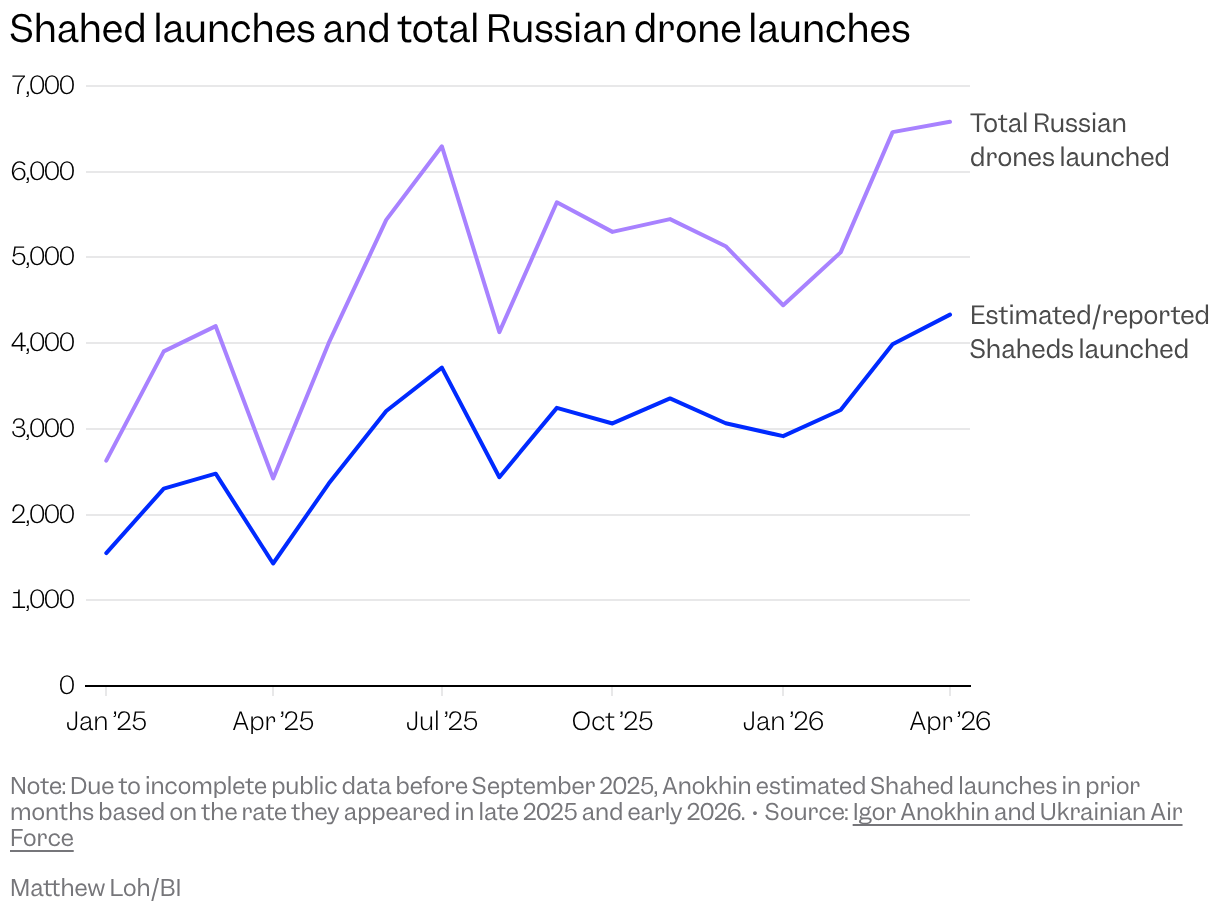
Per Anokhin, Russia's Shahed deployment has grown steadily since early 2025 and now accounts for a larger share of drone strikes, rising from 59% of total launches in the fall of last year to 64% this spring.
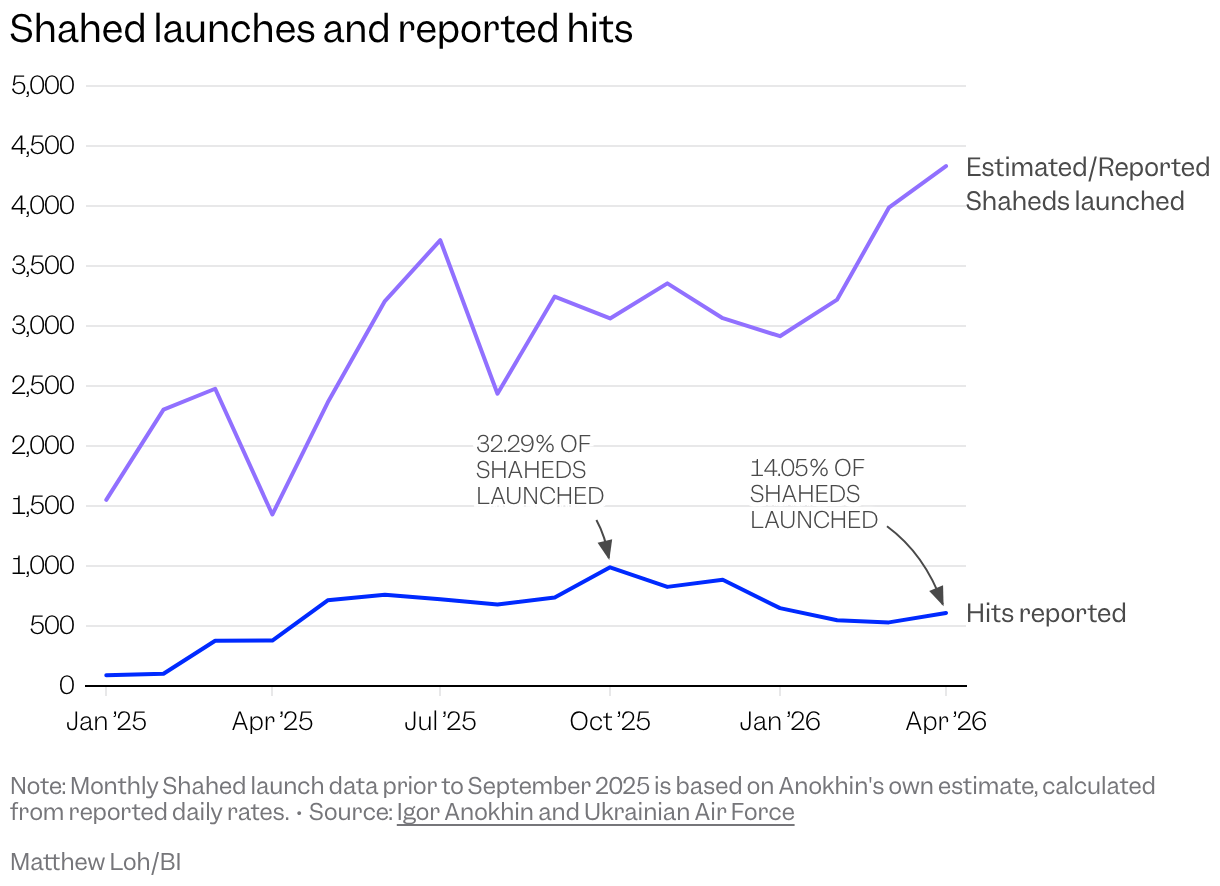
Ukraine's ragtag air defense network, however, appears to be working. Anokhin's analysis shows that while nearly a third of Russia's Shaheds were hitting targets in the fall, that proportion has fallen sharply to around 14% in April.
The country has been emphasizing cheaper systems, such as its interceptor drones. Ukraine's air force estimated in February that about 30% of Russian drones are downed by these inexpensive remote systems, though the reported proportion has risen to 70% in some periods.
Borsari and Anokhin said separately that they believe Russia's extended daytime drone waves will become a more permanent fixture in the war.
"However, it is unclear whether the Russian targeting strategy is bearing fruit," said Borsari.
Read the original article on Business Insider