


Here is the real reason why they hate Caitlin Clark so much | Bobby Burack
Caitlin Clark's refusal to play the expected anti-racist ally role explains the league's hostility, while Cameron Brink and Paige Bueckers thrive.
In a discussion late Friday night on CNN, a panel debated why many WNBA players appear to resent Caitlin Clark. Former ESPN host Cari Champion didn't offer an explanation. Instead, she argued that anyone who suggests race is a factor is disrespecting Black women.
"To suggest that it is intentional or that people are being racist towards her leaves out a long history of women who have supported this league and started this league who were Black. It's very disrespectful to them," Champion told the panel.
OK, then.
But why do so many WNBA players, particularly Black players, display such obvious — and at times physical — hostility toward Clark?
Is it simply because she is a straight White woman in a league that is roughly 70% Black or LGBTQ+?
In part, yes. But her identity alone isn't the issue. There's more to it.
CNN’S ABBY PHILLIP CLAIMS GOP LAWMAKERS BACK CAITLIN CLARK ‘EXCLUSIVELY’ BECAUSE SHE IS WHITE
The problem, for many around the league, is that Clark refuses to play the role expected of her. She is a straight White woman who has declined to turn herself into a vehicle for the racial and sexual activism that increasingly defines the league's public image.
That's an important distinction.
The identity left, if you will, doesn't reject all White people. Many would gladly vote for California Gov. Gavin Newsom for president. They adored Sarah Spain throughout her years covering the WNBA. What they reject is the wrong kind of White person.
Most White players in the WNBA have understood the assignment.
Cameron Brink is White, blonde, engaged to a man, and looks like a supermodel. She was drafted one pick after Clark in 2024. The WNBA establishment practically reveres her.
Of course it does.
From the beginning of her career, Brink has followed the script. Before playing a single WNBA game, she volunteered an acknowledgment of her privilege.
"I could go way deeper into this, but I would just say growing the fan base to support all types of players. I will acknowledge there's a privilege for the younger White players of the league," Brink said. "That's not always true, but there is a privilege that we have inherently, and the privilege of appearing feminine."
Then, in May, she emphasized that privilege once again.
"I've tried to be vocal about this and acknowledge there's such a privilege, marketing-wise, being White and blonde," Brink told Interview magazine. "It does really bother me seeing athletes and players who are consistently putting up crazy stat lines and not being rewarded by brands."
Paige Bueckers occupies a similar space.
She is often presented as Clark's counterpart by the sports media, yet there is little visible resentment toward her from either players or the media. Over the weekend, Bueckers expressed concern about the racial makeup of WNBA coaching staffs.
"[The WNBA] was built on a lot of Black women," Bueckers said, via Yahoo Sports. "It's definitely right for them to get the same equal opportunity as everybody else."
Bueckers' remarks were hardly courageous or groundbreaking. Yet Black Twitter spent Monday celebrating them.
To better understand these dynamics, think back to the use of the term "anti-racism" in 2020. Authors Robin DiAngelo and Ibram X. Kendi, along with sports analyst Emmanuel Acho, argued there was a critical distinction between being "anti-racist" and merely "not racist." They argued that simply refraining from racism wasn't enough.
For White people, the implication was obvious. It was no longer enough not to be racist. You had to prove you weren't. You had to begin actively fighting against racism.
Former ESPN host Bomani Jones articulated that mindset in 2023, suggesting White people could be presumed racially biased until proven otherwise.
"Let's be fair. White people aren't always racially biased, but you can never be 100% sure," Jones said.
Viewed through that lens, the acceptance of Brink and Bueckers makes more sense. Both have repeatedly signaled they are, in fact, anti-racists.
Caitlin Clark has chosen a different path. She's a basketball player. That's all she's ever claimed to be. She never volunteered to become a symbol in America's culture war. She never volunteered to spend press conferences validating racial activists or apologizing for her own success.
Simply put, Clark is normal. She doesn't feel an obligation to tell the world she isn't a racist or a homophobe. Most sane people don't.
CLICK HERE FOR MORE SPORTS COVERAGE ON FOXNEWS.COM
Further, Clark is the first White American sports superstar of post-George Floyd America. That makes her villainous status even harder to shed, as many players and media members seemingly wear their bigotry toward her as a badge of honor.
Combine that with the narrative ingrained in many players that her race and gender are the reasons for her fame. Racial idolaters like Jemele Hill have made sure players continue to hear that message and believe it.
"We would all be very naive if we didn't say race and her sexuality played a role in her popularity," Hill told the Los Angeles Times in 2024.
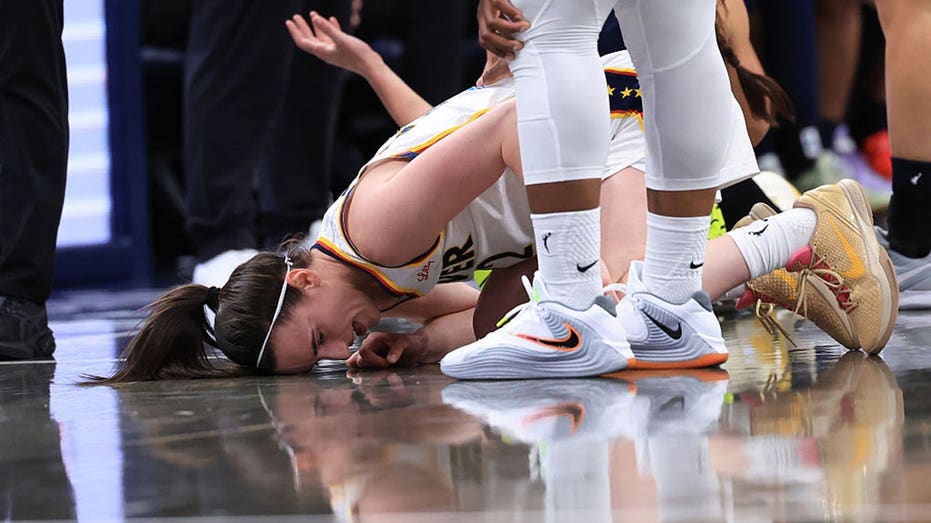
Statements like that help explain why a player can drive her fist into Clark's neck, and reporters instinctively rush to defend the player who threw the punch instead of the player who took it.
Caitlin Clark has so much White privilege that it's her responsibility to defend the women trying to injure her.
Perhaps they eventually browbeat her with false narratives into becoming a spokesperson for the BLM and LGBT agendas. Unfortunately, it's hard to envision any other alternative.
The Black players and media are not going to accept her otherwise. They have shown they'd rather excuse the most egregious behavior directed at Clark than admit they are the ones enjoying the privilege.
The drama surrounding Caitlin Clark has never been difficult to understand. A straight White girl from Iowa transcended the game of women's basketball. She put the sport on the map.
Yet, the players have made clear they'd rather remain stuck in obscurity than ride the wave created by a White player more concerned with basketball than the grievance-based social messaging.
And that's why they hate her.