


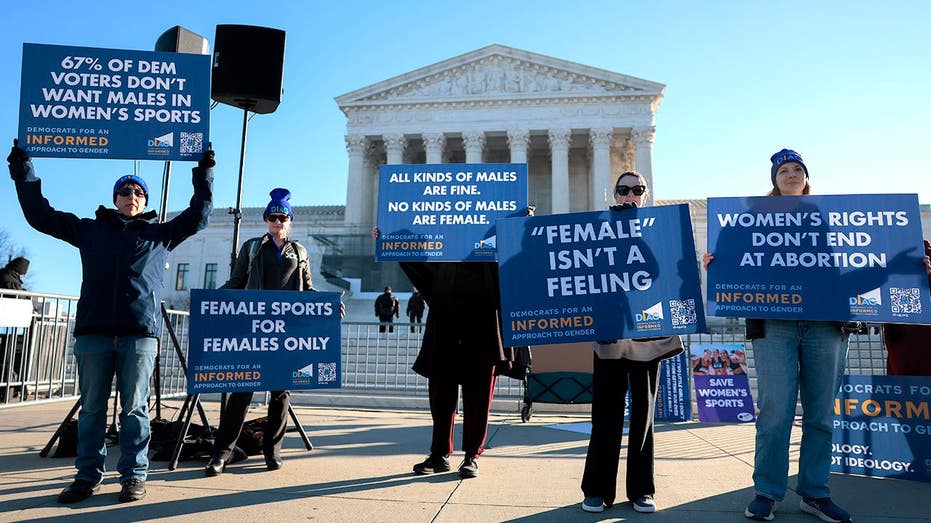
What's next in the battle to 'save women's sports' after SCOTUS ruling — and the hidden damage driving it
Women's sports activists warn of sexual abuse risks in the states that let males compete in girls' sports after SCOTUS ruling.
For millions of women and girls across the country, the Supreme Court's ruling on trans athletes has changed nothing.
There are still 23 states that don't have laws keeping biological males out of women's sports, and 19 of those states have policies that actively allow it. Washington state is one of those.
"No matter what the ruling with the Supreme Court was, nothing has changed," Washington high school athlete Soleil Hoefer told Fox News Digital. "It’s just really frustrating to be a part of such a movement that isn’t getting any relief like these two girls have."
CLICK HERE FOR MORE SPORTS COVERAGE ON FOXNEWS.COM
Her junior year, she said, her club soccer team played against a biological male goalkeeper during a showcase tournament in Las Vegas.
"I was a forward. Wasn’t a great matchup," Hoefer said. "Knowing that I didn’t have the physical ability to beat this man was so frustrating."
Then, during her senior year, she said she had to run against a male athlete in the 400 meters.
"The 400 meter race is already such a mental game," she said. "Knowing that no matter what I trained for and what time I ran, I would always lose was so frustrating, and knowing that this could possibly happen to my little sister is what made me stand up for it."
But Hoefer also warned of an issue that goes beyond just medals podiums, after a fellow female athlete in her state was allegedly sexually assaulted by a trans competitor during a wrestling match earlier this year.
"There’s another case that has just recently happened with a girl named Kallie [Keeler]. She’s a wrestler in Washington state. And she was sexually assaulted during a wrestling match," Hoefer said, referring to the Washington lawsuit. "So I think a big part of what comes next is our state coming to the realization of this is going to keep happening if nothing happens."
Fox News Digital previously reported that a Washington family filed a lawsuit alleging their daughter was sexually assaulted by a biological male trans athlete during a girls’ wrestling match.
Kristen Waggoner, CEO, president and chief counsel of Alliance Defending Freedom (ADF), which is leading the lawsuit, said the Washington case shows why the debate over girls’ sports is not limited to trophies or scholarships.
"Kallie’s experience is not just unfortunate, it is devastating to any girl," Waggoner said, referring to the Washington wrestler. "To wrestle as a 16-year-old in a sport and believe that you’re wrestling a girl, and then learn that it not only is a boy, but to be sexually assaulted… it’s horrendous, and it’s sexual assault."
Waggoner said she wishes the case were isolated.
"I wish it was an isolated case, but it’s not," she said. "We will work until we win that case for her."
To Waggoner, the hidden damage behind the movement is not only competitive unfairness. It is what girls say happens in locker rooms, hotel rooms, bathrooms and contact sports when adults erase sex-based boundaries in the name of inclusion.
"Women and girls deserve their right to privacy and their right to physical safety," Waggoner said. "You shouldn’t have to even have to talk about sexual assault as a consequence of this because we know that differences matter between the sexes."
That same theme came through in the story of Adaleia Cross, a West Virginia student-athlete who spoke out after a trans athlete at the center of the West Virginia case that was decided by the Supreme Court, competed on girls’ teams. Cross has alleged sexual harassment and said her school district failed to protect her; the trans athlete and the trans athlete's mother have denied harassment allegations, and prior reporting said the school district found allegations unsubstantiated. Cross and ADF maintain that the harm occurred.
"I think it needs to be way more focused on than it is," Cross said of the risks of sexual harassment and abuse to girls as a result of trans athlete inclusion.
"Girls are not safe when they have to share private spaces with men, and people just don't talk about it enough. And I think that if more people were aware going forward, more people would be angry.
"It’s really hard to think about even now to know how many other kids could they be doing that to? How many other situations of sexual abuse are happening that they’re silencing?"
Hoefer shares that frustration and fear as a high schooler in a state that continues to allow males in girls' sports.
"Us having to be in spaces with male athletes... having to share bathrooms, having to share locker rooms, having to share a hotel room if we're traveling, none of it is fair. And it makes me wonder, when are people going to realize, like, it shouldn't have to come to this point where people are going through sexual assault or sexual harassment. And I want them to focus on that more, I want the media to highlight that more," Hoefer said.
"People always say 'they're lying about it. People don't do that.' But that's not what the reality is... people think it is all just about fairness, it's about safety."
Former Idaho State runner Madison Kenyon, who was a voluntary defendant on the Idaho SCOTUS case, has been a recurring figure in mainstream media coverage on the case over the last year. She, along with Waggoner, have done interviews on outlets including CNN.
Kenyon said she believes mainstream media coverage has improved since she first started speaking out six years ago, but still has not centered enough on female athletes.
"I think it should be bigger," Kenyon told Fox News Digital. "I think that we should truly be showing the stories of the women."
She said that when she first entered the debate, "nobody was talking about it" and it was "taboo." Now, she said, more Americans understand the issue, but the coverage still too often fails to show the full cost to girls.
"The media needs to show that 80% of Americans do not think it is fair for men to compete as females, that it is unsafe to have men in our locker rooms, and I wish the media would really show that part more clearly," Kenyon said.
A 2025 Gallup survey found that 69% of U.S. adults believed transgender athletes should only be allowed to play on teams matching their birth sex, while 24% said they should be able to play on teams matching their gender identity.
Waggoner said the media environment has shifted from where it was a decade ago.
"It was a tough go 10 years ago, to be able to talk about these things," Waggoner said. "But I think now as Americans have seen in real time the differences between men and women… the media has also begun to shift a little bit as well."
Still, she said interviews on major outlets can remain difficult.
"They do ask the tough questions and sometimes some unfair ones," Waggoner said. "It has been an absolute delight to see courageous young women athletes stand up for truth."
The country is now divided into three practical categories.
The first category is the 27 states with laws protecting girls’ and women’s sports based on biological sex. The second is the 19 states without such laws that still actively allow transgender athletes to compete in girls’ sports. The third is a smaller group — Pennsylvania, Wisconsin, Alaska and Virginia — where there is no state statute, but state education agencies or high school athletic associations have imposed sex-based restrictions.
California is one of the clearest examples of resistance. The state has AB 1266, which protects transgender students’ ability to participate in school programs and athletic teams consistent with gender identity. Gov. Gavin Newsom’s office told Fox News Digital the ruling "does not affect California’s laws."
Illinois has also pushed back. The Illinois High School Association uses a formal policy for transgender athlete participation, and Gov. JB Pritzker called the Supreme Court decision a "setback for equality."
Minnesota and Maine are also major battlegrounds. Minnesota’s high school league allows transgender athletes to compete after case-by-case evaluation, and Maine’s Principals’ Association allows students to compete on teams matching gender identity. Both states, as well as California, are being sued by President Donald Trump’s Department of Justice over their policies.
Other states are moving in the opposite direction. Nevada does not currently have a girls’ sports protection law, but Republican Gov. Joe Lombardo told Fox News Digital the Supreme Court ruling provides "important legal clarity" and said he will push lawmakers to act during the 2027 legislative session. Colorado voters are set to decide a November 2026 ballot measure that could mandate teams based on biological sex.
Vermont and Washington remain especially central to ADF’s next phase. Vermont’s Principals’ Association explicitly protects transgender athletes’ ability to participate on teams consistent with gender identity, while Washington’s WIAA maintains its gender-identity-based participation policy.
Waggoner said ADF’s strategy is to keep pushing in those states through both litigation and culture.
"You can expect that we will uproot gender ideology from the law, and we will not stop until we do," Waggoner said. "We have several lawsuits that are already ongoing in those 23 states, and we will continue to work to protect women and girls."
But she said courtrooms alone will not settle the issue.
"This isn’t just something that it can be won in the courtroom. It has to be won in the culture as well, and the two go hand in hand, so all of us have a role to play," she added.
One of those culture fights is already playing out in Vermont.
Mid Vermont Christian School recently received a $566,000 settlement in damages and legal fees after being barred from state sports and academic competitions following its 2023 girls’ basketball forfeit against a team with a transgender athlete. The Vermont Principals’ Association banned the school from athletics and other competitions after the forfeit; a settlement later allowed the school back into the state athletic association.
Chris Goodwin, the Mid Vermont Christian girls’ basketball coach, said the settlement did not resolve the larger issue in Vermont.
"From just the coaches I’ve talked to, the parents I’ve talked to outside of our school, the vast majority of them would rather not have to compete against a boy," Goodwin told Fox News Digital.
He said the state still has "a culture and environment of fear."
"I know coaches and administrators who, if they wanted to go against this policy before our case was settled, that they told me they would be punished or lose their jobs for it," Goodwin said. "Even though the case was settled, Vermont is still gonna be pretty pervasive with the transgender policies."
Goodwin said the issue is personal because he has a daughter.
"I always think about… my daughter… having to make that choice of you have to play against male athletes or you can’t play at all, and that just seems so unfair to me," he said. "It’s not right, and it goes against our religious beliefs. It goes against what our school teaches."
His wife, Bethany Goodwin, made the same point in simpler terms.
"I have a daughter, and so I know how that makes her feel to have to play against a boy," she said. "It’s uncomfortable and it shouldn’t be something that she has to even think about."
She added, "Girls obviously shouldn’t be forced to have to compete against boys and have that choice of either compete against boys or don’t compete at all. That shouldn’t be a choice they have to make."
Ryan Tucker, ADF senior counsel and director of its Center for Christian Ministries, said Vermont’s sports dispute is part of a broader religious-liberty fight. Tucker oversees ADF litigation involving churches, Christian ministries and religious schools.
"Unfortunately, religious schools, religious people overall in the state of Vermont have been under a constant attack for several decades," Tucker told Fox News Digital. "The discrimination, the hostility that was shown in the sports context is one piece of a broader pattern of problems in the state."
He pointed to other disputes involving religious schools and public benefit programs, including dual enrollment, early college and town tuitioning.
"Every time that we either win a case to open the state up or the United States Supreme Court decides an opinion that really should settle the issue, Vermont looks for a workaround," Tucker said.
After the $566,000 settlement, he said, "I think the state will hopefully think twice about taking a similar action since it cost half a million dollars this go-around."
"If Vermont continues to discriminate against people of faith, we’re gonna be there to get their back and take the state to court if we need to," Tucker said. "My hope is that at some point Vermont will get the message: the U.S. Constitution is supreme."
The legal fight is also moving into a new phase: accountability for past seasons.
The Supreme Court ruling did not award damages to female athletes affected by transgender athlete policies. But lawsuits by Riley Gaines against the NCAA and by Brooke Slusser against San Jose State and the Mountain West Conference seek damages for women who say they lost equal opportunities, privacy, safety or fair competition under policies that allowed transgender-identifying male athletes to compete in women’s sports.
Bill Bock, an attorney leading those cases for the Independent Council on Women’s Sports, said the ruling undermines institutions’ argument that Title IX required them to allow biological males identifying as female into women’s sports.
"They had no basis for what they did to women," Bock told Fox News Digital.
Former University of Arizona swimmer Marshi Smith, co-founder of ICONS, said the ruling was major but incomplete.
"We’re lacking accountability still," Smith said, pointing to titles, records, roster spots and scholarships that female athletes say they lost.
That question resonates with Kenyon, who said athletic opportunities shaped her adult life. She maintained her scholarship, got a nursing degree, works as an emergency room nurse and said sports helped pave the way for her future.
"That scholarship got me my education, my career, and literally has had an impact on the future that I’ve paved for myself," Kenyon said. "When a male competes in female athletics, women are sidelined with nowhere to go."
Kenyon said girls who lost medals and podium places deserve more than a symbolic win.
"We need to give the rewards to the women who won them," she said. "There are so many women who took first place and didn’t get their trophy or their medal, or were on a podium and never got to be on the podium."
Waggoner said the Supreme Court’s Title IX reasoning is now central to ADF’s next lawsuits. The court, she said, answered whether states can recognize biological distinctions in sports, but not whether they must.
"The logic behind the decision does help answer that question because the court recognized these differences are real, they matter," Waggoner said. "For every time a boy takes a girl’s position, it takes away an equal opportunity to a girl."
"Title IX, the whole purpose behind it is to provide equal opportunities to women and girls," she added. "So we believe it’s a violation of Title IX, and we will continue to litigate until we win that issue."
The NCAA changed its transgender athlete policy in 2025 to limit women’s competition to student-athletes assigned female at birth, and the Supreme Court’s opinion noted that the NCAA, USOPC and IOC had all drawn sex-based lines for female competition.
Waggoner hopes to see elite female athletes who benefited from Title IX speak out.
"There’s no room for cowardice. There’s only room for courage, and it’s never too late to speak out on behalf of women and girls," Waggoner said. "The equal opportunities that so many of those athletes have benefited from because of Title IX should be available to those who come behind."
Kenyon said backlash exists, but she believes it is smaller than it sounds.
"I did receive backlash and messages, but I was flooded with support, and that really kept me going," she said. "There really is a loud minority out there."
She said the Supreme Court did more than hand her side a legal win.
"I’m grateful that the Supreme Court not only ruled in our favor, but they addressed biological reality throughout their entire decision," Kenyon said.
For Hoefer, the next step is less abstract. It is not only about Title IX, state statutes, federal funding or athletic associations.
It is about Washington. It is about a little sister entering high school. It is about a state where, she says, girls still have no relief.
"Honestly, I think it just comes down to people like me speaking up," Hoefer said. "The more people speak out, parents advocate, people advocate, administrations advocate, then it’ll just kind of be an overtaking of the show of people who do think that this is wrong."
She paused on the reason she wants that change sooner rather than later.
"My little sister is now a freshman in high school," Hoefer said. "And I cannot even imagine her being in a situation where she has to compete against a boy."