


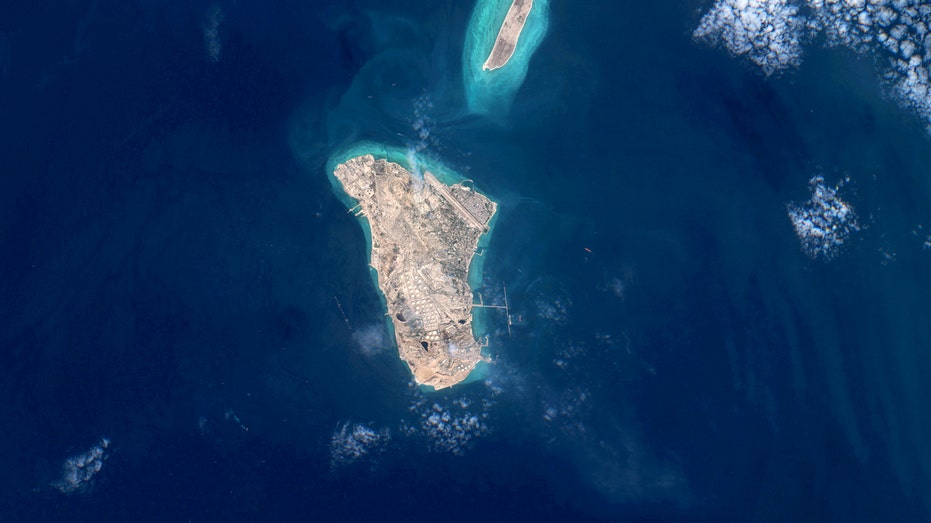
Next move on Iran: Seize Kharg Island, secure uranium or risk ground war escalation
Military analysts discuss three paths for U.S.-Iran conflict: capturing Iran's economic lifeline at Kharg Island, full invasion or securing nuclear sites.
As the U.S.–Iran war enters a new phase, the range of options now being discussed stretches from hitting Iran’s economic lifeline at Kharg Island to the far more dangerous prospect of a ground invasion, or a narrower operation focused on Iran’s nuclear material.
The urgency comes as recent U.S. strikes have degraded parts of Iran’s military infrastructure without collapsing the regime, raising pressure on the Trump administration to decide what comes next.
Each option carries significant risks: disrupting Kharg Island could shock global oil markets, a ground invasion could draw the U.S. into a prolonged regional war, and operations targeting nuclear material could trigger escalation while still failing to eliminate the threat.
What happens next could determine not only the trajectory of the conflict with Iran, but also the stability of global energy supply and the future of Tehran’s nuclear program.
Recent U.S. strikes already hit military targets on Kharg Island, a small island in the Persian Gulf that serves as Iran’s main oil export terminal, and have emerged as a central pressure point in the conflict, while sparing its oil infrastructure, underscoring just how consequential the next move could be.
Kharg Island is the centerpiece of Iran’s oil export system. The island handles about 90% of Iran’s oil exports, and Iran recently has been exporting roughly 1.1 million barrels to 1.5 million barrels of oil per day, mostly to China.
Recent U.S. strikes on Kharg targeted military installations while leaving key oil facilities intact — a sign that Washington is trying to preserve a major pressure point without immediately detonating global oil markets.
Abdullah Aljunaid, a Bahraini analyst, told Fox News Digital that after Iran’s military capabilities were weakened, the U.S. focus could shift to economic pressure on Iran.
"The Iranian military capacity and offensive abilities have been totally degraded, so we need to probably do something else," Aljunaid said.
TOP IRANIAN OFFICIAL, COMMANDER KILLED IN STRIKE, ISRAEL DEFENSE MINISTER SAYS
Aljunaid pointed to key strategic sites, including Bushehr — a coastal city in southern Iran on the Persian Gulf that hosts the country’s only operational nuclear power plant and a key port — and Kharg Island, Iran’s main oil export hub.
"We need to take certain strategic assets — geography — like Bushehr and Kharg, out of the equation," he said. "Those two, especially Kharg, represent the jewel of the crown, and without that, Iran’s economic ability to finance itself is going to be dead."
He added that control over key maritime choke points could further shift the balance.
"If the U.S. decided to take Bushehr at the mouth of the Strait of Hormuz, then I believe we can really see a different equation, forcing the Iranians to come to the negotiating table on our terms — the U.S. terms, and probably the rest of the world."
Retired Gen. Jack Keane has argued that the U.S. could take Iran’s main oil export hub if it chose to do so, but so far has chosen "not to take that now," he said on Fox News’ "Sunday Morning Futures."
Keane said such a move would effectively put the Iranian regime in "checkmate," given how heavily its economy depends on the island.
"Now we (would) own all of their major assets," Keane said. "It's 50% of their budget, 60% of the revenue, 80, 90% of the distribution points for their oil."
That view reflects the logic behind a Kharg scenario: disable the regime’s cash flow without launching a full-scale war across Iran’s interior. At the same time, the fact that Kharg’s oil infrastructure was reportedly spared suggests Washington thinks taking the island fully offline could send energy prices sharply higher and shake global markets.
Kharg’s facilities include major storage capacity and any serious disruption there could remove up to roughly 2 million barrels a day from global supply, Reuters noted.
There also is a nonkinetic version of this scenario.
In an analysis shared with Fox News Digital, Rick Clay, who served as a senior deputy adviser in Iraq from 2003 to 2009, argued that maritime insurance can function as a strategic choke point.
His argument is that a tanker without recognized coverage cannot easily dock, finance cargo or operate in compliant markets, meaning the United States could pressure Iran’s export system financially even without physically seizing the island.
IRAN MOVES HUNDREDS OF MILLIONS IN CRYPTO DURING NATIONWIDE INTERNET BLACKOUT, REPORT REVEALS
Public analyses have long described Iran’s geography as deeply unfavorable to invading armies, with mountain barriers and desert terrain complicating any large-scale advance.
Historical comparisons often point to Iraq’s failed 1980 invasion of Iran, which turned into a long and bloody war rather than the quick victory Saddam Hussein expected.
The term "Fortress Iran" is often used by analysts to describe the country’s natural defenses — a combination of vast mountain ranges, including the Zagros and Alborz, along with deserts and difficult terrain that have historically made invasion and occupation extremely challenging.
For those reasons, analysts say a ground invasion remains the most extreme — and least plausible — path, given Iran’s size, terrain and history.
Aljunaid made a similar point, noting that even the 1991 liberation of Kuwait required more than half a million troops, and warning that a war inside Iran would be exponentially more complicated.
That concern is reinforced by the current state of the conflict.
Despite sustained U.S.-Israeli strikes and heavy damage to Iran’s military infrastructure, the regime itself remains intact and more hardline, The Washington Post reported, with the Islamic Revolutionary Guard Corps consolidating power rather than collapsing.
In other words, air superiority has not translated into regime collapse, which makes the leap to occupation even harder to imagine.
TRUMP SAYS US "TOTALLY DESTROYING" IRAN: "WATCH WHAT HAPPENS TO THESE DERANGED SCUMBAGS TODAY"
"We’re not going to put troops on the mainland," Clay said. "The only troops you might see, if anything, would be to take out those three islands. That’s it."
He added that there is "no appetite" for a sustained ground presence inside Iran, arguing that any internal change would ultimately depend on the Iranian people.
"It’s going to be in the Iranians’ hands at that point — the Iranian people — whether they rise up," he said. "We’ve done damage. We’re still going to do some more damage. We’re not done."
A third scenario would aim not at occupying territory, but at Iran's nuclear program itself.
A narrower operation would likely involve targeting Iran’s enriched uranium stockpiles and deeply buried facilities — potentially including efforts to locate, secure or disable nuclear material that cannot be destroyed from the air.
A third scenario would aim not at occupying territory, but at Iran’s nuclear program itself.
Although President Donald Trump said the June 2025 U.S. strikes had "obliterated" key nuclear sites, analysts note that critical elements of Iran’s program — particularly enriched uranium stockpiles and deeply buried facilities — likely remain intact.
Iran is believed to possess roughly 440.9 kilograms of uranium enriched to 60%, according to the International Atomic Energy Agency (IAEA), with more than 200 kilograms likely stored in the underground Isfahan tunnel complex, Reuters reported March 9.
That matters because the material is small enough to hide and move, unlike oil infrastructure, and some of these deeply buried facilities are believed to have survived conventional air attacks — raising the possibility that securing or neutralizing nuclear material could require more targeted, specialized operations.
Kharg Island offers a way to squeeze Iran’s economy. A ground invasion offers the possibility of a decisive force at extraordinary cost. Targeted operations against nuclear equipment offer a narrower path, but one with high operational risk and no guarantee of finality.
The next phase of the war may depend on which of those risks Washington is willing to take.
The Pentagon chose not to provide a comment.
The White House did not respond to a request for comment by time of publication.
Reuters contributed to this report.